
NUST Engineering Test (NET) Preparation
The NUST NET Engineering Preparation Course at Mahida Academy is a focused, exam-driven program aligned with the exact NET syllabus and weightage. Covering Mathematics (60%), Physics (30%), and English (10%), it builds speed, accuracy, and conceptual clarity through NET-specific strategies, with 365-day access for multiple attempts and score improvement.
Curriculum
- 10 Sections
- 188 Lessons
- Lifetime
- NET (NUST) Engineering SyllabusThe NUST NET Engineering Syllabus is a comprehensive exam covering the core FSc Pre-Engineering curriculum, specifically designed for the NUST Entry Test 2026. The test consists of 200 MCQs with a primary focus on Mathematics (60%), followed by Physics (30%), and English (10%). To succeed, students should prioritize the Punjab and Federal textbook boards, focusing on conceptual clarity and speed-oriented shortcuts to manage the 3-hour time limit effectively without negative marking.1
- NET (NUST) Engineering Diagnostic Tests1
- NET (NUST) Engineering Past Papers0
- MathematicsMaster the Mathematics section of the NUST NET with Mahida Academy’s specialized course. This module covers the most high-weightage chapters from both FSc Part-I & II, focusing on the topics that appear most often in the entry test. From Calculus and Trigonometry to Algebra and Conics, we provide the best NET math preparation by combining core concepts with fast KIPS-style shortcuts. This subject guide is designed to help students solve complex problems quickly, ensuring a high score in the NUST engineering entry test.22
- 4.1Functions and Graphs
- 4.2Trigonometry (identities, equations, inverse trig)
- 4.3Limits & continuity
- 4.4Functions, Trig, and Limits Quiz (I)15 Questions
- 4.5Functions, Trig, and Limits Quiz (II)15 Questions
- 4.6Differentiation
- 4.7Integration
- 4.8Differentiation & Integration Quiz30 Questions
- 4.9Vectors
- 4.10Vectors Quiz20 Questions
- 4.11Matrices & Determinants
- 4.12Matrices & Determinants Quiz26 Questions
- 4.13Complex Numbers
- 4.14Complex Numbers Quiz30 Questions
- 4.15Probability, Permutations, and Combinations
- 4.16Probability, Permutations, and Combinations Reformatted
- 4.17Probability, Permutations, and Combinations Quiz30 Questions
- 4.18Binomial Theorem & Sequences and Series
- 4.19Binomial Theorem Quiz23 Questions
- 4.20Sequences & Series Quiz0 Questions
- 4.21Conic sections (Parabola, Ellipse, Hyperbola)
- 4.22Conic sections (Parabola, Ellipse, Hyperbola) Quiz10 Questions
- Mathematics Part I44
- 5.11.1 Complex Numbers
- 5.21.1 Complex Numbers (1)
- 5.31.2 Properties of Complex Numbers
- 5.41.3 Solution of Equations
- 5.5Complex Numbers Quiz0 Questions
- 5.62.1 Matrices
- 5.72.2 Algebra of Matrices
- 5.82.3 Determinants and Inverse Matrices
- 5.92.4 Properties of Determinants
- 5.102.5 System of Linear Equations
- 5.11Matrices and Determinants Quiz0 Questions
- 5.123.1 Sequence (Progression)
- 5.133.2 Arithmetic Sequence
- 5.143.3 Arithmetic Mean
- 5.153.4 Arithmetic Series
- 5.163.5 Geometric Sequence
- 5.173.6 Geometric Mean
- 5.183.7 Geometric Series
- 5.193.8 Harmonic Sequence
- 5.203.9 Harmonic Mean
- 5.21Overview of 3.0 Sequences and Series
- 5.22Sequences and Series Quiz0 Questions
- 5.234.1 Miscellaneous Series
- 5.245.1 Factorial of a Natural Number
- 5.255.2 Counting Techniques
- 5.265.3 Probability
- 5.27Permutation, Combination and Probability Overview
- 5.28Permutation, Combination and Probability Quiz0 Questions
- 5.296.1 Mathematical Induction
- 5.306.2 Binomial Theorem
- 5.316.3 Binomial Series
- 5.326. Mathematical Induction and Binomial Theorem Overview
- 5.33Mathematical Induction and Binomial Theorem Quiz0 Questions
- 5.347.1 Solution of Quadratic Equation
- 5.357.2 Solution of Equation Reducible to Quadratic Equation in One Variable
- 5.367.3 Nature of the Roots of a Quadratic Equation
- 5.377.4 Cube and Fourth Roots of Unity and their Properties
- 5.387.5 Roots and Coefficient of a Quadratic Equation
- 5.397.6 Formation of Quadratic Equation
- 5.407.7 Synthetic Division
- 5.417.8 Simultaneous Equations
- 5.427.9 Applications of Quadratic Equations
- 5.43Quadratic Equations Quiz0 Questions
- 5.448.1 Trigonometric Ratios
- Mathematics Part II0
- Physics Part I82
- 7.11.1 Measurement-Scope of Physics
- 7.21.2 International System (SI) Units
- 7.31.3 Errors and Uncertainty
- 7.41.4 Precision and Accuracy
- 7.51.5 Significant Figures
- 7.61.6 Dimensions
- 7.71.7 Measurement: Challenge Test
- 7.81.8 Measurement: Challenge Test (Explanations)
- 7.91.9 Measurement Quiz2 Questions
- 7.101.10 Measurement (Extra Notes)
- 7.112.1 Vectors and Equilibrium-Cartesian Coordinate System
- 7.122.2 Addition of Vectors by Head to Tail Rule
- 7.132.3 Addition of Vectors by Rectangular Component Method
- 7.142.4 Scalar Product of Two Vectors
- 7.152.5 Vector Product of Two Vectors
- 7.162.6 Torque
- 7.172.7 Equilibrium of Forces
- 7.182.8 Vectors and Equilibrium: Challenge Test (Explanations)
- 7.192.9 Vectors and Equilibrium Quiz12 Questions
- 7.203.1 Motion and Force-Displacement
- 7.213.2 Velocity
- 7.223.4 Laws of Motion
- 7.233.5 Force, Momentum and Impulse
- 7.243.6 Projectile
- 7.253.7 Motion and Force: H5P Quiz
- 7.263.8 Motion and Force: Challenge Test (Explanations)
- 7.274.1 Work, Power and Energy-Work
- 7.284.2 Work Done in a Gravitational Field
- 7.294.3 Power
- 7.304.4 Energy
- 7.314.5 Work-Energy Relation
- 7.324.6 Absolute Gravitational Energy
- 7.334.7 Escape Velocity
- 7.344.8 Conservation of Energy
- 7.354.9 Types of Energy Sources
- 7.364.10 Work, Power and Energy: Challenge Test (Explanations)
- 7.374.11 Work, Power and Energy Quiz27 Questions
- 7.385.1 Circular Motion-Angular Motion
- 7.395.2 Centripetal Force and Centripetal Acceleration
- 7.405.3 Moment of Inertia
- 7.415.4 Angular Momentum
- 7.425.5 Rotational Kinetic Energy
- 7.435.6 Artificial Satellites and Weightlessness
- 7.445.7 Orbital Velocity
- 7.455.8 Circular Motion: Challenge Test (Explanations)
- 7.465.9 Circular Motion and Momentum-Quiz13 Questions
- 7.476.1 Fluid Dynamics-Streamline and Turbulent Flow
- 7.486.2 Equation of Continuity
- 7.496.3 Bernoulli’s Equation
- 7.506.4 Viscous Fluids and Fluid Friction
- 7.516.5 Fluid Friction and Terminal Velocity
- 7.526.6 Fluid Dynamics: Challenge Test (Explanations)
- 7.537.1 Oscillations-Simple Harmonic Motion (SHM)
- 7.547.2 Uniform Circular Motion and SHM
- 7.557.3 Phase Angle
- 7.567.5 Simple Pendulum
- 7.577.6 Energy Conservation in SHM
- 7.587.7 Free and Forced Oscillation
- 7.597.8 Resonance
- 7.607.9 Damped Oscillations
- 7.617.10 Oscillations: Challenge Test (Explanations)
- 7.628.1 Waves-Wave Motion
- 7.638.2 Speed of Sound
- 7.648.3 Superposition of Waves
- 7.658.4 Stationary Waves
- 7.668.5 Doppler’s Effect
- 7.678.6 Waves: Challenge Test (Explanations)
- 7.689.1 Physical Optics-Nature of Light
- 7.699.2 Interference of Light
- 7.709.3 Interference in Thin Films
- 7.719.4 Newton’s Ring
- 7.729.5 Michelson’s Interferometer
- 7.739.6 Diffraction of Light
- 7.749.7 Bragg’s Law
- 7.759.8 Polarisation
- 7.769.9 Physical Optics: Challenge Test (Explanations)
- 7.7710.1 Thermodynamics-Kinetic Theory of Gases
- 7.7810.2 Gas Laws
- 7.7910.3 Internal Energy
- 7.8010.4 Work and Heat
- 7.8110.4 Work and Heat
- 7.8210.5 Thermodynamics
- Physics Part II67
- 8.112.1 Electrostatics
- 8.212.2 Coulomb’s Law
- 8.312.3 Electric Field and Electric Intensity
- 8.412.4 Electric Flux
- 8.512.5 Gauss’s Law with its Applications
- 8.612.6 Electric Potential
- 8.712.7 Capacitor
- 8.812.8 Energy Stored in a Capacitor
- 8.9Chapter 12 Quiz80 Questions
- 8.1013.1 Current Electricity
- 8.1113.2 Resistance
- 8.1213.3 Resistivity and Conductivity
- 8.1313.4 Internal Resistance
- 8.1413.5 Kirchhoff’s Laws
- 8.1513.6 Potential Divider
- 8.1613.7 Balanced Potential
- 8.17Chapter 13 Quiz65 Questions
- 8.1814.1 Current Carrying Conductor in a Magnetic Field
- 8.1914.2 Force on a Moving Charged Particle
- 8.2014.3 Cathode Rays Oscilloscope (CRO)
- 8.2114.4 Current Carrying Rectangular Coils in a Uniform Magnetic Field
- 8.2214.5 Electrical Instruments
- 8.23Chapter 14 Quiz35 Questions
- 8.2415.1 Law of Electromagnetic Induction
- 8.2515.2 Inductance
- 8.2615.3 Energy Stored in an Inductor
- 8.2715.4 Simple AC Generator, DC Generator and DC Motor
- 8.2815.5 Transformer
- 8.2915.6 Alternating Current (AC) and Root Mean Square (RMS) Value
- 8.3015.7 Alternating Current (AC) Circuits
- 8.3115.8 Impedance
- 8.3215.9 Three Phase AC supply
- 8.3315.10 Electromagnetic Waves
- 8.3415.11 Semiconductor Devices
- 8.3515.12 Rectification and Smoothing
- 8.36Chapter 15 Quiz72 Questions
- 8.3716.1 Einstein Special Theory of Relativity
- 8.3816.2 Quantum Theory
- 8.3916.3 Photoelectric Effect
- 8.4016.4 Compton’s Effect
- 8.4116.5 Wave-Particle Duality
- 8.4216.6 Atomic Structure and Heisenberg’s Uncertainty Principle
- 8.43Chapter 16 Quiz18 Questions
- 8.4417.1 Structure of Nucleus
- 8.4517.2 Mass Defect and Binding Energy
- 8.4617.3 Radioactivity
- 8.4717.4 Radioactive Decay Law
- 8.4817.5 Nuclear Reactions
- 8.49Chapter 17 Quiz15 Questions
- 8.5018.1 Basic Forces of Nature
- 8.5118.2 Fundamental Particles
- 8.5218.3 Quarks and Anti-Quarks
- 8.5318.4 Particle Accelerator
- 8.54Chapter 18 Quiz12 Questions
- 8.5519.1 Production and Use of Ultrasound
- 8.5619.2 Production and Use of X-rays
- 8.5719.3 PET Scanning
- 8.5819.4 Luminosity and Inverse Square Law
- 8.5919.5 Stellar Radii
- 8.6019.6 Hubble Law
- 8.61Chapter 19 Quiz18 Questions
- 8.6216.1 Classification of Solids
- 8.6316.2 Mechanical Properties of Solids
- 8.6416.3 Electric Properties of Solids
- 8.6516.4 Super Conductors
- 8.6616.5 Magnetic Properties of Solids
- 8.6717.1 Electronics
- English0
- NET (NUST) Engineering Model Papers0
Overview
The NUST Engineering Test (NET) Preparation Course at Mahida Academy is a focused, exam-oriented program designed to help students secure high-merit positions for admission to the National University of Science and Technology (NUST) engineering programs.
The NUST Entry Test (NET) is a concept-based, time-pressured examination where performance matters far more than board marks. This course is structured strictly according to the NET syllabus and weightage, transforming HSSC P
NUST Engineering Test (NET) Preparation
Comprehensive Course at Mahida Academy
365-Day Access | Target Multiple Series (NET-1 to NET-4)
The NUST Engineering Test (NET) Preparation Course at Mahida Academy is a focused, exam-oriented program designed to help students secure high-merit positions for admission to the National University of Science and Technology (NUST) engineering programs.
Course Overview & Strategy
- Concept-Based & Time-Pressured: Performance matters far more than board marks; designed for competitive MCQ-driven testing.
- Structured Syllabus: Aligned strictly according to official NET weightage, transforming HSSC Part I & II content into actionable prep.
- Skill Development: Emphasizes conceptual clarity, speed, and smart problem-solving techniques.
1. What You’ll Study
Mathematics (60%)
Functions, graphs, calculus, algebra, matrices, complex numbers, probability, sequences, and coordinate geometry—taught with NET-specific shortcuts and elimination techniques.
Physics (30%)
Complete coverage of HSSC Part I & II physics, including mechanics, electricity & magnetism, waves, optics, and modern physics, aligned with Federal and Punjab Board textbooks.
English (10%)
Vocabulary, grammar, sentence correction, and reading comprehension focused on high-yield NET patterns.
| Exam Strategy & Practice | Who This Course Is For |
|---|---|
|
|
2. Course Outcome
By the end of the course, students are fully prepared to attempt the NET with confidence, accuracy, and speed—maximizing their chances of achieving a top merit position at NUST.
Frequently Asked Questions (FAQs)
1. What is the NUST Engineering Test (NET)?
View Answer
2. What subjects are included in the NET Engineering test?
View Answer
3. Who should enroll in the NUST Engineering Test (NET) Preparation course?
View Answer
4. Does this course help with multiple NET attempts?
View Answer
5. Is this course aligned with the official NET syllabus?
View Answer
Instructor

You May Like


FPSC SST (BS-17) and SET (BS-16) (Physical) Test Preparation
FPSC Secondary School Teacher (BS-17) Test Preparation Course at Mahida Academy is a comprehensive, exam-focused program designed according to the prescribed official FPSC syllabus. The course covers the complete paper pattern, including English language proficiency, specialized subject knowledge, and core pedagogical domains such as teaching methodology, assessment & evaluation, classroom management, and Bloom's taxonomy. With structured lessons, targeted practice, and high-yield conceptual coverage, this program prepares candidates to excel in the written examination and secure a Secondary School Teacher position under Federal Public Service Commission.


Shifa Preparation
Prepare for the MDCAT with a clear, structured, and fully online program at Mahida Academy. This self-paced course is strictly aligned with the syllabus set by the Pakistan Medical and Dental Council (PMDC) and covers all subjects with concept-focused lessons, thousands of MCQs, timed full-length mock exams, and performance tracking. Enroll with confidence—enjoy flexible access and a 100% refund option if the course does not meet your expectations.
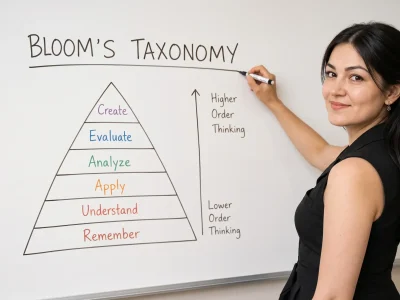

FPSC Assistant Professor BS-18 Test Preparation
FPSC Assistant Professor Test Preparation 2026 at Mahida Academy is a comprehensive course designed according to the latest FPSC syllabus. The program covers English and Teaching Methodology concepts required for the BS-18 Assistant Professor examination. With structured lessons, exam-focused practice, and conceptual clarity, this course prepares candidates to perform confidently in the written test and succeed in educational leadership roles.
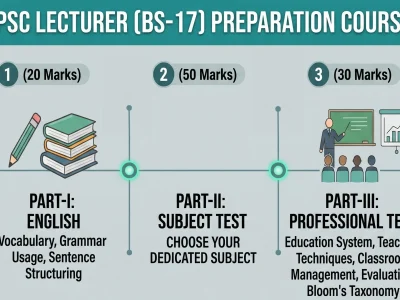
FPSC Lecturer BS-17 Test Preparation
FPSC Lecturer (BS-17) Test Preparation Course at Mahida Academy is a comprehensive, exam-focused program designed according to the prescribed official FPSC syllabus. The course covers the complete paper pattern, including English language proficiency, specialized subject knowledge, and core pedagogical domains such as teaching methodology, assessment & evaluation, classroom management, and Bloom's taxonomy. With structured lessons, targeted practice, and high-yield conceptual coverage, this program prepares candidates to excel in the written examination and secure a lecturer position under Federal Public Service Commission.

AKU ASDH Entrance Test Preparation
Mahida Academy’s AKU ASDH Entrance Test Preparation is designed to closely reflect the official exam pattern and difficulty level. It covers English, Science, and Mathematics through focused practice, MCQs, and full-length mock tests. Delivered via an interactive LMS and developed by experts, this course prepares you to excel with confidence—not just pass the exam.

Course Features
- Lectures 188
- Quizzes 29
- Duration Lifetime access
- Skill level Intermediate
- Language English
- Students 7
- Assessments Yes