
Plant Systems: Root and Shoot System in Plants
Root and Shoot System in Plants
Suggested Videos
Root System
The root system is the part of the plant that grows below the ground. Roots help the plant stay fixed in the soil, absorb water and minerals, and in some plants, they also store food.
In this section, we will study the functions of roots, the types of root systems, the internal structure of the root, and some special types of roots.

Functions of Roots
- Anchorage: Roots fix the plant firmly in the soil.
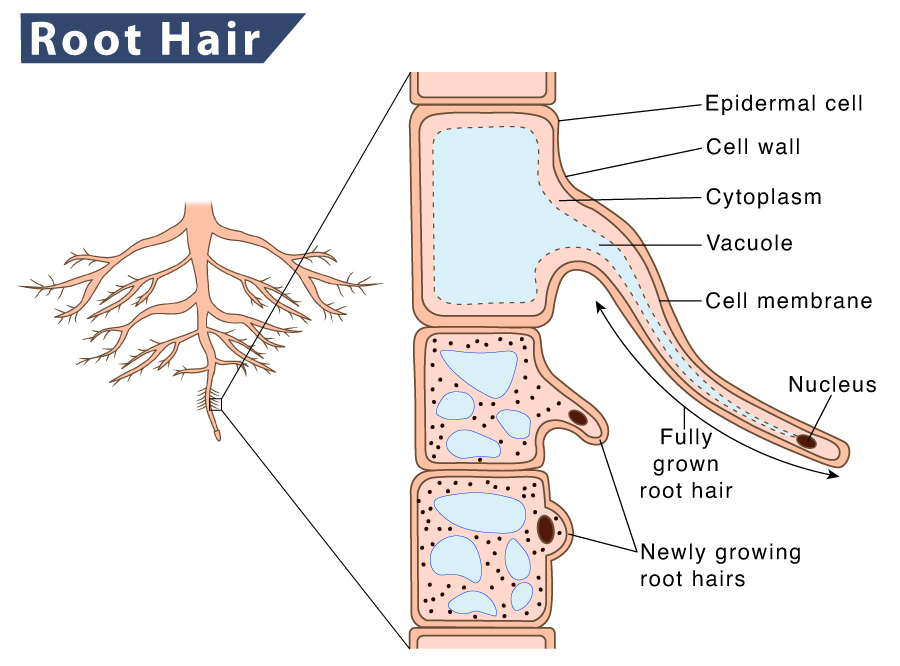
- Absorption: Root hairs absorb water and minerals from the soil.
- Transport: Roots transport absorbed materials to the stem.
- Storage: In plants like carrot, radish, and beetroot, roots store food.
Types of Root Systems
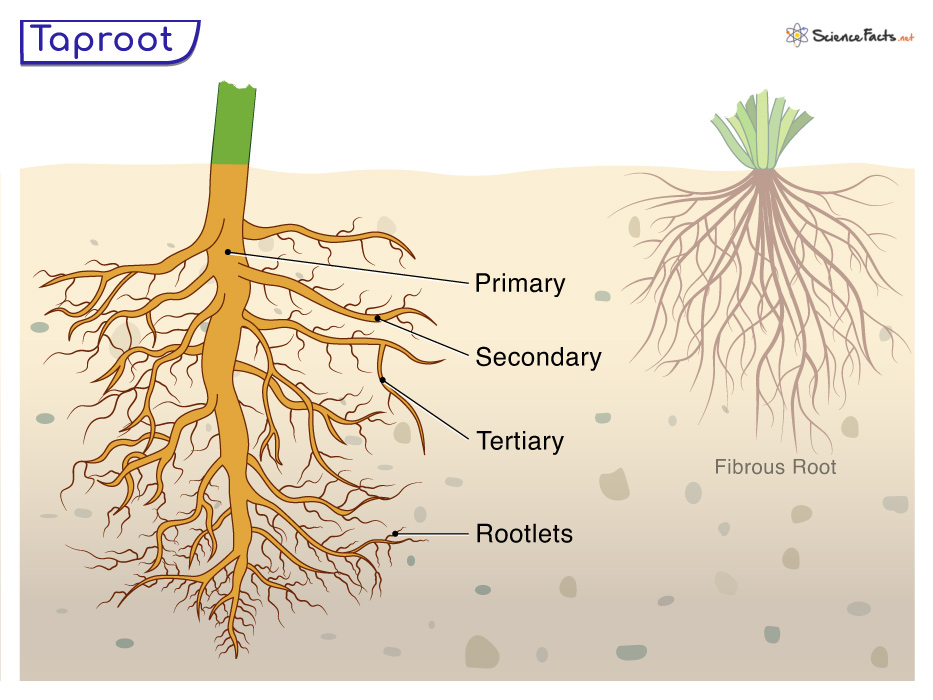
1. Tap Root System
In dicot plants, the seed develops one primary root that grows straight down into the soil. Smaller lateral roots branch out from it.
- Examples: mango, pea, mustard, carrot, turnip
2. Fibrous Root System
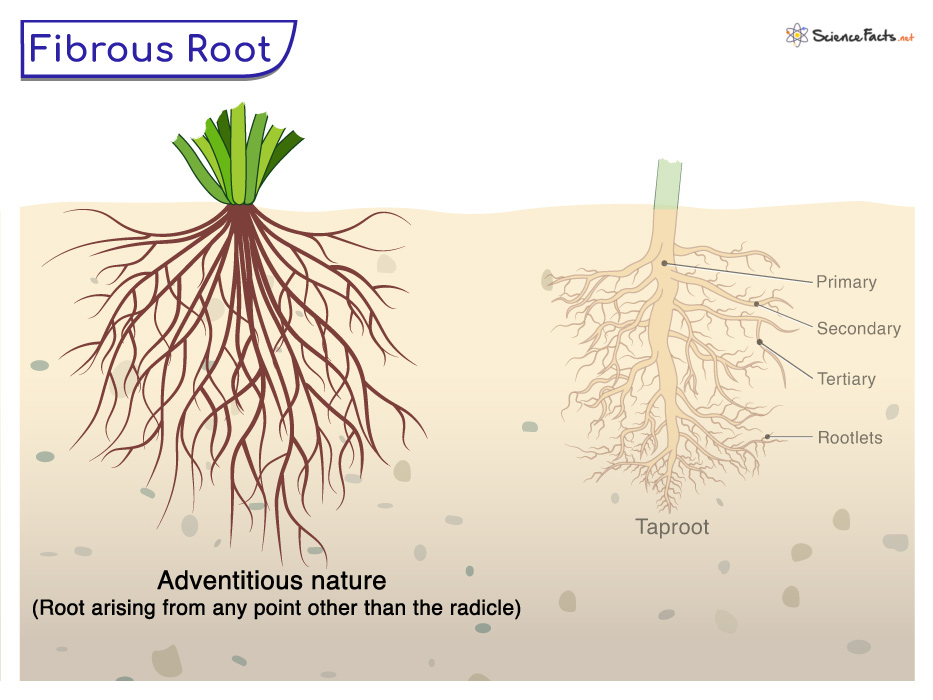
In monocot plants, many thin roots of almost equal size arise from the base of the stem. These roots spread out and form a dense network.
- Examples: wheat, maize, rice, onion, grasses
Internal Structure of a Root
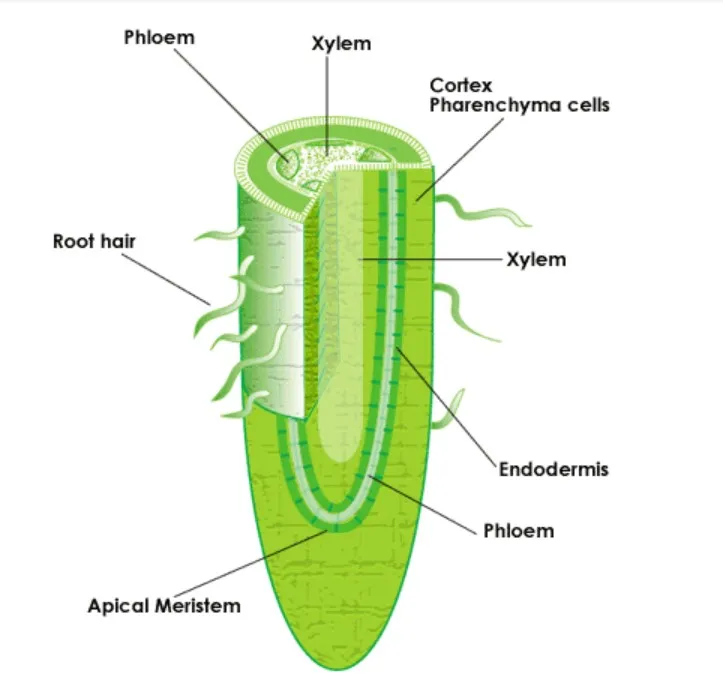
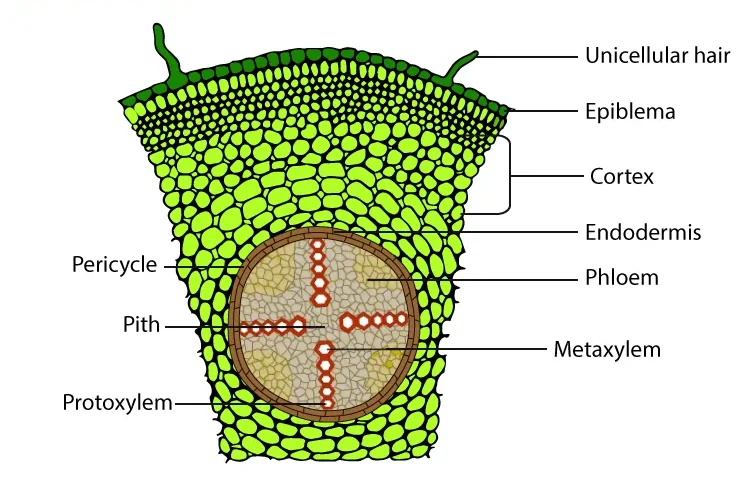
When we look at the root under a microscope, we see that it is made up of several layers of cells. From the outside to the inside, the main parts are:
- Root’s Epidermis or Epiblema (Root Hair Zone): The outermost layer of cells. Root hairs grow here and absorb water and minerals.
- Cortex: A thick region made of many layers of parenchyma cells. It stores food and allows water movement.
- Endodermis: The innermost layer of the cortex. It controls the flow of water and minerals into the vascular bundle.
- Stele (Vascular Cylinder): Found at the center of the root. It contains:
- Xylem: Transports water and minerals upward to the stem.
- Phloem: Transports prepared food from leaves to other parts of the plant.
Quick Recap
- The root system grows below the soil surface.
- Functions: anchorage, absorption, transport, storage.
- Tap root → one main root with branches (dicots).
- Fibrous root → many equal roots from the stem base (monocots).
- Internal structure includes epidermis, cortex, endodermis, and stele (xylem + phloem).
Shoot System
The shoot system is the part of the plant that grows above the ground. It includes the stem, leaves, flowers, fruits, and seeds. The shoot system helps the plant in support, photosynthesis, reproduction, and transport.
Stem
The stem is the main axis of the shoot system. It supports branches, leaves, flowers, and fruits. It also carries water, minerals, and food to different parts of the plant.
- Support: Keeps the plant upright and holds leaves for sunlight exposure.
- Transport: Conducts water and minerals upward and food downward.
- Storage: Some stems store food (e.g., potato, sugarcane).
- Reproduction: Some stems help in vegetative reproduction (e.g., ginger, onion).
Leaf
Leaves are called the food factories of the plant because they make food by photosynthesis. They also play a role in transpiration (release of water vapor).
Structure of a Leaf
- Lamina: Broad, flat surface of the leaf.
- Petiole: Stalk attaching leaf to stem.
- Midrib: Main vein providing support.
- Veins: Smaller branches carrying water and food.
Venation in Leaves
- Reticulate venation: Veins form a net-like pattern (dicots, e.g., mango, pea).
- Parallel venation: Veins run side by side (monocots, e.g., maize, wheat).
[Figure Placeholder: Parallel vs. Reticulate venation]
Flower
The flower is the reproductive organ of the plant. It produces seeds and fruits.
- Calyx (Sepals): Green outer parts protecting the bud.
- Corolla (Petals): Brightly colored parts attracting insects.
- Androecium (Stamens): Male part producing pollen grains.
- Gynoecium (Carpel): Female part containing the ovary with the ovules.
Fruit and Seed
After fertilization, the ovary develops into a fruit, while each ovule develops into a seed. The seed contains the embryo, which can grow into a new plant.
[Figure Placeholder: Fruit and seed development]
Role of Xylem and Phloem in Transport of Water and Food
Inside the stem, special tissues called xylem and phloem transport materials. Together, they are called vascular tissues.
Transport of Water (Xylem)
- Xylem carries water and dissolved minerals from roots to the stem and leaves.
- Movement is only upward.
- Helps leaves perform photosynthesis using water.
Transport of Food (Phloem)
- Phloem carries food (sugars made in leaves) to all parts of the plant.
- Transport happens both upward and downward.
- Supplies energy for growth and storage in roots, stems, and fruits.
Quick Recap
- The shoot system grows above ground and includes stem, leaves, flowers, fruits, and seeds.
- The stem supports the plant and helps in transport, storage, and reproduction.
- Leaves make food by photosynthesis; venation may be reticulate or parallel.
- Flowers are reproductive parts; fruits and seeds form after fertilization.
- Xylem transports water upward from roots; phloem distributes food throughout the plant.