Brief History of Atomic Models
A Journey Through Atomic Models
Our understanding of the atom, the fundamental building block of all matter, has not been a sudden revelation. It has evolved over centuries, with scientists and philosophers gradually refining the concept.
Early Philosophical Ideas
The story begins with ancient thinkers who pondered the nature of matter.
Around 500 BCE, the Greek philosopher Leucippus is credited with the first articulation of the atomic concept. He proposed that matter was not infinitely divisible.

His student, Democritus (around 430 BCE), further developed this idea. Democritus suggested that all matter is composed of tiny, indivisible particles called “atomos.” This Greek word translates to “uncuttable.” Democritus also thought that atoms existed for feelings and the human soul and proposed that the properties of matter were determined by the shape and size of these atoms. He explained that changes in matter occurred due to the combining and rearranging of these “atomos.”

These were significant philosophical leaps, but they lacked experimental evidence.
Dalton’s Atomic Theory: The Dawn of Scientific Atomism
In 1808, John Dalton, an English chemist, transformed the atomic concept from a philosophical idea into a scientific theory. Dalton’s Atomic Theory provided a more quantitative and experimental basis for understanding atoms.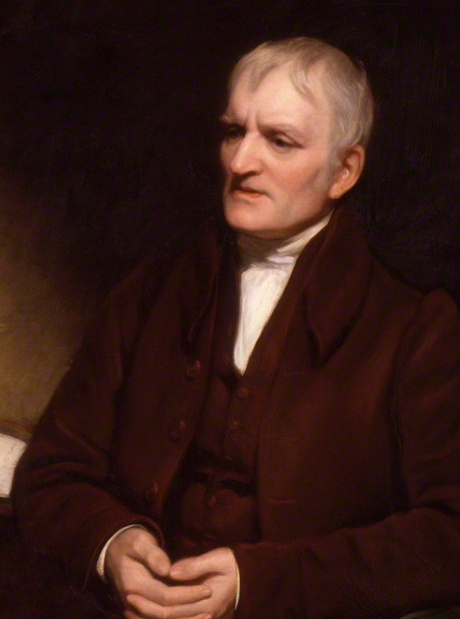
Dalton presented his theory in his book “A New System of Chemical Philosophy.” His work provided an experimental basis for understanding how elements combine to form compounds. Later, the work of Gay-Lussac and Amedeo Avogadro further supported Dalton’s theory, solidifying the experimental foundation of atomic chemistry.
Bohr’s Atomic Model: Quantized Energy Levels
Niels Bohr’s model was a significant advancement in our understanding of atomic structure. Bohr’s model was the first approach to quantized energy levels or electronic shells with fixed energy.

Bohr successfully calculated the radius of the hydrogen atom and the energy of the electron in any shell of the hydrogen atom. His model effectively explained the emission spectrum of hydrogen. However, with the development of high-resolution spectrophotometers, finer spectral details emerged, revealing split spectral lines. These lines were splitting in electric and magnetic fields giving rise to the Stark effect and Zeeman effect respectively, which were obviously not explained by Bohr. This new spectral advancement made the atomic structure more complicated. The concept of subshells and orbitals as the comprising parts of an electronic shell arose from Heisenberg’s uncertainty principle.
Subatomic Particles: The Components of an Atom
Atoms themselves are composed of even smaller particles called subatomic particles. The key subatomic particles are:
- Electron: The electron is a negatively charged particle. It carries a negative charge of -1.6022 x 10⁻¹⁹ Coulombs (C). For simplicity, its relative charge is often represented as -1. The electron has a mass of 9.1095 x 10⁻³¹ kilograms (kg). Electrons are deflected towards the positive pole in an electric field. The electron was discovered by J.J. Thomson.
- Proton: The proton is a positively charged particle. It carries a positive charge of +1.6022 x 10⁻¹⁹ C, which is equal in magnitude but opposite in sign to the electron’s charge. The proton is much heavier than the electron, with a mass of 1.6727 x 10⁻²⁷ kg (approximately 1836 times the mass of an electron). Its relative charge is +1. Protons are deflected towards the negative pole in an electric field. Electrons and protons are electromagnetic in nature.
- Neutron: The neutron is an electrically neutral particle, meaning it has no charge. It is not deflected by electric or magnetic fields. Neutrons are slightly more massive than protons, with a mass of 1.6750 x 10⁻²⁷ kg.
Table 2.1: Properties of Subatomic Particles
| Subatomic Particle | Charge (C) | Relative Charge | Mass (kg) |
|---|---|---|---|
| Electron | -1.6022 x 10⁻¹⁹ | -1 | 9.1095 x 10⁻³¹ |
| Proton | +1.6022 x 10⁻¹⁹ | +1 | 1.6727 x 10⁻²⁷ |
| Neutron | 0 | 0 | 1.6750 x 10⁻²⁷ |
Behavior of Subatomic Particles in an Electric Field
When electrons, protons, and neutrons are placed in an electric field, their behavior is determined by their charge.
- Electrons and protons, with their opposite charges, experience forces in opposite directions. Electrons, being negatively charged, are attracted to the positive pole and move against the direction of the electric field. Protons, being positively charged, are attracted to the negative pole and move in the direction of the electric field.
- Neutrons, having no charge, experience no force and show no deflection in an electric field.
- When electrons, protons, and neutrons have the same velocity, their paths diverge in an electric field. Due to its much smaller mass, the electron is deflected much more than the proton. The degree of curvature also depends on the trajectory force or velocity of the particles.
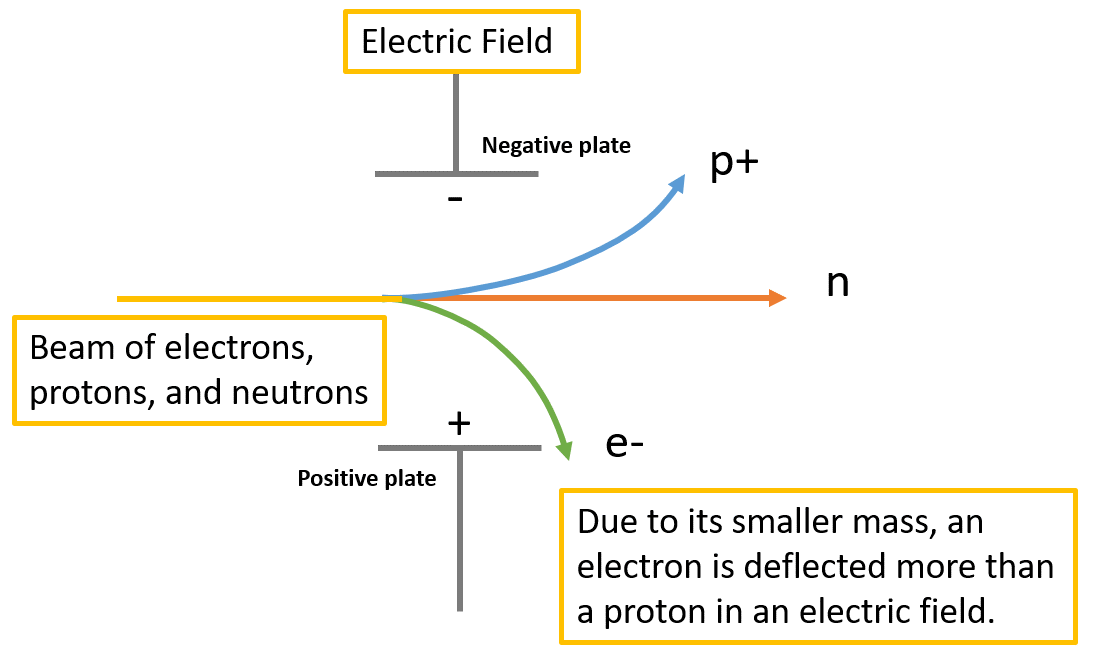
Deflection of subatomic particles in an electric field.
Atomic Number and Mass Number: Identifying Atoms
Two key numbers define an atom: the atomic number and the mass number.
- Atomic Number (Z): The atomic number (Z) of an atom is defined as the number of protons in the nucleus of that atom. In a neutral atom, the number of electrons orbiting the nucleus is equal to the number of protons in the nucleus.
- Mass Number (A): The mass number (A), also known as the nucleon number, is the total number of protons and neutrons in the nucleus of an atom. The mass number is approximately equal to the atomic mass of an atom.
The relationship between atomic number, number of neutrons, and mass number is:
Atomic number + Number of neutrons = Mass number
This can be represented as: P + N = A
In a neutral atom: Number of Protons = Number of Electrons
For ions (charged atoms):
- Number of electrons in a cation (positive ion) = Atomic number – Magnitude of charge on cation
- Number of electrons in an anion (negative ion) = Atomic number + Magnitude of charge on anion
Table 2.2: Atomic Number, Mass Number, and Calculating Subatomic Particles
| Term | Symbol | Definition | Example |
|---|---|---|---|
| Atomic Number | Z | Number of protons in the nucleus | Carbon (C), Z = 6 (6 protons) |
| Mass Number | A | Total number of protons and neutrons in the nucleus | Carbon-12 (¹²C), A = 12 (6 protons + 6 neutrons) |
| Number of Neutrons | N | Mass Number (A) – Atomic Number (Z) | Oxygen-16 (¹⁶O), A = 16, Z = 8, N = 16 – 8 = 8 neutrons |
| Electrons in a Neutral Atom | – | Equal to the Atomic Number (Z) | Sodium (Na), Z = 11, 11 electrons |
| Electrons in a Cation | – | Atomic Number (Z) – Magnitude of positive charge | Magnesium ion (Mg²⁺), Z = 12, 12 – 2 = 10 electrons |
| Electrons in an Anion | – | Atomic Number (Z) + Magnitude of negative charge | Chloride ion (Cl⁻), Z = 17, 17 + 1 = 18 electrons |
Atomic and Ionic Radius: The Size of Atoms and Ions
The size of atoms and ions is an important property that influences their chemical behavior.
- Atomic Radius: The atomic radius is the average distance from the nucleus to the outermost electrons in an atom. It provides a measure of the size of an atom. The term “average” is used because the boundary of the electron cloud is not sharply defined.
Periodic Trends in Atomic Radius
- Across a Period (Left to Right): In the main groups, atomic and ionic radii generally decrease from left to right across a period. This decrease is due to an increase in nuclear charge. The shielding effect remains constant across a period (in main groups). However, in the transition metal series, the shielding effect increases as electrons are added to the inner d-orbitals.

- Down a Group (Top to Bottom): Atomic radius increases from top to bottom within a group throughout the periodic table. This increase is due to the increasing number of electron shells (each period adds a shell). The shielding effect also increases down a group due to the increasing number of intervening electrons.

Ionic Radius
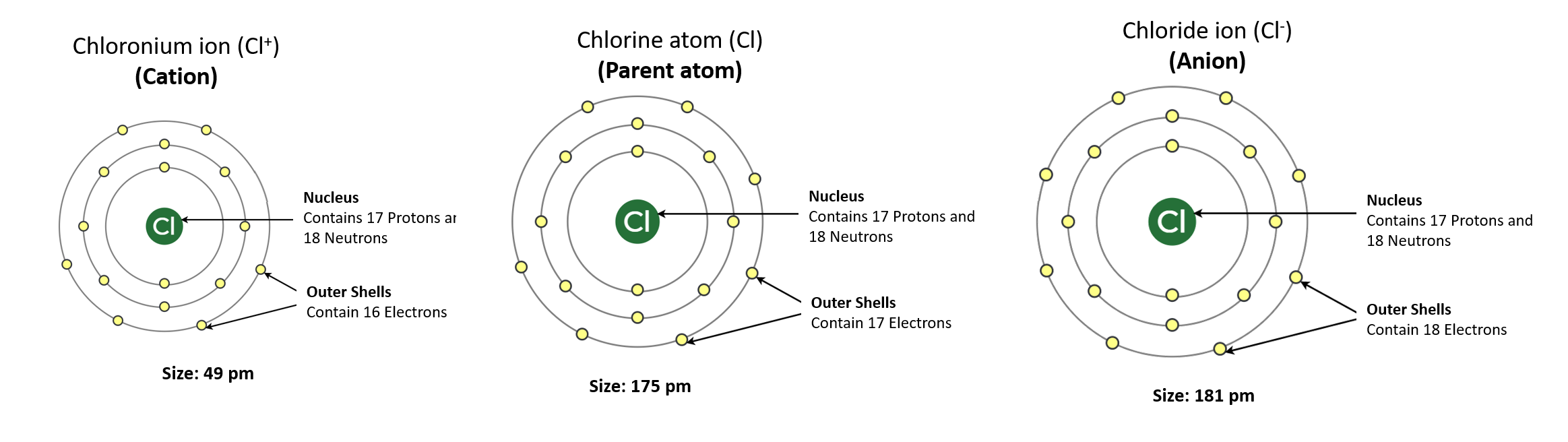
- Cations: Cations are always smaller than their parent atoms. This is due to an increase in effective nuclear charge. It is also due to a decrease in electron-electron repulsion in the valence shell following the removal of electrons.
- Anions: Anions are always bigger than their parent atoms.
Periodic Trends in Ionic Radius
- Down a Group (Top to Bottom): Ionic radius increases from top to bottom within a group. This trend is the same as that of atomic radius. This is due to the same charge on the ions throughout the group.
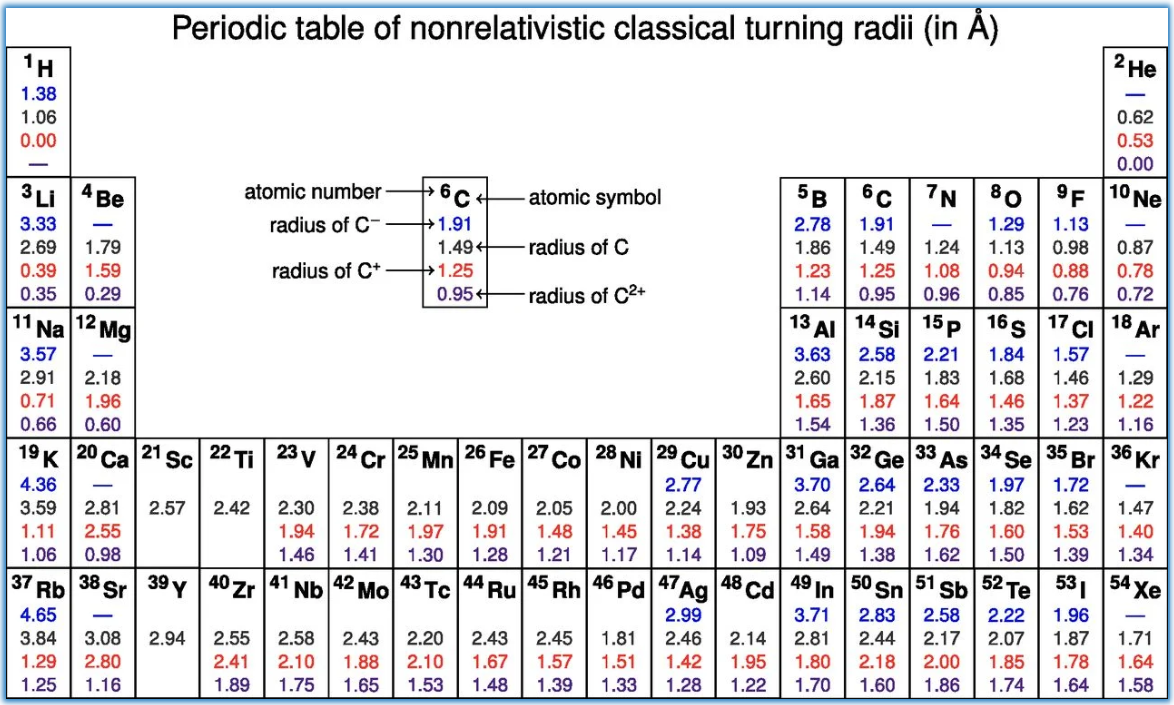
- Across a Period (Left to Right): The trend is debatable because elements in a period typically do not form ions with the same charge. The charge on the ion depends upon the valence shell electronic configuration, which changes from left to right. However, if we consider ions with the same charge, the trend will be the same as atomic radii: ionic radius decreases from left to right across a period.
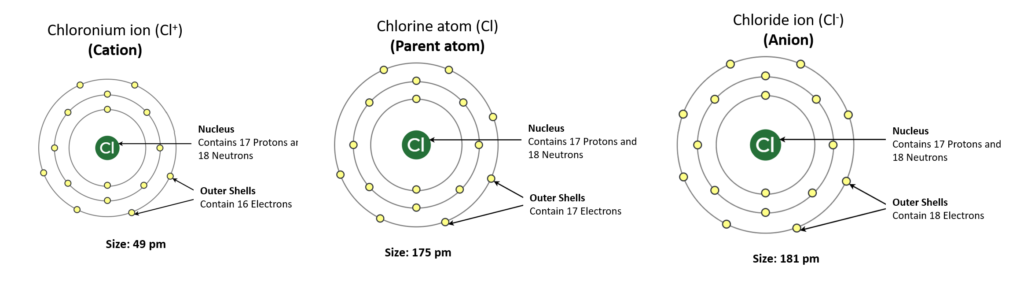
Compared to the chlorine atom (175 pm), its cation, the chloronium ion (Cl⁺, 49 pm), is significantly smaller, and its anion, the chloride ion (Cl⁻, 181 pm), is larger. This illustrates the general trend that cations are smaller than their parent atoms, and anions are larger.