
Islamic Concept Education (Copy)
📝 Module 1.3: The Islamic Concept of Education
Phase 1: Conceptual and Theoretical Frameworks
Focus Areas: Epistemological Integration, Holistic Objectives, and Classical Pedagogy
Learning Objectives
- Analyze the Islamic epistemological framework by differentiating and integrating Naqli (Revealed) and Aqli (Acquired) knowledge.
- Deconstruct the tripartite objectives of Islamic education: Ta’leem (Instruction), Tarbiyah (Character Development), and Tazkiyah (Purification).
- Evaluate the enduring pedagogical contributions of classical scholars, specifically Al-Ghazali and Ibn Khaldun, to modern instructional theory.
📺 Video Lesson: The Synthesis of Faith and Intellect
Understand the foundational philosophies that bridge spiritual ethics with empirical scientific inquiry in the educational process.
1. Epistemology in Islam: Naqli and Aqli Knowledge
Epistemology is the philosophical study of knowledge—how we know what we know. The Islamic concept of education inherently rejects the Western, secular dichotomy that separates “religious” knowledge from “scientific” knowledge. Instead, it mandates a seamless integration of two epistemological streams.
Naqli* Knowledge (Revealed / Transmitted)
Knowledge derived from divine revelation (the Quran) and the prophetic traditions (Sunnah). It is considered absolute, infallible truth. It provides the ultimate ethical, moral, and metaphysical framework within which human life must operate.
* In classical Islamic philosophy and epistemology, Naqli refers to revealed or transmitted knowledge regarded as an absolute source of truth. It should not be confused with the conversational Urdu/Hindi term “Naqli” (نقلی), which means fake, counterfeit, or artificial.
Aqli Knowledge (Acquired / Rational)
Knowledge generated through human intellect (Aql), sensory observation, scientific inquiry, and logical deduction. This includes physics, sociology, mathematics, and medicine. It is empirical but inherently fallible and subject to progressive revision.
The Integration Principle: In the Islamic framework, Aqli knowledge is utilized to understand and harness the physical universe, but it must be continuously guided by the ethical boundaries of Naqli knowledge to prevent scientific advancement from causing societal or moral destruction.
2. The Tripartite Objectives of Islamic Education
Modern educational systems often restrict their focus solely to cognitive development (intellect). The Islamic framework demands a holistic approach, addressing the mind, the character, and the soul simultaneously through three distinct, yet overlapping, concepts.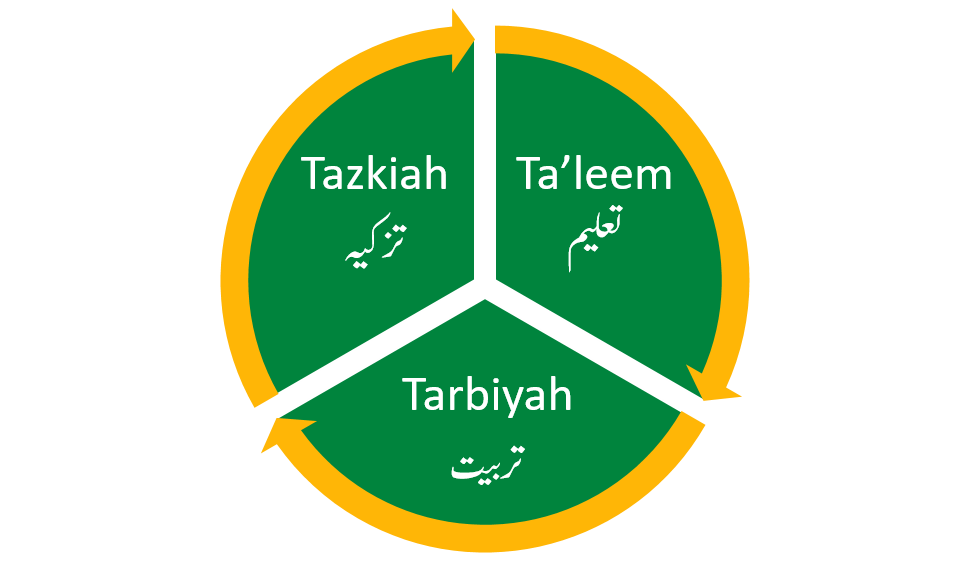
| Term | Direct Translation | Educational Application |
|---|---|---|
| Ta’leem | Instruction / Teaching | The cognitive transmission of facts, skills, and intellectual knowledge. It represents the objective dissemination of information from the educator to the educand. |
| Tarbiyah | Nurturing / Development | The holistic, gradual process of nurturing a child’s physical, social, and moral character. It implies raising an individual to their highest potential through continuous mentorship and care. |
| Tazkiyah | Purification | The spiritual dimension of education. It involves cleansing the heart and soul from vices (e.g., arrogance, greed) and embedding virtues. Education is futile if it does not lead to a purified intent and moral rectitude. |
3. Classical Scholars and Modern Pedagogical Thought
The pedagogical strategies employed in modern classrooms, such as developmentally appropriate pacing and the rejection of harsh physical punishment, were extensively formulated centuries ago by classical Islamic scholars.
Imam Al-Ghazali (1058–1111 CE)
- Curriculum Classification: He revolutionized curriculum design by dividing knowledge into Fard Ayn (individual obligatory knowledge, such as basic religious duties) and Fard Kifayah (communal obligatory knowledge, such as medicine, agriculture, and engineering, which society needs to survive).
- Pedagogical Ethics: Warned strictly against acquiring knowledge solely for material gain or to secure elite social status. The primary aim of education must be proximity to the Divine and societal service.
Ibn Khaldun (1332–1406 CE)
- Gradualism (Scaffolding): Argued in his masterpiece, the Muqaddimah, that teaching must be progressive. Knowledge should be introduced in three distinct stages: starting with broad, simple concepts, moving to detailed explanations, and finally addressing complex, ambiguous points.
- Rejection of Corporal Punishment: Issued a severe sociological warning against harsh physical discipline. He argued that ruling students with fear destroys their intrinsic motivation, makes them lazy, and forces them to become deceitful liars to avoid punishment.
- Linguistic Pedagogy: Strongly advocated for initial instruction to be conducted in the child’s mother tongue to ensure deep conceptual understanding before introducing secondary languages.
⚡ Quick-Fact: Rote Memorization
A common misconception is that classical Islamic education relied entirely on rote memorization. On the contrary, Ibn Khaldun explicitly criticized the over-reliance on memorizing texts without understanding their underlying principles. He argued that true education develops the faculty of critical thinking and analytical reasoning, not merely the storage capacity of the brain.
🎯 FPSC Exam Insights
- Scholar Attribution Traps: The FPSC frequently tests the specific contributions of Al-Ghazali and Ibn Khaldun.• If a question addresses the psychological damage of strict punishment, teaching in the mother tongue, or moving from simple to complex, the answer is always Ibn Khaldun.• If a question addresses the division of knowledge into Fard Ayn and Fard Kifayah or emphasizes the moral purity of the teacher’s intent, the answer is Al-Ghazali.
4. Concept Check
1. In the Islamic epistemological framework, the study of biological sciences and advanced mathematics is classified as:
View Answer & Explanation
Explanation: Aqli refers to “acquired” or “rational” knowledge generated through human intellect, observation, and scientific inquiry. Naqli refers strictly to revealed, divine knowledge.
2. An educational policy dictates that schools must prioritize not only academic instruction but also the holistic nurturing of a student’s social and moral character. This policy directly aligns with the Islamic objective of:
View Answer & Explanation
Explanation: Tarbiyah implies the gradual, holistic nurturing and development of a child’s character. Ta’leem is limited to the transfer of cognitive instruction, while Tazkiyah is strictly spiritual purification.
3. Which classical scholar explicitly warned against the use of harsh corporal punishment in schools, arguing that it breeds deceit and destroys a student’s character?
View Answer & Explanation
Explanation: In his Muqaddimah, Ibn Khaldun provided a profound sociological and psychological critique of harsh discipline, noting that fear-based education forces students to become liars to protect themselves, thereby destroying their moral character.
➡ Coming Next
Phase 2: Education as a Macro-Societal Catalyst (Module 2.1)
🔀