

Mass Spectrometer: Principle, Working, Spectrum, and Applications
Mass spectrometry is an analytical technique used to determine the mass-to-charge ratio ($m/z$) of ions. It plays a crucial role in identifying unknown compounds, quantifying known substances, and studying isotopes. The figure below shows a schematic of a Magnetic Sector Mass Spectrometer, which separates ions by bending their paths in a magnetic field according to their $m/z$ ratio.
How a Magnetic Sector Mass Spectrometer Works
This spectrometer operates in four main stages: ionization, acceleration, deflection, and detection.
1. Ionization:
The sample is first vaporized and bombarded with high-energy electrons from an electron gun. This process knocks out electrons from the sample, forming positively charged ions (M+). The reaction can be represented as:
M + e– (high energy) → M+ + 2e–
2. Acceleration:
The positively charged ions are accelerated by electric fields through accelerator plates. All ions receive the same kinetic energy, but lighter ions move faster than heavier ions, as described by the kinetic energy equation:
$KE = \tfrac{1}{2} m v^2$
3. Deflection:
The ion beam passes through a magnetic field, which bends their paths depending on their $m/z$ ratio:
- Lighter ions (low $m/z$) are deflected more strongly.
- Heavier ions (high $m/z$) are deflected less.
This separation produces distinct ion beams that can be detected individually.
4. Detection:
Ions of different $m/z$ values strike the detector at different positions. The detector records their relative intensities and sends the signal to a computer, which generates a mass spectrum.
Interpreting a Mass Spectrum
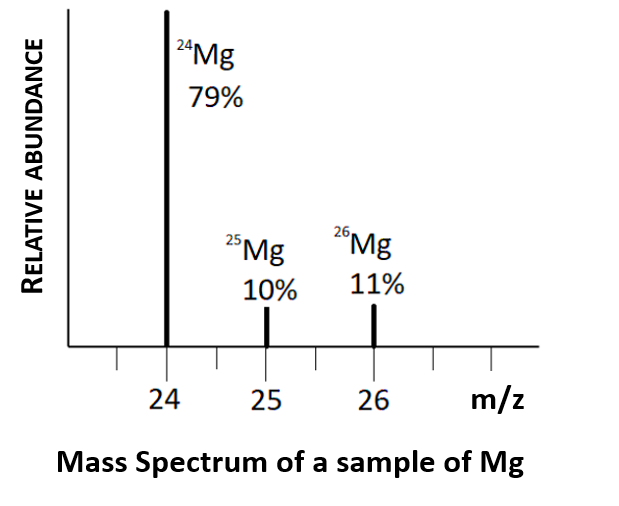
A mass spectrum is a graphical representation of the data obtained from a mass spectrometer. It displays the relative abundance of ions as a function of their m/z values.
- X-axis: The x-axis represents the mass-to-charge ratio (m/z).
- Y-axis: The y-axis represents the relative abundance of ions, often expressed as a percentage.
For elemental analysis, each peak in the mass spectrum corresponds to a different isotope of the element. The height of each peak represents the relative isotopic abundance of that isotope in the sample.
Applications
Mass spectrometry is a versatile analytical technique with broad applications in science. It is used to determine isotopic abundances, identify compounds by analyzing fragmentation patterns and mass-to-charge ratios, quantify substances, elucidate molecular structures, and study biomolecules like proteins and nucleic acids.
Calculating Average Atomic Mass
The average atomic mass of an element, as listed in the periodic table, is a weighted average of the masses of its isotopes, taking into account their relative abundances. It is calculated using the following formula:
Average Atomic Mass = $\frac{[(Mass Number × Relative Abundance) + (Mass Number × Relative Abundance) + … ] }{100} $
Where Mass Number represents the isotopic mass, and Relative Abundance is the percentage of that isotope in a naturally occurring sample.
Non-Integer Relative Atomic Masses
The atomic masses presented in the periodic table are often not whole numbers due to the presence of multiple isotopes with varying abundances. The non-integer atomic masses reflect the average mass of the isotopes, weighted by their relative abundances. Relative abundance is typically expressed as a percentage. To calculate the average atomic mass, the mass number of each isotope is multiplied by its relative abundance, and the sum of these products is divided by 100.
Example: Chlorine Isotopic Abundance and Average Atomic Mass
Chlorine (Cl) has two naturally occurring isotopes: chlorine-35 ($^{35}_{17}\mathrm{Cl}$) and chlorine-37 ($^{37}_{17}\mathrm{Cl}$). The relative abundances of these isotopes are 75.76% and 24.24%, respectively. This isotopic composition is often visualized in a mass spectrum, where peaks correspond to the isotopes, and their heights reflect their relative abundances.
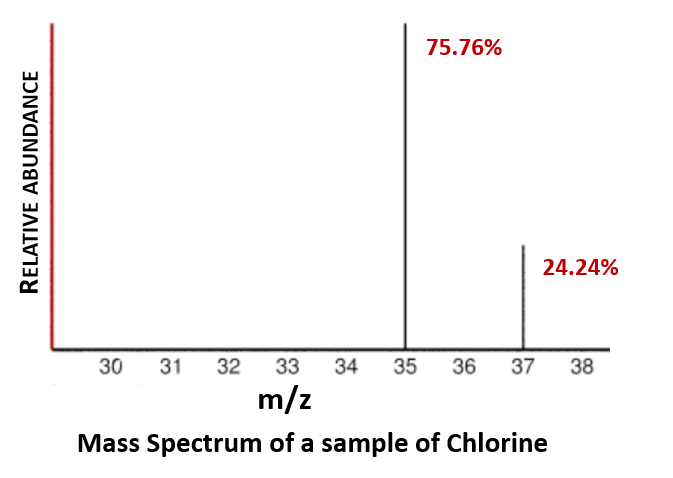
To calculate the average atomic mass of chlorine, we apply the formula:
Average Atomic Mass (Cl) = $\frac{[(35 × 75.76) + (37 × 24.24) ] }{100} $
Average Atomic Mass (Cl) = $\frac{(2651.6 + 896.88)}{100} $
Average Atomic Mass (Cl) = $\frac{3548.48}{100} $
Average Atomic Mass (Cl) = 35.48 amu
Therefore, the average atomic mass of chlorine is 35.48 atomic mass units (amu).

You may also like
The Nitration of Benzene

