The Nitration of Benzene
The Nitration of Benzene
Nitration is the chemical process of introducing a nitro group ($-\text{NO}_2$) into an aromatic ring. Benzene undergoes nitration when heated with a “nitrating mixture”—a 1:1 volumetric ratio of concentrated nitric acid ($\text{HNO}_3$) and concentrated sulfuric acid ($\text{H}_2\text{SO}_4$) at a highly controlled temperature of 50-55°C.
In this reaction, sulfuric acid acts as a powerful catalyst. It reacts with the nitric acid to produce the highly reactive nitronium ion ($\text{NO}_2^+$), which serves as the active electrophile that breaches the benzene ring.
Step 1: Formation of the Electrophile (Nitronium Ion)
Because sulfuric acid is a stronger acid than nitric acid, it forces the nitric acid to act as a base. The $\text{H}_2\text{SO}_4$ donates a proton to the $\text{HNO}_3$ molecule. This protonation creates an unstable intermediate that rapidly loses a water molecule (dehydration), generating the super-charged electrophile: the nitronium ion ($\text{NO}_2^+$).
$$\text{HNO}_3 + \text{H}_2\text{SO}_4 \; \overset{50^\circ\text{C}}{\rightleftharpoons} \; \text{NO}_2^+ + \text{HSO}_4^- + \text{H}_2\text{O}$$
Step 2: Attack of the Electrophile on the Benzene Ring
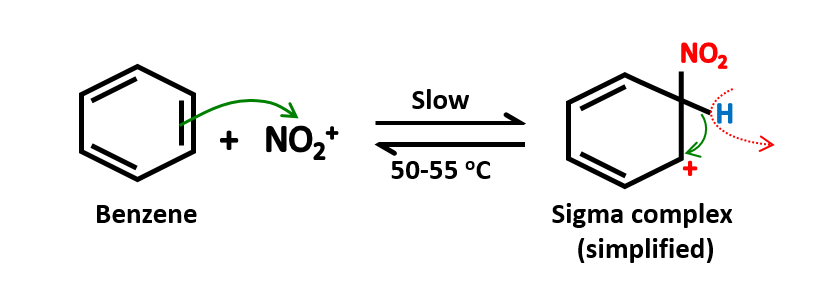
The electron-dense $\pi$ cloud of the benzene ring acts as a nucleophile, actively attacking the positively charged nitronium ion ($\text{NO}_2^+$). Two $\pi$ electrons break out of the aromatic circuit to form a new carbon-nitrogen $\sigma$ bond. This yields a non-aromatic, resonance-stabilized carbocation known as the sigma complex (or arenium ion).
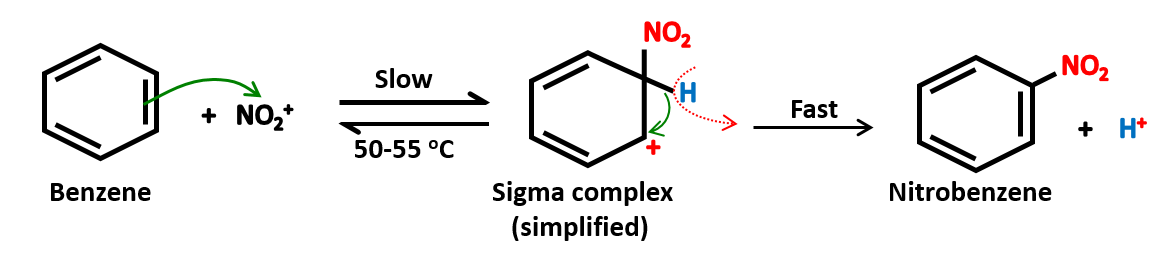
The nitronium ion attacks the $\pi$-electrons of the benzene ring, breaking aromaticity to form the intermediate sigma complex.
Step 3: Regeneration of the Catalyst
To rapidly recover its lost aromatic stability, the sigma complex must eject a proton ($\text{H}^+$). The bisulfate ion ($\text{HSO}_4^-$), generated back in Step 1, acts as a weak base. It plucks the hydrogen off the ring, allowing the electrons to fold back in, finalizing the nitrobenzene derivative and perfectly regenerating the sulfuric acid catalyst.
$$\text{HSO}_4^- + \text{H}^+ \longrightarrow \text{H}_2\text{SO}_4$$
Updated on May 27, 2026