
18.7 Dawn of Modern Physics: Challenge Test (Hard)
📝 Chapter 18: Dawn of Modern Physics Challenge Test
Comprehensive AKU Standard MCQs
1. A spacecraft travels from Earth to a distant star at a constant relativistic speed of \(0.8c\). According to mission control on Earth, the journey takes exactly 5.0 years. How much do the astronauts age during this trip, and what is the distance to the star as measured by the astronauts?
View Answer & Explanation
Explanation: The Lorentz factor is \(\gamma = 1/\sqrt{1 – 0.8^2} = 1/0.6 = 5/3\). The Earth time is dilated, so the proper time experienced by the astronauts is \(t_0 = t/\gamma = 5 / (5/3) = 3.0\) years. The Earth measures the proper distance as \(L_0 = v \times t = 0.8c \times 5 \text{ years} = 4.0\) light-years. The astronauts measure the length-contracted distance: \(L = L_0/\gamma = 4.0 / (5/3) = 2.4\) light-years.
2. Monochromatic light of frequency \(f\) illuminates a metal surface with a threshold frequency of \(f_0\), resulting in the emission of photoelectrons with a maximum kinetic energy \(K\). If the frequency of the incident light is exactly doubled to \(2f\), what will be the new maximum kinetic energy (\(K’\)) of the emitted photoelectrons?
View Answer & Explanation
Explanation: From Einstein’s photoelectric equation, initially \(K = hf – hf_0\). When the frequency is doubled, the new kinetic energy is \(K’ = h(2f) – hf_0\). We can rewrite this by substituting \(hf = K + hf_0\) into the new equation: \(K’ = 2(K + hf_0) – hf_0 = 2K + 2hf_0 – hf_0 = 2K + hf_0\). The new kinetic energy is more than double the original.
3. An incident X-ray photon of wavelength \(\lambda_i\) strikes a stationary electron and is scattered at exactly \(90^\circ\). The scattered photon has a wavelength \(\lambda_f\). What is the magnitude of the momentum imparted to the recoiling electron?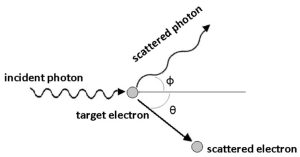
View Answer & Explanation
Explanation: By conservation of momentum in 2D space, the initial momentum is purely in the x-direction (\(p_{ix} = h/\lambda_i\)). The scattered photon moves entirely in the y-direction (\(p_{fy} = h/\lambda_f\)). The electron must carry the remaining momentum to balance the system: \(p_{ex} = h/\lambda_i\) and \(p_{ey} = -h/\lambda_f\). The magnitude of the electron’s total momentum vector is \(\sqrt{(p_{ex})^2 + (p_{ey})^2} = h\sqrt{1/\lambda_i^2 + 1/\lambda_f^2}\).
4. A charged particle accelerated from rest through a potential difference \(V\) acquires a de Broglie wavelength \(\lambda\). If the accelerating potential difference is increased to \(4V\), what will be the new de Broglie wavelength of the particle?
View Answer & Explanation
Explanation: The kinetic energy gained by the particle is \(K = qV\). The momentum is related to kinetic energy by \(p = \sqrt{2mK} = \sqrt{2mqV}\). The de Broglie wavelength is \(\lambda = h/p = h / \sqrt{2mqV}\). This shows that \(\lambda \propto 1/\sqrt{V}\). If \(V\) is multiplied by 4, the denominator is multiplied by \(\sqrt{4} = 2\), reducing the wavelength to \(\lambda/2\).
5. A highly energetic gamma-ray photon with an energy of \(3.02 \, \text{MeV}\) strikes a heavy nucleus, inducing pair production. Assuming the massive nucleus absorbs negligible kinetic energy and the energy is shared equally between the created electron and positron, what is the resulting kinetic energy of the positron? (Rest mass energy of an electron is \(0.51 \, \text{MeV}\))
View Answer & Explanation
Explanation: The total energy of the incident photon must cover the rest mass energy of both the electron and the positron (\(2 \times 0.51 \, \text{MeV} = 1.02 \, \text{MeV}\)). The remaining energy becomes the total kinetic energy of the pair: \(K_{total} = E_{photon} – 2m_0c^2 = 3.02 \, \text{MeV} – 1.02 \, \text{MeV} = 2.00 \, \text{MeV}\). Since the kinetic energy is shared equally, the positron receives \(1.00 \, \text{MeV}\).
6. A blackbody sphere of radius \(R\) at absolute temperature \(T\) radiates a total power \(P\), with its emission spectrum peaking at wavelength \(\lambda_0\). If the total radiated power is observed to increase to \(16P\) while its radius remains unchanged, what is the new peak wavelength?
View Answer & Explanation
Explanation: According to the Stefan-Boltzmann Law, power \(P \propto T^4\). If \(P\) increases by a factor of 16, \(T\) must increase by a factor of 2 (since \(2^4 = 16\)). According to Wien’s Displacement Law, \(\lambda_{max} T = \text{constant}\). Since the temperature is doubled, the peak wavelength is halved (\(\lambda_0 / 2\)).
7. Incident Frequency (\(f\)) on the x-axis for two different metals, A and B. Metal B’s line is parallel to Metal A’s line but has a larger x-intercept. What does the ratio of their slopes (\(m_A / m_B\)) represent?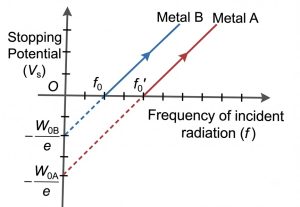
View Answer & Explanation
Explanation: From Einstein’s photoelectric equation, \(eV_s = hf – \phi \implies V_s = (h/e)f – (\phi/e)\). The slope of any \(V_s\) vs. \(f\) graph for *any* metal is always Planck’s constant divided by the elementary charge (\(h/e\)). Therefore, the lines are perfectly parallel, and the ratio of their slopes is 1.
8. Monochromatic light of wavelength \(200 \, \text{nm}\) is incident on a metal surface with a work function of \(4.2 \, \text{eV}\). What is the minimum stopping potential required to halt the most energetic photoelectrons? (Assume \(hc \approx 1240 \, \text{eV}\cdot\text{nm}\))
View Answer & Explanation
Explanation: First, find the energy of the incident photon: \(E = hc/\lambda = 1240 / 200 = 6.2 \, \text{eV}\). The maximum kinetic energy is \(K_{max} = E – \phi = 6.2 \, \text{eV} – 4.2 \, \text{eV} = 2.0 \, \text{eV}\). To stop an electron with \(2.0 \, \text{eV}\) of kinetic energy, a stopping potential of \(2.0 \, \text{V}\) is required (\(eV_s = K_{max}\)).
9. During a Compton scattering event, under which specific condition will the recoiling electron acquire the maximum possible fraction of the incident X-ray photon’s energy?
View Answer & Explanation
Explanation: The Compton shift is given by \(\Delta\lambda = \frac{h}{m_0c}(1 – \cos\theta)\). To transfer the maximum energy to the electron, the photon must lose the maximum energy, meaning its wavelength must increase by the maximum amount. This occurs when \(\cos\theta = -1\) (at \(\theta = 180^\circ\)), making the shift \(\frac{2h}{m_0c}\).
10. At what velocity \(v\) will the relativistic kinetic energy of a massive particle be exactly equal to its own rest mass energy (\(m_0c^2\))?
View Answer & Explanation
Explanation: Relativistic kinetic energy is \(K = (\gamma – 1)m_0c^2\). We are given \(K = m_0c^2\). Therefore, \((\gamma – 1)m_0c^2 = m_0c^2 \implies \gamma – 1 = 1 \implies \gamma = 2\). Solving \(1/\sqrt{1 – v^2/c^2} = 2\) yields \(1 – v^2/c^2 = 1/4 \implies v^2/c^2 = 3/4 \implies v = \frac{\sqrt{3}}{2}c \approx 0.866c\).
11. Why is it physically impossible for a single isolated photon to undergo pair production in a perfect vacuum, even if its energy strictly exceeds \(1.02 \, \text{MeV}\)?
View Answer & Explanation
Explanation: A single photon converting into an electron-positron pair in empty space cannot conserve momentum and energy at the same time. The presence of a heavy nucleus is required to absorb the recoil momentum without carrying away significant kinetic energy.
12. An alpha particle (\(q = +2e, m = 4m_p\)) and a proton (\(q = +e, m = m_p\)) are accelerated from rest through the same potential difference \(V\). What is the ratio of their final De Broglie wavelengths (\(\lambda_\alpha / \lambda_p\))?
View Answer & Explanation
Explanation: The kinetic energy gained is \(K = qV\). Momentum \(p = \sqrt{2mK} = \sqrt{2mqV}\). The De Broglie wavelength is \(\lambda = h/p = h/\sqrt{2mqV}\). Therefore, \(\lambda \propto 1/\sqrt{mq}\). The ratio is \(\sqrt{(m_p \cdot e) / (4m_p \cdot 2e)} = \sqrt{1/8} = 1/(2\sqrt{2})\).
13. If an electron’s position is measured with an uncertainty exactly equal to its own De Broglie wavelength (\(\Delta x = \lambda\)), what is the theoretical minimum fractional uncertainty in its momentum (\(\Delta p / p\))? (Using the standard uncertainty relation \(\Delta x \Delta p \geq h/4\pi\))
View Answer & Explanation
Explanation: We are given \(\Delta x = \lambda\). From De Broglie, \(\lambda = h/p\). The Uncertainty Principle states \(\Delta x \Delta p \geq h/4\pi\). Substituting \(\Delta x\), we get \((h/p)\Delta p \geq h/4\pi\). Dividing both sides by \(h\) leaves \(\Delta p / p \geq 1/4\pi\).
14. Unstable muons created in the upper atmosphere travel at \(0.99c\) and routinely reach the Earth’s surface despite their proper half-life being only \(2.2 \, \mu\text{s}\) (which classically wouldn’t allow them to travel the distance). From the *reference frame of the muon itself*, how is its successful arrival explained?
View Answer & Explanation
Explanation: In the Earth’s frame, the muon’s time is dilated (it lives longer). However, in the muon’s own rest frame, its clock runs normally (living only \(2.2 \, \mu\text{s}\)), but the Earth and its atmosphere are rushing toward it at \(0.99c\), making the distance to the surface severely length-contracted.
15. Source A emits \(10^{15}\) photons per second at a wavelength of \(400 \, \text{nm}\). Source B emits \(10^{15}\) photons per second at \(300 \, \text{nm}\). Both independently illuminate the identical ideal photocell (work function \(\phi = 2.0 \, \text{eV}\)). How do their resulting photoelectric saturation currents compare?
View Answer & Explanation
Explanation: First, verify both cause emission: \(400 \, \text{nm} \implies \approx 3.1 \, \text{eV}\) and \(300 \, \text{nm} \implies \approx 4.1 \, \text{eV}\). Both exceed the \(2.0 \, \text{eV}\) work function. Saturation current depends *strictly* on the number of photoelectrons emitted per second, which depends entirely on the *number* of incident photons per second. Since both emit \(10^{15}\) photons/sec, the saturation currents are identical (Source B just produces faster electrons, not more of them).
16. An electron and a positron, both essentially at rest, annihilate each other to produce two identical gamma-ray photons. Which of the following best approximates the wavelength of each emitted photon? (Given \(m_e = 9.11 \times 10^{-31} \, \text{kg}\), \(h \approx 6.63 \times 10^{-34} \, \text{J}\cdot\text{s}\))
View Answer & Explanation
Explanation: The energy of each photon equals the rest mass energy of one electron (\(E = m_e c^2\)). Using \(E = hc/\lambda\), we get \(m_e c^2 = hc/\lambda \implies \lambda = h / (m_e c)\). This is the definition of the Compton wavelength of an electron, which evaluates to \(\approx 2.43 \times 10^{-12} \, \text{m}\) (or \(2.43 \, \text{pm}\)).
17. A high-speed proton is accelerated in a particle collider until its relativistic momentum is exactly twice its classical, non-relativistic momentum (\(p = m_0v\)). At what fraction of the speed of light is this proton traveling?
View Answer & Explanation
Explanation: Relativistic momentum is \(p_{rel} = \gamma m_0v\). We are given \(p_{rel} = 2 \times (m_0v)\). Therefore, \(\gamma m_0v = 2m_0v \implies \gamma = 2\). The velocity that yields a Lorentz factor of 2 is \(\sqrt{3}/2 \approx 0.866c\).
18. For a non-relativistic ideal gas molecule of mass \(m\) residing in a sealed container at absolute thermodynamic temperature \(T\), its root-mean-square De Broglie wavelength is proportional to:
View Answer & Explanation
Explanation: The average kinetic energy of the gas molecule is \(K = \frac{3}{2}kT\). Momentum \(p = \sqrt{2mK} = \sqrt{2m(3/2)kT} = \sqrt{3mkT}\). The De Broglie wavelength is \(\lambda = h/p = h / \sqrt{3mkT}\). Since \(h, 3, m,\) and \(k\) are constants, \(\lambda \propto 1 / \sqrt{T}\).
19. In a photoelectric experiment, the maximum kinetic energy (\(K_{max}\)) of photoelectrons is plotted against the frequency (\(f\)) of incident light, yielding a straight line. If the exact same experiment is repeated using a metal with a substantially larger work function, how does the new graph visually compare to the original?
View Answer & Explanation
Explanation: The equation is \(K_{max} = hf – \phi\). The slope is always \(h\) (Planck’s constant), so the lines are parallel. The x-intercept is the threshold frequency (\(f_0 = \phi / h\)). A larger work function (\(\phi\)) means a higher threshold frequency, shifting the intercept to the right along the frequency axis.
20. An unstable subatomic particle of rest mass \(M_0\) at rest completely decays into two identical particles, each with a rest mass of \(M_0 / 3\), which fly apart in opposite directions. What is the relativistic Lorentz factor (\(\gamma\)) for each of these two decay products?
View Answer & Explanation
Explanation: Due to conservation of total relativistic energy, the rest mass energy of the parent particle becomes the total relativistic energy of the two daughter particles. \(M_0c^2 = 2 \times E_{daughter}\). The energy of one daughter particle is \(E_{daughter} = \gamma (m_{daughter}) c^2 = \gamma (M_0/3) c^2\). Equating the two: \(M_0c^2 = 2 \times \gamma (M_0/3) c^2 \implies 1 = (2/3)\gamma \implies \gamma = 3/2 = 1.5\).
21. A \(100 \, \text{W}\) monochromatic laser operates at a wavelength of \(600 \, \text{nm}\). Assuming exactly \(10\%\) of the electrical power is converted into an active light beam, roughly how many photons are emitted by the laser per second? (Use \(hc \approx 20 \times 10^{-26} \, \text{J}\cdot\text{m}\))
View Answer & Explanation
Explanation: The useful optical power is \(10\%\) of \(100 \, \text{W} = 10 \, \text{J/s}\). The energy of a single photon is \(E = hc/\lambda \approx (20 \times 10^{-26}) / (600 \times 10^{-9}) \approx 3.33 \times 10^{-19} \, \text{J}\). The number of photons per second (\(n\)) is \(P/E = 10 / (3.33 \times 10^{-19}) \approx 3 \times 10^{19}\) photons/sec.
22. A uniform beam of electrons travels along the x-axis and passes through a narrow horizontal slit of width \(d\) (restricting their position in the y-axis). If the physical width of the slit is subsequently halved to \(d/2\), what mathematically happens to the minimum uncertainty in the transverse (y-axis) momentum of the emerging electrons?
View Answer & Explanation
Explanation: The slit restricts the electron’s position, creating an uncertainty \(\Delta y \approx d\). From Heisenberg (\(\Delta y \Delta p_y \geq \hbar/2\)), we see \(\Delta p_y\) is inversely proportional to \(\Delta y\). If the position uncertainty (\(d\)) is halved, the momentum uncertainty (\(\Delta p_y\)) must double to satisfy the inequality, resulting in a broader diffraction spread.
23. Spacecraft A is traveling directly toward Earth at a velocity of \(0.7c\). It fires a forward-facing laser beam aimed at an Earth observatory. According to the foundational postulates of special relativity, at what absolute velocity will an observer on Earth measure the approaching laser beam?
View Answer & Explanation
Explanation: The second postulate of special relativity dictates that the speed of light in a vacuum (\(c\)) is invariant; it is exactly the same for all observers, regardless of the relative motion of the source or the observer. Classical Galilean velocity addition (\(c + 0.7c\)) does not apply to light.
24. A high-energy photon and a non-relativistic free electron have the exact same De Broglie wavelength. Which of the following statements regarding their physical properties is mathematically sound?
View Answer & Explanation
Explanation: The De Broglie relation states that \(\lambda = h/p\). If two entities—regardless of whether they have rest mass (electron) or not (photon)—have the identical wavelength \(\lambda\), they must possess identical momentum \(p\). Their energies, however, are governed by different equations (\(E=pc\) vs \(K=p^2/2m\)) and will not be equal.
25. A vacuum photocell connected to an adjustable variable voltage supply and a sensitive ammeter. When the reverse (retarding) voltage is set to exactly \(-1.5 \, \text{V}\), the ammeter reads zero. If the frequency of the incident monochromatic light is increased by \(20\%\), what must be logically done to the retarding voltage to maintain the zero current reading?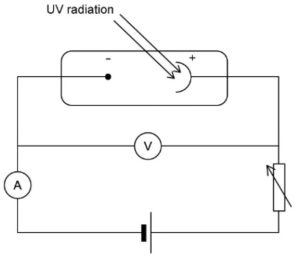
View Answer & Explanation
Explanation: An increase in frequency increases the photon energy (\(E=hf\)). By the photoelectric equation, the maximum kinetic energy of the emitted electrons also increases. To stop these faster, more energetic electrons, a stronger (more negative) repelling potential is strictly required.
26. Why is the Compton effect prominently observed in laboratory settings using X-rays and gamma rays, but almost entirely undetectable when using visible light?
View Answer & Explanation
Explanation: The absolute Compton shift (\(\Delta\lambda\)) depends only on the scattering angle and is maxed at \(\approx 0.0048 \, \text{nm}\). For an X-ray (e.g., \(\lambda = 0.1 \, \text{nm}\)), this represents a massive, easily measurable \(5\%\) shift. For visible light (e.g., \(\lambda = 500 \, \text{nm}\)), a \(0.0048 \, \text{nm}\) shift represents an undetectable \(0.00096\%\) change.
27. A positron and an electron, each moving toward the other with a kinetic energy of exactly \(0.50 \, \text{MeV}\), undergo a head-on annihilation event. What is the energy of each of the two resulting gamma-ray photons? (Assume the rest mass energy of an electron is \(0.51 \, \text{MeV}\)).
View Answer & Explanation
Explanation: The total initial energy of the system is the sum of the rest mass energies and kinetic energies: \((0.51 + 0.50) \, \text{MeV}\) for the electron, and \((0.51 + 0.50) \, \text{MeV}\) for the positron, totaling \(2.02 \, \text{MeV}\). Because the collision is symmetric head-on, momentum is zero, so two identical photons are emitted in opposite directions. Each photon receives exactly half the total energy: \(2.02 / 2 = 1.01 \, \text{MeV}\).
28. An astronaut’s biological pulse rate is precisely 60 beats per minute while at rest on Earth. If the astronaut travels in a deep-space craft at a constant speed of \(0.8c\) relative to Earth, what pulse rate will an observer stationed on Earth calculate the astronaut to have?
View Answer & Explanation
Explanation: The observer on Earth views the astronaut’s time as dilated (running slower). The Lorentz factor \(\gamma = 1/\sqrt{1-(0.8)^2} = 1/\sqrt{0.36} = 1/0.6 = 5/3\). If one beat takes \(1\) second in the astronaut’s proper frame, it takes \((5/3)\) seconds observed from Earth. Therefore, the observed heart rate is \(60 / (5/3) = 60 \times (3/5) = 36\) beats per minute.
29. The physical unit of Planck’s constant (\(h\)) is Joules \(\cdot\) seconds (\(\text{J}\cdot\text{s}\)). Which of the following fundamental physical quantities shares this exact dimensional unit?
View Answer & Explanation
Explanation: Planck’s constant \(h\) has units of \(\text{J}\cdot\text{s} = (\text{kg}\cdot\text{m}^2/\text{s}^2) \cdot \text{s} = \text{kg}\cdot\text{m}^2/\text{s}\). Angular momentum (\(L = mvr\)) has units of \(\text{kg} \cdot (\text{m/s}) \cdot \text{m} = \text{kg}\cdot\text{m}^2/\text{s}\). They are dimensionally identical (which is why \(h\) governs the quantization of angular momentum in the Bohr model).
30. The “Ultraviolet Catastrophe” was a severe failing of classical physics regarding blackbody radiation. What specific flaw in the classical Rayleigh-Jeans law caused this catastrophe, and how did Planck resolve it?
View Answer & Explanation
Explanation: The Rayleigh-Jeans classical model modeled standing waves in a cavity, allowing infinite modes at short wavelengths (ultraviolet), predicting infinite energy emission. Planck resolved this by postulating that the cavity walls’ atomic oscillators could only emit energy in discrete packets (\(E=nhf\)), suppressing the infinite high-frequency modes.