
6.5 Fluid Friction and Terminal Velocity
🪂 Lesson 5: Fluid Friction & Terminal Velocity
Chapter 6: Fluid Dynamics
Student Learning Outcomes (SLOs 6.5.1 – 6.5.5)
Learning Objectives
- Define terminal velocity and describe the physical factors it depends upon.
- State Stokes’ law and apply dimensional analysis to verify its formula.
- Mathematically derive the expression for the terminal velocity of a spherical body falling through a viscous fluid.
📺 Video Lesson: Reaching Terminal Velocity
Understanding the balance of forces that prevents falling objects from accelerating indefinitely.
1. Stokes’ Law & Dimensional Analysis (SLOs 6.5.3 & 6.5.5)
As established in the previous lesson, Stokes’ Law dictates that the retarding drag force ($F_D$) on a small sphere moving slowly through a viscous fluid is given by: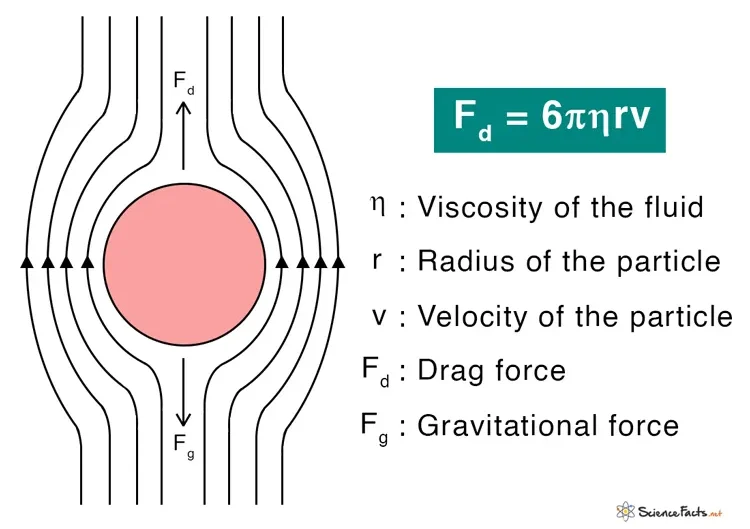
$F_d = 6 \pi \eta r v$
We can confirm the validity of this equation using dimensional analysis. By isolating the coefficient of viscosity ($\eta$), we have $\eta = \frac{F_D}{6 \pi r v}$. Since $6\pi$ is a dimensionless constant, we substitute the standard dimensions for Force $[MLT^{-2}]$, radius $[L]$, and velocity $[LT^{-1}]$:
$[\eta] = \frac{[M L T^{-2}]}{[L] [L T^{-1}]} = \frac{[M L T^{-2}]}{[L^2 T^{-1}]}$
$[\eta] = [M L^{-1} T^{-1}]$
This precisely matches the established dimensional formula for dynamic viscosity, confirming the structural integrity of Stokes’ Law.
2. Defining Terminal Velocity (SLOs 6.5.1 & 6.5.2)
When an object, such as a raindrop, begins to fall through the atmosphere, its initial velocity is zero. As gravity pulls it downward, it accelerates. However, as its speed ($v$) increases, the upward drag force ($F_D$) also increases proportionally according to Stokes’ Law.
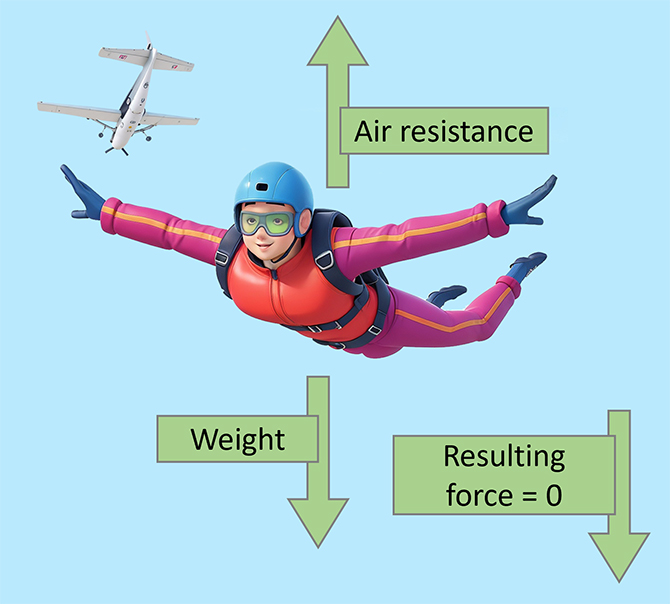
Eventually, a point is reached where the upward drag force exactly equals the downward force of gravity (the object’s weight). At this precise moment, the net force on the object becomes zero ($\Sigma F = 0$). According to Newton’s First Law, acceleration ceases, and the object continues to fall at a constant, maximum speed. This constant speed is called the Terminal Velocity ($v_t$).
Factors Affecting Terminal Velocity:
Size (Radius): Larger objects generally fall faster.
Mass/Density: Denser objects have a higher weight to overcome, resulting in a higher terminal velocity.
Fluid Viscosity: A more viscous fluid provides greater drag, lowering the terminal velocity.
3. Deriving the Expression (SLO 6.5.4)
Let us derive the exact formula for the terminal velocity of a spherical water droplet of radius $r$ and density $\rho$ falling through air of viscosity $\eta$.

Downward Force (Weight): The weight of the sphere is $W = mg$. Since mass is volume times density ($m = V\rho$), and the volume of a sphere is $\frac{4}{3}\pi r^3$, we get:
$$W = \left(\frac{4}{3}\pi r^3\right) \rho g$$
Upward Force (Drag): By Stokes’ Law, when the sphere reaches terminal velocity ($v_t$), the drag force is:
$$F_d = 6 \pi \eta r v_t$$
Equilibrium Condition: At terminal velocity, Net Force = 0, so Downward Force = Upward Force:
$$W = F_d$$
$$\frac{4}{3}\pi r^3 \rho g = 6 \pi \eta r v_t$$
Solving for $v_t$: We cancel $\pi$ and one $r$ from both sides, and isolate $v_t$:
$$v_t = \frac{\frac{4}{3} r^2 \rho g}{6 \eta}$$
$v_t = \frac{2 \rho g r^2}{9 \eta}$
(Note: If the fluid is dense enough that buoyancy cannot be ignored, the formula modifies to $v_t = \frac{2(\rho – \sigma)gr^2}{9\eta}$, where $\sigma$ is the fluid’s density).
🎯 AKU Exam Insights
- The $r^2$ Proportionality: The most highly tested concept here is $v_t \propto r^2$. If the radius of a falling raindrop is doubled, its terminal velocity increases by a factor of four ($2^2 = 4$). Conversely, tiny fog droplets have incredibly small radii, causing their terminal velocities to be so low that they appear suspended in the air.
- Acceleration Graph: Be prepared to identify an Acceleration-Time graph for a falling object. It starts at $g$ ($9.8 \text{ m/s}^2$) and curves downward until it reaches exactly zero at terminal velocity.
QUICK-FACT: A skydiver in a standard “belly-to-earth” position reaches a terminal velocity of about $195 \text{ km/h}$ ($120 \text{ mph}$). By diving headfirst and pulling their arms in (reducing their aerodynamic cross-section and effectively altering their drag characteristics), they can reach speeds exceeding $320 \text{ km/h}$ ($200 \text{ mph}$)!
📝 Concept Check
1. The terminal velocity of a spherical body falling through a viscous fluid is directly proportional to:
Check Answer
Correct: The square of the radius of the sphere
Explanation: Looking at the derived formula $v_t = \frac{2\rho g r^2}{9\eta}$, terminal velocity is directly proportional to $r^2$ and inversely proportional to $\eta$.
2. When a falling body attains terminal velocity, its acceleration is:
Check Answer
Correct: Zero
Explanation: Terminal velocity means the speed has become constant. If velocity is constant, the rate of change of velocity (acceleration) must be exactly zero, due to the net force being zero ($W = F_d$).
🏆 Final Challenge
Next: Challenge Test (Chapter 6 Review)
📝