
15.3.2 Isomerism
🔀 Lesson 3.2: Isomerism
Chapter 15: Organic Compounds
Student Learning Outcomes (SLOs 15.3.1 – 15.3.5)
Learning Objectives
- Exemplify the core differences between Structural Isomerism and Stereo-isomerism.
- Define and mathematically identify a Chiral Centre within complex structural formulas.
- Explain the mechanics of Optical Isomerism and the rotation of plane-polarized light.
- Map the specific types of isomerism exhibited by 8 major organic functional groups.
📺 Video Lesson: The 3D World of Isomers
Visualize how shifting a single atom in 3D space can completely alter a molecule’s biological interaction.
1. Structural vs. Stereo-Isomerism (SLO 15.3.1)
Isomerism exists when two or more compounds share the exact same molecular formula but have different physical or chemical properties due to different arrangements of atoms. This is the primary reason why millions of distinct organic compounds exist.
Structural Isomerism
The atoms are connected in a completely different sequence (different bonding connectivity). This includes Chain, Position, Functional Group, and Metamerism.
Stereo-isomerism
The atoms have the exact same connectivity, but they are arranged differently in 3D space. This includes Geometric (Cis/Trans) and Optical Isomerism.
2. The Chiral Centre (SLO 15.3.2 & 15.3.4)
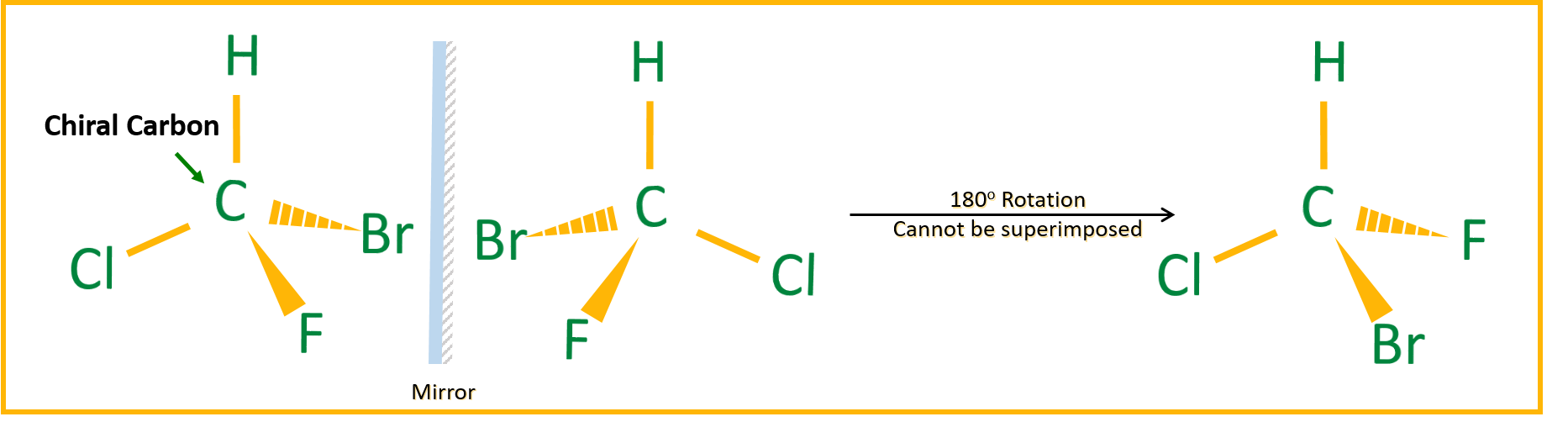
The foundation of optical isomerism is the Chiral Centre (often called a stereocenter or asymmetric carbon). By definition, a chiral carbon is an $sp^3$ hybridized carbon atom bonded to four completely different groups or atoms.
|
|
|


How to Detect a Chiral Centre in Exams:
- Rule 1: Ignore all $CH_3$ (methyl) and $CH_2$ (methylene) groups. They have identical hydrogens, so they cannot be chiral.
- Rule 2: Ignore all carbons involved in double ($C=C$, $C=O$) or triple ($C \equiv C$) bonds. A chiral carbon must have 4 single bonds ($sp^3$).
- Rule 3: Focus on $CH$ carbons. Look at the four pathways extending from that carbon. If all four pathways lead to different atomic environments, it is a chiral center, denoted with an asterisk ($C^*$).
Example: In 2-chlorobutane, Carbon-2 is bonded to: 1) a Hydrogen, 2) a Chlorine, 3) a Methyl group, and 4) an Ethyl group. Since all 4 are different, Carbon-2 is a chiral center.
3. Optical Isomerism (SLO 15.3.3)

If a molecule possesses a chiral center and lacks any internal plane of symmetry, it will be chiral. This means the molecule and its mirror image are non-superimposable (just like your left and right hands). These non-superimposable mirror-image molecules are called Enantiomers.


Bromochlorofluoromethane (CHBrClF) possesses a chiral carbon atom. Its mirror image cannot be superimposed on the original molecule, regardless of rotation.
📊 Interactive 3D Widget: Exploring Chirality
Enantiomers have identical physical properties (boiling point, density, etc.). They only differ in one specific physical property: their interaction with plane-polarized light.

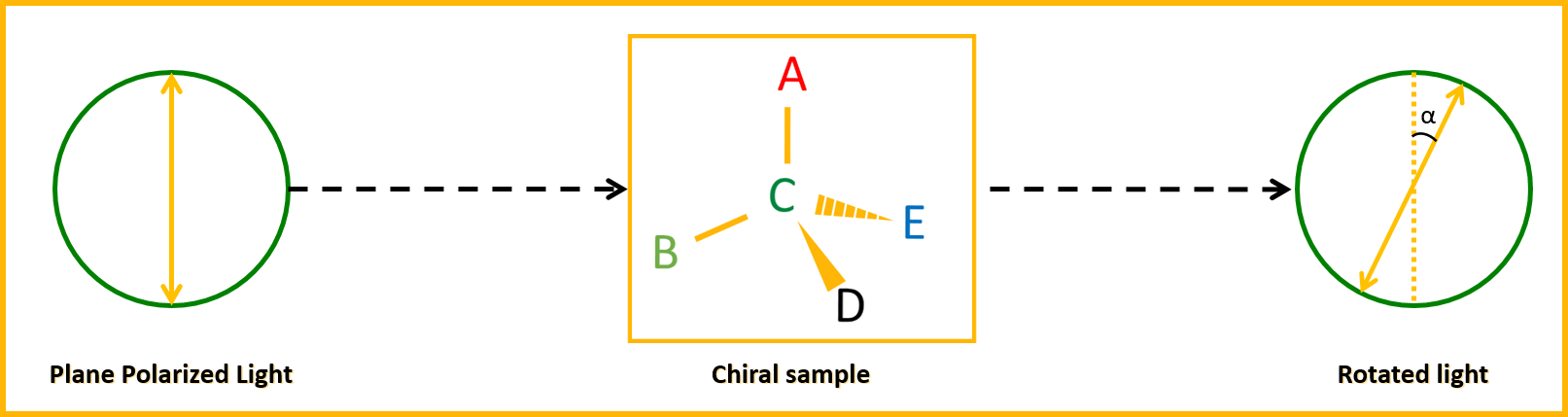
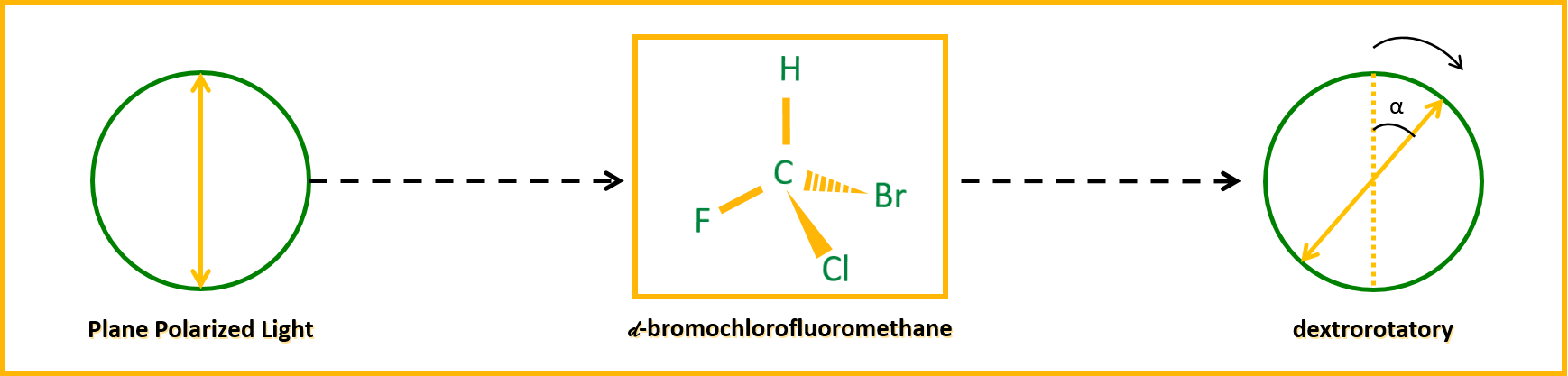
- Dextrorotatory (d or +): The enantiomer that rotates the plane of polarized light to the right (clockwise).
- Laevorotatory (l or -): The enantiomer that rotates the plane of polarized light to the left (counter-clockwise).

4. Isomerism Across Functional Groups (SLO 15.3.5)
Different homologous series exhibit specific patterns of structural isomerism based on their geometry and valency.
| Functional Group | Primary Types of Isomerism Exhibited | Struture | |
|---|---|---|---|
| Alkyl Halides ($R-X$) | Position: (1-chloropropane vs. 2-chloropropane). | 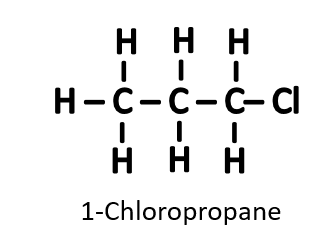 |
 |
| Optical: If the halogen creates a chiral center (e.g., 2-bromobutane). |  |
||
| Alcohols ($R-OH$) & Ethers ($R-O-R$) |
Functional Group Isomerism: Alcohols and Ethers with the same carbon count are isomers of each other (e.g., Ethanol and Dimethyl ether both share $C_2H_6O$). Ethers also heavily exhibit Metamerism. |
|
|
| Aldehydes ($-CHO$) & Ketones ($>C=O$) |
Functional Group Isomerism: Propanal and Propanone both share $C_3H_6O$. Ketones also exhibit |
 |
 |
| Tautomerism (shifting to an enol form). |  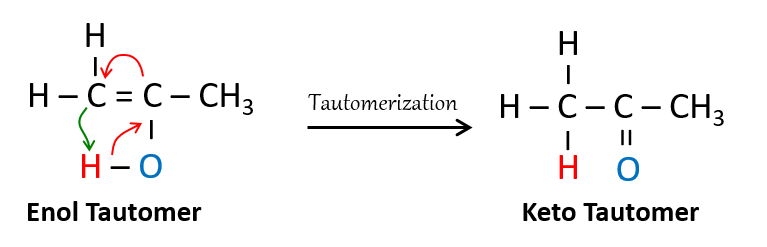 |
||
| Carboxylic Acids & Esters | Functional Group Isomerism: Propanoic acid and Methyl ethanoate both share $C_3H_6O_2$. |  |
 |
| Amines ($-NH_2, -NH-, -N-$) | Metamerism: Secondary and tertiary amines exhibit metamerism depending on how the alkyl chains are distributed around the central Nitrogen atom. |  |
 |
| Metamerism: Tertiary amines |  |
 |
|

⚡ Quick-Fact: The Thalidomide Tragedy
Why does optical isomerism matter in medicine? In the 1950s, the drug Thalidomide was sold as a mixture of two enantiomers to cure morning sickness. The (R)-enantiomer worked perfectly. However, the (S)-enantiomer was a teratogen that caused severe birth defects. Biological receptors are highly stereospecific—they can distinguish between mirror images just like your right hand can only fit into a right-handed glove!

🎯 AKU Exam Insights
- Racemic Mixture: An equimolar (50:50) mixture of the d-isomer and l-isomer. Because their optical rotations cancel each other out exactly, a racemic mixture is optically inactive due to external compensation.
- Meso Compounds: A molecule that has chiral centers but is optically inactive because it possesses an internal plane of symmetry (e.g., meso-tartaric acid). The top half cancels the bottom half. This is optical inactivity due to internal compensation.
- The $2^n$ Formula: To calculate the maximum number of optical isomers for a molecule with no symmetry, use the formula $2^n$, where $n$ is the number of chiral centers. (e.g., Glucose has 4 chiral centers, so it has $2^4 = 16$ optical isomers).
5. Concept Check
1. Which of the following molecules possesses a chiral centre?
View Answer & Explanation
Correct: 2-bromobutane
Explanation: In 2-bromobutane, Carbon-2 is attached to: 1) a Hydrogen, 2) a Bromine, 3) a Methyl group ($CH_3$), and 4) an Ethyl group ($C_2H_5$). Because all four groups are different, it is a chiral center. (2-chloropropane is not chiral because Carbon-2 is attached to two identical methyl groups).
2. Ethanol ($CH_3CH_2OH$) and Dimethyl ether ($CH_3OCH_3$) have the exact same molecular formula ($C_2H_6O$). They are classic examples of which type of isomerism?
View Answer & Explanation
Correct: Functional Group Isomerism
Explanation: The molecular formula is rearranged so drastically that entirely different functional groups are created (an alcohol vs. an ether), placing them in completely different homologous series with vastly different properties.
3. Why is a racemic mixture optically inactive?
View Answer & Explanation
Correct: Because the 50:50 mixture of enantiomers causes the rightward rotation to be perfectly canceled out by the leftward rotation (external compensation).
Explanation: The d-isomer rotates light $+x^\circ$, and the l-isomer rotates light $-x^\circ$. In a 50:50 racemic mixture, these effects cancel each other out completely.
➡ Coming Next
Chapter 15: Challenge Test
🎯