
Oxidation Reduction Concepts
Oxidation–Reduction Concepts (Redox)
Suggested Videos
The Electron Transfer Concept
Oxidation and reduction are fundamental chemical processes that involve the transfer of electrons between substances. These processes are central to energy conversion, corrosion, and biological reactions. When both oxidation and reduction occur simultaneously, the overall reaction is called a redox reaction.
Oxidation and Reduction
- Oxidation: the loss of electrons by an atom, ion, or molecule. (LEO – Loss of Electrons is Oxidation)
- Reduction: the gain of electrons by an atom, ion, or molecule. (GER – Gain of Electrons is Reduction)
- Redox Reaction: a reaction in which oxidation and reduction occur simultaneously, allowing electrons to transfer from one species to another.
Example — Zinc and Copper Reaction
Electron Transfer in $\text{Zn} / \text{CuSO}_4$
When a piece of zinc metal is placed in an aqueous solution of $\text{CuSO}_4$:
- The blue colour fades as $\text{Cu}^{2+}$ ions are reduced.
- Copper metal deposits on the zinc surface.
- The solution becomes enriched in $\text{Zn}^{2+}$ ions.
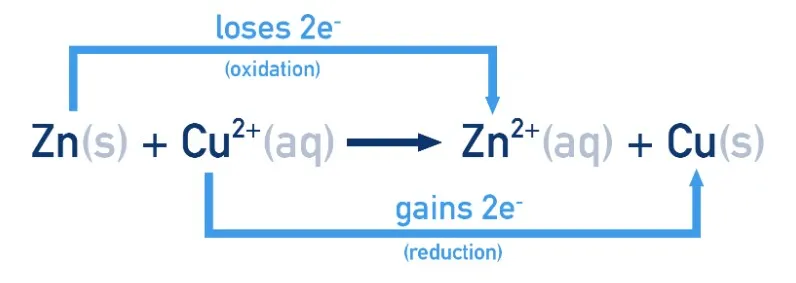
Overall Reaction: $\mathbf{Zn(s) + Cu^{2+}(aq) \rightarrow Zn^{2+}(aq) + Cu(s)}$
Oxidation Half-Reaction
Zinc atoms lose electrons and are oxidized.
Reduction Half-Reaction
Copper(II) ions gain electrons and are reduced.
Oxidation Number
The oxidation number is a formalism used to track electrons in chemical reactions. It represents the hypothetical charge an atom would have if all bonds were completely ionic. Oxidation numbers are essential for identifying which atoms are oxidized or reduced, especially in complex reactions.
Redox by Oxidation Number Change
One can determine oxidation and reduction by observing the changes in oxidation numbers:
- Oxidation: The oxidation number increases as electrons are lost.
- Reduction: The oxidation number decreases as electrons are gained.
Example — $\text{Sodium}$ and $\text{Chlorine}$ Reaction
- Sodium: $0 \rightarrow +1$ (oxidation)
- Chlorine: $0 \rightarrow -1$ (reduction)
This illustrates electron transfer in the formation of a simple ionic compound.
Example: Combustion of Methane
- Carbon: $-4 \rightarrow +4$ (oxidation)
- Oxygen: $0 \rightarrow -2$ (reduction)
Disproportionation Reactions
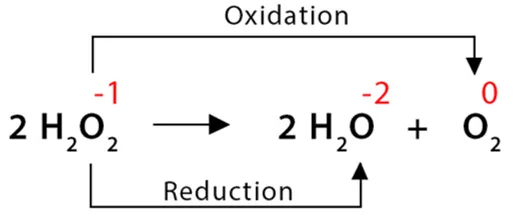
In disproportionation, a single element undergoes both oxidation and reduction simultaneously. These reactions are common in compounds like hydrogen peroxide and some halogens.
Example — Hydrogen Peroxide Decomposition
Oxygen in $\text{H}_2\text{O}_2$ has an oxidation state of $\mathbf{-1}$. During the reaction, it is:
- Reduced to $\mathbf{-2}$ in $\text{H}_2\text{O}$.
- Oxidized to $\mathbf{0}$ in $\text{O}_2$.
Quick Recap
- Redox reactions involve the transfer of electrons.
- Oxidation is the loss of electrons (increase in oxidation number).
- Reduction is the gain of electrons (decrease in oxidation number).
- The oxidation number helps track electron transfer in complex reactions.
- Disproportionation occurs when a single element is both oxidized and reduced.