Theories of Covalent Bonding and Shape of Molecules
Bond Characteristics
Define the term ‘bond energy’
Bond energy is defined as the average amount of energy required to break all bonds of a particular type in one mole of the substance. It is a measure of the strength of the bond.
Key Information:
- The SI unit for bond energy is kJ/mol (kilojoules per mole)
- Some older literature may use kcal/mol (1 kcal/mol ≈ 4.184 kJ/mol)
- Bond energy is always reported as a positive value (bond breaking is endothermic)
Note: Bond energy values are typically measured at standard conditions (298 K and 1 atm pressure).
Relate Bond Energy with Bond Strength
Bond energy is a direct measure of bond strength—the higher the bond energy, the stronger the bond, and the more energy is required to break it. Stronger bonds are typically shorter and more stable, while weaker bonds are longer and more easily broken.
Key Relationships:
- Bond Energy & Bond Strength:
– Higher bond energy = Stronger bond (more stable, harder to break).
– Lower bond energy = Weaker bond (less stable, easier to break). - Bond Energy & Bond Length:
– Stronger bonds (higher bond energy) tend to be shorter (e.g., triple bonds are shorter and stronger than double or single bonds).
– Weaker bonds (lower bond energy) tend to be longer (e.g., single bonds are longer and weaker than double bonds). - Dipole Moment & Bond Energy:
– A stronger dipole (greater electronegativity difference between bonded atoms) generally leads to higher bond energy in polar covalent bonds.
Examples:
1. Covalent Bonds (Homonuclear Diatomics)
| Bond | Bond Energy (kJ/mol) | Bond Strength | Bond Length (pm) |
|---|---|---|---|
| N≡N (Triple) | 945 | Very Strong | 110 |
| O=O (Double) | 498 | Moderate | 121 |
| F-F (Single) | 158 | Weak | 142 |
- N≡N has the highest bond energy, making it one of the strongest bonds in chemistry (hard to break, very stable).
- F-F has the lowest bond energy, making it relatively weak (easily broken, reactive).
2. Polar Covalent Bonds (Dipole Effect)
| Bond | Bond Energy (kJ/mol) | Electronegativity Difference (ΔEN) |
|---|---|---|
| H-F | 567 | 1.78 (Highly Polar) |
| H-Cl | 431 | 0.96 (Moderately Polar) |
| H-Br | 366 | 0.76 (Less Polar) |
- H-F has the highest bond energy due to its strong dipole (large ΔEN).
- H-Br has lower bond energy because it is less polar.
3. Ionic vs. Covalent Bonds
- NaCl (Ionic Bond) – Very high bond energy (~787 kJ/mol) due to strong electrostatic attraction.
- C-C (Covalent Bond) – Moderate bond energy (~346 kJ/mol), weaker than ionic but still strong.
Conclusion:
- Strongest Bonds: Triple bonds (N≡N), ionic bonds (NaCl), and highly polar covalent bonds (H-F).
- Weakest Bonds: Single bonds (F-F) and nonpolar bonds (C-H).
This relationship is crucial in predicting reactivity, stability, and physical properties of molecules.
Define the term “bond Length
The distance between the nuclei of two atoms forming a covalent bond is called bond length.
Key Points:
- Bond length is typically measured in picometers (pm) or angstroms (Å)
- 1 Å = 100 pm = 10-10 m
- Bond length decreases with increasing bond order (single > double > triple)
- Shorter bonds are generally stronger than longer bonds
Explain the ionic character of a covalent bond
A covalent bond involves the sharing of electrons between two atoms. However, if there is a significant difference in the electronegativities of the two atoms, the sharing of electrons is unequal. The more electronegative atom attracts the shared electron pair more strongly, resulting in a partial negative charge (δ−) on that atom and a partial positive charge (δ+) on the other atom. This unequal sharing of electrons introduces ionic character to the covalent bond.
Examples of Bonds with Ionic Character:
| Bond | Electronegativity Difference | % Ionic Character |
|---|---|---|
| H-F | 1.78 | ~43% |
| H-Cl | 0.96 | ~20% |
| C-O | 0.89 | ~18% |
Key Factors Affecting Ionic Character:
- Electronegativity difference between bonded atoms
- Bond polarity (dipole moment)
- Molecular geometry and symmetry
Predict the nature of bonding on the basis of electronegativity
The difference in electronegativity between two bonded atoms can be used to predict the nature of the bond.
Ionic Bond
- Electronegativity difference > 1.8
- Electron transfer occurs
- Example: NaCl (ΔEN = 2.23)
Polar Covalent
- ΔEN between 0.4 – 1.8
- Unequal electron sharing
- Example: HCl (ΔEN = 0.96)
Nonpolar Covalent
- ΔEN < 0.4
- Equal electron sharing
- Example: Cl2 (ΔEN = 0)
Bond Length in Heteronuclear Molecules
In heteronuclear molecules (molecules with different types of atoms), a greater difference in electronegativity between the bonded atoms can lead to a shorter bond length. This is because the atom with higher electronegativity pulls the shared electron pair more strongly towards itself, effectively drawing the two nuclei closer together due to increased electrostatic attraction.
Key Points:
- Greater EN difference → stronger electrostatic attraction → shorter bond length
- This effect is most noticeable in polar covalent bonds
- Bond length also depends on atomic size and bond order
Bond Length Comparison
Note: As the electronegativity difference decreases, the bond length increases
Exemplify Dipole Moment
Dipole moment is a measure of the polarity of a molecule. It arises when there is a separation of positive and negative charges within the molecule due to differences in electronegativity. It is a vector quantity, having both magnitude and direction.
The magnitude of the dipole moment (μ) is given by:
μ = q × r
where:
q = magnitude of charge (C)
r = distance between charges (m)
Units of Dipole Moment
- Debye (D) – Commonly used in chemistry
- Coulomb-meter (Cm) – SI unit
- Conversion: 1 D = 3.33564 × 10⁻³⁰ Cm
Example: HCl Molecule
Charge Separation
Chlorine is more electronegative than hydrogen, creating:
- Positive end (δ⁺) on hydrogen
- Negative end (δ⁻) on chlorine
Calculation
Given:
- q = 1.602 × 10⁻¹⁹ C
- r = 1.275 × 10⁻¹⁰ m
Step 1: Calculate in Cm
= 2.04255 × 10⁻²⁹ Cm
Step 2: Convert to Debye
= 6.12 D
HCl Dipole Moment Representation

The arrow points toward the more electronegative atom
Predict Molecular Polarity from Molecular Shapes
While bond polarity depends on the electronegativity difference between atoms, molecular polarity depends on both the bond polarities and the overall shape or geometry of the molecule.
Nonpolar Molecules
- Have polar bonds
- Symmetrical molecular shape
- Bond dipoles cancel out
- No net dipole moment
Examples:


Polar Molecules
- Have polar bonds
- Asymmetrical molecular shape
- Bond dipoles do not cancel
- Net dipole moment exists
Examples:


Determining Molecular Polarity
 Flowchart for determining molecular polarity
Dipole Moment in Molecules
CO2 (Nonpolar)
Dipoles cancel → Nonpolar
H2O (Polar)
Dipoles don’t cancel → Polar
Key Takeaways:
- Molecular polarity depends on both bond polarity and molecular geometry
- Symmetrical shapes often (but not always) lead to nonpolar molecules
- Lone pairs frequently create asymmetry and polarity
- The presence of a net dipole moment indicates polarity
Shape of Molecules using VSEPR Theory
Explain Valence Shell Electron Pair Repulsion (VSEPR) Theory
Valence Shell Electron Pair Repulsion (VSEPR) theory is a model used to predict and explain the shapes of molecules. The main postulate of this theory is that electron pairs in the valence shell of a central atom, whether bonding pairs or lone pairs, repel each other and tend to remain at maximum distance apart to minimize this repulsion. This arrangement of electron pairs determines the electron pair geometry, and the arrangement of only the bonding pairs determines the molecular geometry or shape.
Electron Pair Repulsion Strength
 A diagram showing lone pairs and bonding pairs
Draw Molecular Shapes Using VSEPR Theory
Step-by-Step Process:
- Count valence electrons of the central atom
- Add electrons contributed by the surrounding atoms
- Adjust for ions (add for anions, subtract for cations)
- Calculate electron pairs (total valence electrons ÷ 2)
- Determine bonding pairs (number of atoms) and lone pairs (total pairs – bonding pairs)
- Arrange electron pairs to minimize repulsion (linear, trigonal planar, tetrahedral, etc.)
- Determine molecular shape based on bonding pair arrangement
Molecular Shape Examples
SO3 (Sulfur Trioxide)
- 6 bonding pairs (3 double bond units), 0 lone pairs
- Trigonal planar geometry
- Bond angles: 120°


PCl3 (Phosphorus Trichloride)
- 4 bonding pairs, 1 lone pair
- Trigonal pyramidal
- Bond angles: 100°

H2O (Water)
- 2 bonding pairs, 2 lone pairs
- Bent/V-shaped
- Bond angles: 104.5°
BeCl2
- 2 bonding pairs, 0 lone pairs
- Linear geometry
- Bond angles: 180°


AlCl3

- 3 bonding pairs, 0 lone pairs
- Trigonal planar
- Bond angles: 120°
SO2
- 4 bonding pairs, 1 lone pair
- Bent/V-shaped
- Bond angles: 119°
VSEPR Geometry Summary
| Electron Domains | Bonding Pairs | Lone Pairs | Geometry | Example |
|---|---|---|---|---|
| 2 | 2 | 0 | Linear | BeCl2 |
| 3 | 3 | 0 | Trigonal planar | BF3 |
| 4 | 4 | 0 | Tetrahedral | CH4 |
| 4 | 3 | 1 | Trigonal pyramidal | NH3 |
| 4 | 2 | 2 | Bent/V-shaped | H2O |
VBT, MOT and Hybridization
Explain Valence Bond Theory (VBT)
Valence Bond Theory (VBT) describes a covalent bond as the overlap of half-filled atomic orbitals in the valence shells of two atoms. When these orbitals overlap, a pair of electrons, one from each atom, occupies the overlapped region, resulting in bond formation. The greater the overlap between the atomic orbitals, the stronger the bond formed. VBT considers the molecule as a combination of individual atoms retaining their atomic orbitals, although they may overlap. VBT is concerned with both the formation of bonds and the shapes of molecules.
Key Features of VBT:
- Focuses on atomic orbital overlap between bonding atoms
- Electron pairs are localized between atoms
- Accounts for both bond formation and molecular shapes
- Atoms retain their atomic orbitals which may overlap during bonding
Sigma (σ) and Pi (π) Bonds
Sigma (σ) Bonds
- Formed by head-on (axial) overlap of orbitals
- Types: s-s, s-p, or p-p (end-to-end)
- Electron density concentrated along the internuclear axis
- All single bonds are σ bonds
Pi (π) Bonds
- Formed by sideways (parallel) overlap of p orbitals
- Electron density above and below the internuclear axis
- Weaker than σ bonds due to less effective overlap
- Multiple bonds: Double = 1σ+1π, Triple = 1σ+2π
Bond Type Examples
H2 (H-H)
Single bond
1 σ bond
O2 (O=O)
Double bond
1 σ + 1 π bond
N2 (N≡N)
Triple bond
1 σ + 2 π bonds
Sigma vs. Pi Bonds Comparison
| Property | Sigma (σ) Bond | Pi (π) Bond |
|---|---|---|
| Formation | Head-on orbital overlap | Sideways p-orbital overlap |
| Electron Density | Along the internuclear axis | Above/below internuclear axis |
| Strength | Stronger | Weaker |
| Rotation | Free rotation possible | Restricts rotation |
| Occurrence | All single bonds | Additional bonds in multiples |
Key Takeaways:
- VBT explains bonding through orbital overlap
- Sigma bonds are stronger and allow free rotation
- Pi bonds are weaker and restrict rotation
- Multiple bonds combine both σ and π bonds
VBT, MOT, and Hybridization
3.3.1 Valence Bond Theory (VBT)
VBT describes covalent bonds as the overlap of half-filled atomic orbitals from two atoms. When orbitals overlap, electron pairs occupy the shared region, forming bonds. The bond strength increases with greater orbital overlap.
Sigma (σ) and Pi (π) Bonds
Sigma (σ) Bonds
- Head-on (axial) orbital overlap
- Types: s-s, s-p, p-p (end-to-end)
- Electron density along the internuclear axis
- All single bonds are σ bonds
Pi (π) Bonds
- Sideways (parallel) p-orbital overlap
- Electron density above/below the axis
- Weaker than σ bonds
- Double: 1σ+1π, Triple: 1σ+2π
Sigma and pi bond formation
Hybridization and Its Types
Hybridization is the mixing of atomic orbitals to form new hybrid orbitals with equivalent energy and shape. These hybrid orbitals are more effective in forming stable σ bonds.
sp Hybridization

- Mixing of one s + one p orbital
- Forms two sp hybrid orbitals
- Linear geometry (180° bond angle)
- Example: BeCl2, C2H2 (Acetylene)
sp² Hybridization

- Mixing of one s + two p orbitals
- Forms three sp² hybrid orbitals
- Trigonal planar geometry (120° bond angle)
- Example: BF3, C2H4 (Ethylene)

sp³ Hybridization

- Mixing of one s + three p orbitals
- Forms four sp³ hybrid orbitals
- Tetrahedral geometry (109.5° bond angle)
- Examples:
- CH4 (4 bonding pairs)
- NH3 (3 bonding + 1 lone pair → trigonal pyramidal)
- H2O (2 bonding + 2 lone pairs → bent)
|
Tetrahedral |
trigonal pyramidal |
bent |
 |
 |
 |
|
CH4 4 bonding pairs |
NH3
3 bonding + 1 lone pair |
H2O 2 bonding + 2 lone pairs |
sp³d (trigonal bipyramidal) Hybridization
- Mixing of one s, three p and one d orbitals
- Forms five sp³d hybrid orbitals
- Trigonal bipyramidal geometry with bond angles of 120° between the three equatorial bonds and 90° between the axial and equatorial bonds.
- d Orbital: In sp³d hybridization, the dz² d-orbital is typically involved. This is because its symmetry, which involves the z-axis, aligns well with the overlap required for bonding with the s and p orbitals in the hybridization process.
- Examples:
- Phosphorus pentachloride (PCl5) → trigonal bipyramidal.
- SF₄
| Trigonal bipyramidal | Seesaw | T-Shaped | Linear |
 |
 |
 |
 |
| PCl5
5 bonding pairs |
SF4
4 bonding + 1 lone pair |
ClF3
3 bonding + 2 lone pairs |
I3–
2 bonding + 3 lone pairs |
sp³d² (octahedral) Hybridization
- Mixing of one s, three p, and two d orbitals
- Forms six sp³d² hybrid orbitals
- Octahedral geometry with bond angles of 90° between atoms in an octahedral structure. These six sp³d² hybrid orbitals are arranged in a way that they point towards the six corners of an octahedron, which is a regular polyhedron with eight triangular faces.
- d Orbitals: The d orbitals involved in sp³d² hybridization are typically the dx²-y² and dz² orbitals
- Examples:
- SF6 (sulfur hexafluoride)
- XeF4 (xenon tetrafluoride)
|
Octahedral |
Square pyramidal | Square planar |
 |
 |
 |
| SF6
6 bonding pairs |
ClF5
5 bonding + 1 lone pair |
XeF4 4 bonding + 2 lone pair |
Molecular Shapes from Hybridization
| Hybridization | Geometry | Bond Angle | Examples |
|---|---|---|---|
| sp | Linear | 180° | BeCl2, CO2 |
| sp² | Trigonal planar | 120° | BF3, C2H4 |
| sp³ | Tetrahedral | 109.5° | CH4 |
| sp³ (3bp + 1lp) | Trigonal pyramidal | ~107° | NH3 |
| sp³ (2bp + 2lp) | Bent/V-shaped | ~104.5° | H2O |
Key Takeaways:
- Hybridization explains molecular geometry and bond angles
- More p orbitals in hybridization → more complex geometries
- Lone pairs affect the final molecular shape (VSEPR)
- Sigma bonds form first, and pi bonds add to multiple bonds
Molecular Orbital Theory (MOT)
Molecular Orbital Theory (MOT) describes how atomic orbitals combine to form molecular orbitals that belong to the entire molecule. These molecular orbitals are formed by the linear combination of atomic orbitals (LCAO).
Key Concepts of MOT:
Molecular Orbitals
- Formed by combining atomic orbitals
- Number of MOs = Number of AOs combined
- Extend over the entire molecule
Orbital Types
- Bonding (BMO): Lower energy, stabilizing
- Antibonding (ABMO): Higher energy, destabilizing
- Non-bonding: Neutral energy
Electron Filling
Electrons are filled into molecular orbitals according to rules similar to those for filling atomic orbitals:
- Aufbau principle
- Pauli exclusion principle
- Hund’s rule
 Formation of bonding (BMO) and antibonding molecular orbitals (ABMO) from atomic orbitals of Hydrogen atoms
MOT Applications for Homonuclear Diatomics
Using MOT, we can determine the electronic configuration of homonuclear diatomic molecules by filling electrons into the molecular orbitals in order of increasing energy.

Molecular Orbital Energy Diagrams and s-p mixing
In the molecular orbital diagram of O₂, we assumed that the 2s orbitals interact only with other 2s orbitals. In contrast, the 2p orbitals interact only with other 2p orbitals, due to the significant energy difference between the 2s and 2p levels. However, this assumption does not hold for less electronegative atoms like N₂. In such elements, the energy gap between the 2s and 2p orbitals is smaller, allowing them to satisfy the energy condition required for orbital overlap.
MO diagram for O2, F2
The typical energy level diagram for second-period homonuclear diatomic molecules involves the following order of increasing energy for the molecular orbitals formed from 2s and 2p atomic orbitals:
 MO diagram for O2
For N2, B2, and C2
For diatomic molecules (like N, and ), the order of and is reversed: In these elements, the energies of the 2s and 2p orbitals are closer in energy and meet the energy criterion for overlap.
 MO diagram for N2
Key Calculations
Bond Order
Bond order is defined as half the difference between the number of electrons in bonding molecular orbitals () and the number of electrons in antibonding molecular orbitals ():
Where:
Nb = bonding electrons
Na = antibonding electrons
Magnetic Properties
- Paramagnetic: Unpaired electrons
- Diamagnetic: All electrons paired
Example Molecules
| Molecule | Configuration | Bond Order | Magnetism | Stability |
|---|---|---|---|---|
| He2 | (σ1s)2(σ*1s)2 | 0 | Diamagnetic | Unstable |
| N2 | (σ2s)2(σ*2s)2(π2p)4(σ2p)2 | 3 | Diamagnetic | Very stable |
| O2 | (σ2s)2(σ*2s)2(σ2p)2(π2p)4(π*2p)2 | 2 | Paramagnetic | Stable |
| O22+ | (σ2s)2(σ*2s)2(σ2p)2(π2p)4 | 3 | Diamagnetic | Very stable |
| O22- | (σ2s)2(σ*2s)2(σ2p)2(π2p)4(π*2p)4 | 1 | Diamagnetic | Less stable |
Key Takeaways:
- MOT explains bonding through delocalized molecular orbitals
- Bond order predicts bond strength and length
- Unpaired electrons cause paramagnetism
- Different energy level orders exist for light vs heavy diatomic molecules
Compare VBT and MOT
Valence Bond Theory (VBT) and Molecular Orbital Theory (MOT) are two fundamental approaches to understanding chemical bonding, each with distinct perspectives and applications.
| Feature | Valence Bond Theory (VBT) | Molecular Orbital Theory (MOT) |
|---|---|---|
| Molecular View | Molecule as collection of atoms with localized bonds | Molecule as nuclei surrounded by delocalized molecular orbitals |
| Bond Formation | Overlap of atomic orbitals (retains atomic character) | Combination of atomic orbitals forming new molecular orbitals |
| Electron Description | Electrons localized between bonding atoms | Electrons delocalized over entire molecule |
| Magnetic Properties | Cannot explain paramagnetism of O2 | Explains O2 paramagnetism via unpaired electrons |
| Excited States | Limited ability to describe excited states | Effectively describes excited states and spectroscopy |
| Resonance | Requires resonance structures for delocalization | Naturally accounts for electron delocalization |
| Bond Order | Qualitative (based on bond count) | Quantitative: BO = (Nb – Na)/2
(Nb = bonding e–, Na = antibonding e–)
|
When to Use VBT
- Simple molecules with localized bonds
- Predicting molecular geometry
- Understanding hybridization
- Organic chemistry applications
When to Use MOT
- Molecules with delocalized electrons
- Predicting magnetic properties
- Understanding excited states
- Diatomic and polyatomic molecules
Key Takeaways:
- VBT emphasizes localized bonds while MOT emphasizes delocalized orbitals
- MOT better explains magnetic properties and excited states
- VBT is more intuitive for simple molecules
- MOT provides quantitative bond order calculations
Effect of Bonding on Physical and Chemical Properties
Solubility of Ionic and Covalent Compounds
“Like dissolves like” principle:
Substances with similar bonding types and polarity tend to be mutually soluble.
Ionic Compounds
- Soluble in polar solvents (e.g., water)
- Dissolution involves ion-dipole interactions
- Water molecules hydrate ions, overcoming lattice energy
 Hydration of NaCl in water
Polar Covalent Compounds
- Soluble in polar solvents
- Dissolution involves dipole-dipole interactions
- May form hydrogen bonds with water
 Alcohol dissolving in water
Nonpolar Covalent Compounds
- Soluble in nonpolar solvents
- Dissolution involves London dispersion forces
- Generally insoluble in polar solvents
 Oil is insoluble in water
Chemical Properties of Ionic and Covalent Compounds
Ionic Compounds
- Conduct electricity when molten or dissolved
- Fast ionic reactions (e.g., precipitation)
- High melting/boiling points due to strong lattice energy
- Brittle crystal structure
Covalent Compounds
- Non-conductive (unless ionized in solution)
- Slower molecular reactions (e.g., combustion)
- Lower melting/boiling points due to weaker intermolecular forces
- Variable physical states at room temperature
Examples:
NaCl (ionic):
- MP: 801°C
- Conducts when molten
CH4 (covalent):
- MP: -182°C
- Non-conductive
Directional vs. Non-directional Bonds
Covalent Bonds (Directional)
- Result from orbital overlap in specific directions
- Create definite molecular shapes (VSEPR)
- Bond strength depends on overlap orientation
- Example: CH4 tetrahedral structure
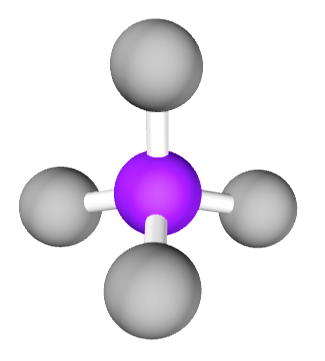 Tetrahedral structure (CH4)
Ionic Bonds (Non-directional)
- Result from electrostatic attraction in all directions
- Form crystal lattices based on ion packing
- Strength depends on charge and distance
- Example: NaCl cubic crystal structure

Key Takeaways:
- Bond type determines solubility through “like dissolves like”
- Ionic compounds have distinct properties from covalent
- Covalent bonds are directional, ionic bonds are non-directional
- Physical properties reflect bond strength and interactions

You may also like