
1.2. Identify symptoms, mode of transmission and cause of viral disease (AIDS)
〰️ Unit 2: HIV & AIDS – Cause, Transmission, and Symptoms
Chapter 1: Acellular Life
Student Learning Outcomes (SLO 1.2)
Learning Objectives
- Identify the specific causative agent of AIDS and its unique genomic and enzymatic profile.
- Explain the modes of transmission of the Human Immunodeficiency Virus (HIV).
- Detail the clinical progression of HIV infection into AIDS, focusing on the quantitative decline of $CD4^+$ T-lymphocytes.
- Recognize the concept of opportunistic infections as the primary cause of mortality in AIDS patients.
📺 Video Lesson: The Pathogenesis of HIV/AIDS
A detailed molecular explanation of how HIV targets the immune system, integrates into the host genome, and ultimately leads to immunodeficiency.
1. The Causative Agent: Human Immunodeficiency Virus (HIV)
AIDS (Acquired Immunodeficiency Syndrome) is a severe, life-threatening clinical condition caused by infection with HIV. HIV is a highly specialized enveloped virus belonging to the family Retroviridae. Its structure is defined by:
- Genome: Contains two identical strands of positive-sense single-stranded RNA ($+ssRNA$).
- Enzymes: Carries three essential pre-formed enzymes inside its capsid: Reverse Transcriptase (converts RNA to DNA), Integrase (splices viral DNA into the host genome), and Protease (cleaves large viral proteins into functional units).
- Surface Glycoproteins: The viral envelope is studded with glycoprotein complexes consisting of gp120 (the “head” that recognizes host receptors) and gp41 (the “stalk” that mediates membrane fusion).
2. Modes of Transmission
HIV cannot survive long outside the human body and is not transmitted through casual contact, air, water, or insect bites. Transmission requires the direct exchange of specific highly infectious bodily fluids—primarily blood, semen, vaginal secretions, and breast milk. The dominant modes include:
- Unprotected Sexual Contact: The most common route globally, facilitating viral entry through micro-abrasions in mucous membranes.
- Blood-to-Blood Contact: Sharing of contaminated intravenous needles among drug users, or unsterilized surgical/dental equipment. (Screening has made transmission via blood transfusions exceedingly rare).
- Vertical Transmission: From an infected mother to her child during pregnancy (transplacental), childbirth, or through breastfeeding.
3. Clinical Progression and Symptoms
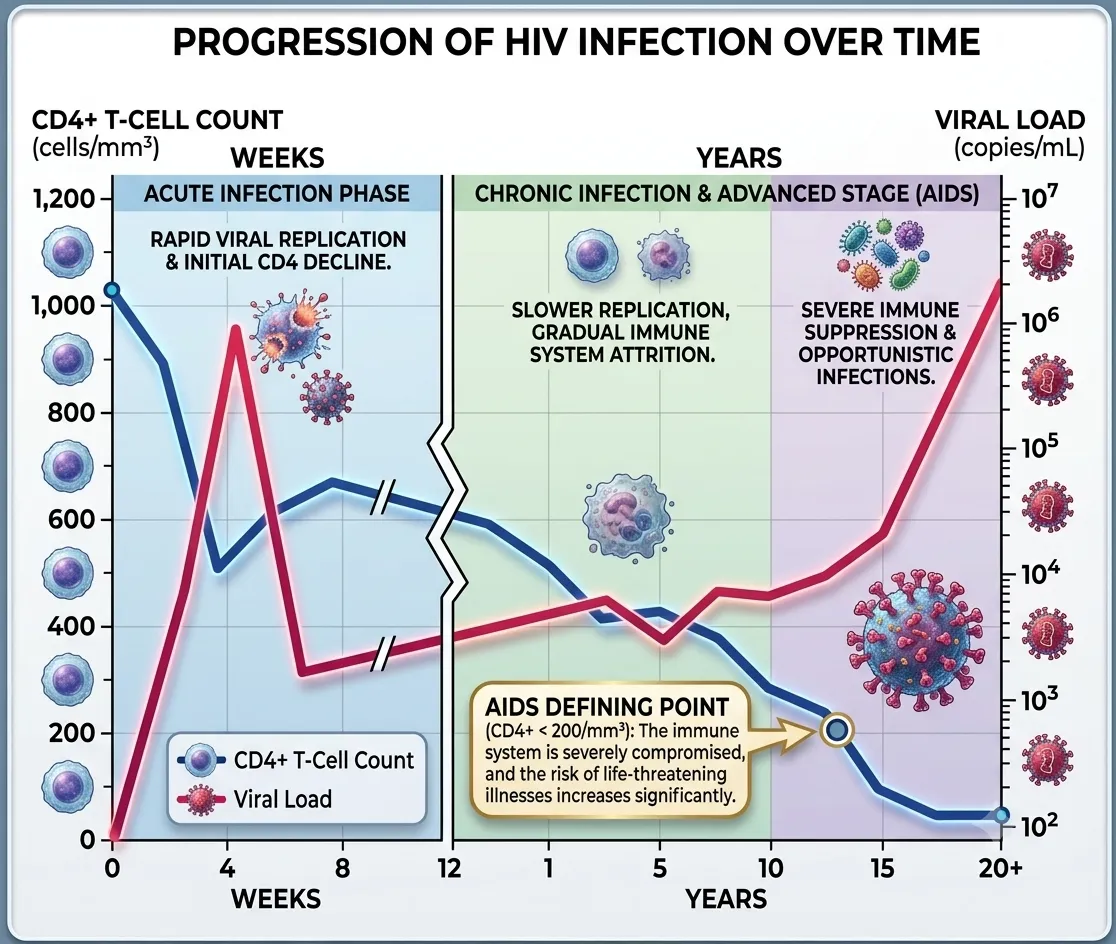
HIV exhibits a very specific tropism: it strictly targets and destroys immune cells bearing the CD4 receptor (primarily $CD4^+$ T-helper cells and macrophages). The disease progresses in three distinct phases:
- Acute HIV Infection: Occurs 2-4 weeks post-exposure. Patients often experience severe flu-like symptoms (fever, swollen lymph nodes, sore throat, rash). The viral load in the blood is extremely high, and the $CD4^+$ count drops sharply before partially rebounding.
- Clinical Latency (Chronic HIV): The virus establishes a provirus in the host DNA and replicates slowly. The patient is largely asymptomatic, but a steady, invisible war is raging in the lymph nodes. The $CD4^+$ T-cell count gradually declines over years.
- Progression to AIDS: The terminal phase. A patient is clinically diagnosed with AIDS when their $CD4^+$ T-cell count falls strictly below $200 \, \text{cells}/\mu\text{L}$ (normal is $500-1500$). The immune system collapses, leading to opportunistic infections—diseases that rarely affect healthy individuals, such as Pneumocystis jirovecii pneumonia, Tuberculosis, and Kaposi’s sarcoma (a rare vascular cancer). These secondary infections are the actual cause of death.
🎯 MDCAT Exam Insights
- Receptor Mechanics: HIV binding is a two-step process. The viral gp120 must first bind to the primary CD4 receptor on the T-helper cell. Crucially, it must then bind to a co-receptor (either CCR5 or CXCR4) to initiate entry. Mutations in the CCR5 gene (like CCR5-delta32) confer natural immunity to HIV!
- Provirus Concept: Once reverse transcriptase forms viral dsDNA, Integrase permanently inserts it into the host’s chromosome. This integrated viral DNA is called a provirus, explaining why HIV cannot be entirely cured—it becomes a permanent part of the host cell’s genetic code.
📝 Concept Check
1. The clinical diagnosis of AIDS (as opposed to being merely HIV-positive) is definitively established when the patient’s immune system crosses which specific quantitative threshold?
A $CD4^+$ T-lymphocyte count falling below $200 \, \text{cells}/\mu\text{L}$.
A rapid increase in the production of mature B-lymphocytes.
A viral load exceeding $10,000$ RNA copies per mL of plasma.
Check Answer
Explanation: HIV infection is a spectrum. The term “AIDS” specifically refers to the final, most severe stage of the disease, which is strictly defined by the CDC as a $CD4^+$ count below $200 \, \text{cells}/\mu\text{L}$, leaving the patient vulnerable to severe opportunistic infections.
2. The high mutation rate of HIV, which makes it incredibly difficult to develop a permanent vaccine, is primarily attributed to the error-prone nature of which viral enzyme?
Protease
Reverse Transcriptase
RNA Polymerase II
Check Answer
Explanation: Reverse transcriptase copies the viral RNA into DNA. Unlike cellular DNA polymerases, reverse transcriptase lacks “proofreading” ability, meaning it makes frequent copying errors (mutations). This causes the viral antigens to change constantly.
3. To successfully infect a host macrophage, HIV must bind to both a primary receptor and a co-receptor. Which of the following pairs correctly identifies these molecules on the host cell surface?
gp120 and gp41
CD4 and CXCR4 or CCR5
MHC Class II and CD4
Check Answer
Explanation: The primary target is the CD4 receptor on T-helper cells and macrophages. However, binding to CD4 alone is insufficient for viral entry; the virus must also engage a co-receptor, typically CCR5 or CXCR4, to trigger the membrane fusion process.
➡ Coming Next
Chapter 2, Unit 1: Cellular Respiration of Proteins, Fats, and Glucose
⏱️