
1.3 Exercise: Classification and Acellular Life Quiz-1
1. Which of the following represents the correct hierarchical order of biological classification from most inclusive to most specific?
Kingdom, Class, Phylum, Family, Order, Genus, Species
Species, Genus, Family, Order, Class, Phylum, Kingdom
Phylum, Kingdom, Order, Class, Genus, Family, Species
Check Answer
Explanation: This follows the standard taxonomic hierarchy established in biological classification (often remembered by the mnemonic: King Philip Came Over For Good Soup).
2. The modification of Whittaker’s five-kingdom system by Margulis and Schwartz was primarily based on the inclusion of:
Genetics and cytology
The discovery of new viruses
Geographical distribution
Check Answer
Explanation: Margulis and Schwartz refined the system by considering cellular structure (cytology) and genetic data alongside Whittaker’s original criteria.
3. Based on the diagram of a bacteriophage, the function of the tail fibers is to: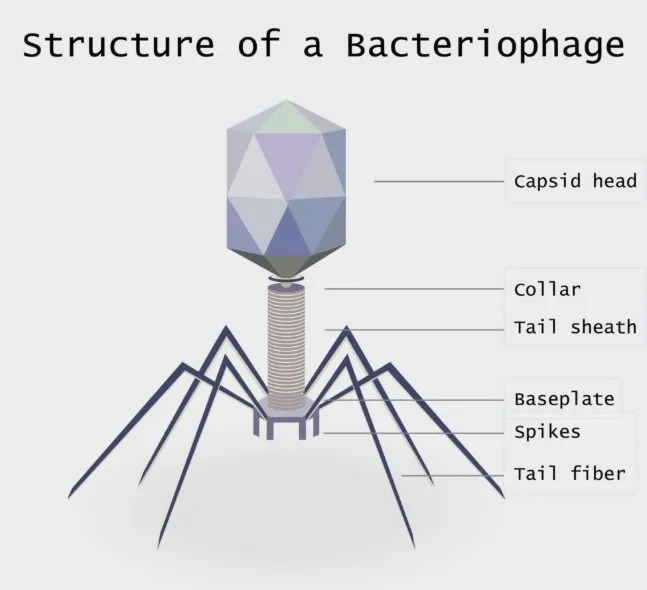
Provide energy for movement
Attach the virus to specific receptors on the host cell
Replicate the viral DNA
Check Answer
Explanation: Tail fibers are specialized structures that allow the phage to anchor itself to the bacterial surface before injection of genetic material.
4. In binomial nomenclature, which of the following is the correct way to write the scientific name for a human?
homo sapiens
Homo sapiens
Homo Sapiens
Check Answer
Explanation: The Genus name must be capitalized, the species name lowercase, and both must be italicized (or underlined if handwritten).
5. A viral life cycle that results in the immediate destruction of the host cell is known as the:
Lytic cycle
Biphasic cycle
Prophage cycle
Check Answer
Explanation: In the lytic cycle, the virus takes over the host’s machinery to produce new virions and eventually bursts (lyses) the cell.
6. Which of the following acellular agents consists only of misfolded infectious proteins and lacks nucleic acids?
Prions
Bacteriophages
Retroviruses
Check Answer
Explanation: Prions are unique infectious particles composed entirely of protein, causing diseases like Mad Cow Disease.
7. The classification of viruses into ‘Phytophaginae’ and ‘Zoophaginae’ is based on their:
Host organism
Capsid shape
Method of replication
Check Answer
Explanation: Phytophaginae infect plants, while Zoophaginae infect animals.
8. Hepatitis is a viral disease that primarily targets which human organ?
Brain
Liver
Kidneys
Check Answer
Explanation: Hepatitis causes inflammation of the liver, often resulting in jaundice.
9. Reverse transcriptase is an enzyme found in which group of viruses?
Retroviruses
Bacteriophages
Adenoviruses
Check Answer
Explanation: Retroviruses (like HIV) use reverse transcriptase to convert their RNA genome into DNA within the host.
10. In the five-kingdom system, which kingdom contains all prokaryotic organisms?
Fungi
Monera
Animalia
Check Answer
Explanation: Kingdom Monera is unique in the five-kingdom system as it is composed exclusively of prokaryotes (bacteria and cyanobacteria).
11. In the lysogenic cycle, the viral DNA integrated into the bacterial chromosome is referred to as a: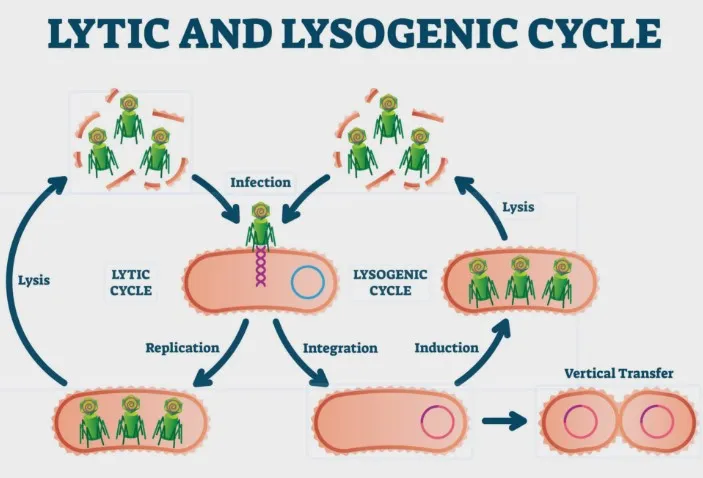
Virion
Prophage
Plasmid
Check Answer
Explanation: A prophage is the latent form of a phage, where its DNA is incorporated into the host’s genetic material without killing the host.
12. Which of the following is an infectious RNA molecule that lacks a protein coat?
Prion
Virusoid
Retrovirus
Check Answer
Explanation: Viroids are the smallest known pathogens, consisting of naked, circular, single-stranded RNA, mostly causing plant diseases.
13. The Tobacco Mosaic Virus (TMV) is characterized by having which type of symmetry?
Helical
Complex
Spherical
Check Answer
Explanation: TMV consists of a helical arrangement of capsomeres around a central RNA strand, forming a rod-like shape.
14. Organisms that share a common evolutionary origin but have different functions are studied under:
Homology
Cytology
Biochemistry
Check Answer
Explanation: Homology refers to similarity in structure due to common ancestry, a key evidence used in biological classification.
15. Which viral disease is primarily transmitted through contaminated food or water (fecal-oral route)?
AIDS
Bird Flu
Zika
Check Answer
Explanation: Poliovirus is primarily spread through the fecal-oral route, making sanitation a key factor in its prevention.
16. The binomial system of nomenclature was first introduced by:
Carolus Linnaeus
Lynn Margulis
Aristotle
Check Answer
Explanation: Carolus Linnaeus, the father of taxonomy, introduced the two-part naming system for species in the 18th century.
17. What is the status of viruses in the five-kingdom system of classification?
They are in Kingdom Protista
They are excluded from the system
They form a separate sixth kingdom
Check Answer
Explanation: Viruses are acellular and do not meet the definition of living organisms used in Whittaker’s five-kingdom classification.
18. If two organisms belong to the same ‘Family’, they must also belong to the same:
Species
Order
Sub-species
Check Answer
Explanation: Order is a higher level of classification than Family. If organisms share a Family, they must share all levels above it (Order, Class, Phylum, Kingdom).
19. Which viral disease is often associated with high fever and respiratory distress in birds and can occasionally jump to humans?
Bird Flu
Polio
AIDS
Check Answer
Explanation: Avian influenza (Bird Flu) is a viral infection that primarily affects birds but is a major public health concern for humans.
20. The protein coat of a virus is composed of subunits called:
Nucleotides
Amino acids
Viroids
Check Answer
Explanation: The capsid (protein coat) is built from individual protein subunits called capsomeres.
Found an error? Please report it in the comments below.