Stochiometry (Comprehensive)
Curriculum
1.1 Chemistry as a Quantitative Science: Significance in Daily Life

Chemistry is fundamentally a quantitative science. It’s not just about observing reactions; it’s about measuring, calculating, and predicting the outcomes of those reactions with precision. This quantitative nature is what makes chemistry so powerful and relevant to our daily lives.
1.1.1 Significance in Daily Life
1. Measurement and Composition:
Daily Examples:
Think about the food we eat. Nutrition labels provide quantitative information about the composition of food (e.g., grams of carbohydrates, fats, and proteins, milligrams of vitamins and minerals). This information is derived from chemical analyses.
Chemistry’s Role:
Chemistry provides the tools and techniques to determine these compositions accurately. Techniques like titration, spectroscopy, and chromatography are used to measure the amounts of different substances in a sample.
Significance:
This quantitative data allows us to make informed decisions about our diet, ensuring we get the nutrients we need and avoid harmful substances.
2. Stoichiometry and Proportions:
Daily Examples:
Cooking is a practical example of stoichiometry. Recipes provide specific ratios of ingredients (e.g., 2 cups of flour, 1 cup of water). These ratios are crucial for the desired outcome.
Chemistry’s Role:
Stoichiometry is the branch of chemistry that deals with the quantitative relationships between reactants and products in chemical reactions. It allows us to predict how much product will be formed from given amounts of reactants.
Significance:
In manufacturing, stoichiometry is essential for optimizing chemical reactions, minimizing waste, and maximizing yield. This is crucial for producing everything from pharmaceuticals to plastics.
3. Concentrations and Solutions:
Daily Examples:
 Cleaning products often specify concentrations (e.g., a bleach solution might be 5% sodium hypochlorite). This concentration determines the effectiveness of the cleaner.
Chemistry’s Role:
Chemistry provides ways to express concentration quantitatively (e.g., molarity, parts per million). It also provides methods for preparing solutions of desired concentrations.
Significance:
Precise concentrations are crucial in medicine (e.g., drug dosages), environmental science (e.g., measuring pollutants), and many industrial processes.
4. Rates of Reactions:
Daily Examples:
Food spoilage is a chemical process. The rate at which food spoils is affected by temperature and other factors. Understanding reaction rates helps us preserve food.
Chemistry’s Role:
Chemical kinetics is the study of reaction rates. It allows us to quantify how fast reactions occur and what factors influence them.
Significance:
Controlling reaction rates is essential in industrial chemistry (e.g., optimizing production), medicine (e.g., drug delivery), and many other fields.
5. Energy Changes:
Daily Examples:
Burning fuel (e.g., in a car engine) releases energy. The amount of energy released can be measured.
Chemistry’s Role:
Thermochemistry is the study of energy changes in chemical reactions. It allows us to quantify the amount of heat absorbed or released in a reaction.
Significance:
Understanding energy changes is crucial for developing new energy sources, designing efficient engines, and understanding chemical processes.
1.2 Mole and Avogadro’s Number
1.2.1a Mole
The mole is defined as the amount of a substance that contains as many elementary entities (atoms, molecules, ions, or other particles) as there are atoms in 12 grams of carbon-12. This quantity is numerically equivalent to the substance’s atomic mass, formula mass, or molecular mass when expressed in grams.

Examples:
-
- One mole of O (atom) = 16 g
- One mole of O₂ (molecule) = 32 g
- One mole of H₂O (molecule) = 18 g
- One mole of Na⁺ (ion) = 23 g
- One mole of NaCl (Formula unit) = 58.5 g
1.2.1b Avogadro’s Number
Avogadro’s number represents the number of elementary entities (atoms, molecules, ions, or other particles) present within one mole of a substance. This constant has been experimentally determined to be approximately 6.022 × 10²³. Therefore, one mole of any substance contains 6.022 × 10²³ particles. Under standard temperature and pressure (STP), one mole of any ideal gas occupies a volume of 22.414 cubic decimeters (dm³).

Example:
Consider the following reaction.
2H₂(g) + O₂(g) → 2H₂O(g)
This reaction can be interpreted on a molecular level. It means that 2 × (6.022 × 10²³) molecules of hydrogen (H₂) react with 6.022 × 10²³ molecules of oxygen (O₂) to produce 2 × (6.022 × 10²³) molecules of water (H₂O).
1.2.2 Relating the Mole and Avogadro’s Number:
The mole concept provides a convenient way to work with chemical quantities. Because atoms and molecules are so tiny, it’s impractical to count them individually. The mole allows us to group these particles into manageable quantities.
1 mole of a substance = 6.022 x 10²³ particles of that substance
This relationship is crucial for calculations:
-
- 1.008 g of hydrogen = 1 mole of hydrogen (H) = 6.022 x 10²³ atoms of H
- 23 g of sodium = 1 mole of sodium (Na) = 6.022 x 10²³ atoms of Na
- 18 g of H₂O = 1 mole of water (H₂O) = 6.022 x 10²³ molecules of water (H₂O)
Notice the connection: the mass in grams that corresponds to one mole is numerically equal to the atomic or molecular mass expressed in amu.
1.2.3 Calculating Chemical Species/Particles:
To calculate the number of chemical species (atoms, molecules, or ions), use the following formulas:
Number of atoms of an element = 
Number of molecules of a compound =
For ions, consider their mass and charge when performing calculations.
Example 1: 18 g of water (H₂O)
Number of H₂O molecules = 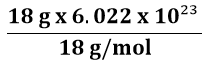 = 6.022 x 10²³ molecules of H₂O
Number of H atoms = x 2 = 2 x 6.022 x 10²³ atoms of H (Note the x2 because there are 2 H atoms in each water molecule)
Number of O atoms = = 6.022 x 10²³ atoms of O
Example 2: 20g of Sodium Chloride (NaCl)
a. Finding Atoms:
-
-
- Number of Na atoms:
-
Start with the given mass: 20g NaCl
Convert grams to moles: Divide by the molar mass of NaCl (58.44 g/mol). This tells you how many moles of NaCl you have.
Convert moles to formula units: Multiply by Avogadro’s number (6.022 x 10²³ formula units/mol). This tells you how many formula units (since NaCl is ionic) of NaCl you have.
Account for atoms per formula unit: Multiply by 1 Na atom/NaCl because there’s one sodium atom in each formula unit of NaCl.
Result:
 = 2.06 x 10²³ Na atoms
-
-
- Number of Cl atoms:
-
The process is identical, except we multiply by 1 Cl atom/NaCl:
 = 2.06 x 10²³ Cl atoms
-
-
- Total atoms:
- Total atoms:
-
Add the number of Na atoms and Cl atoms: 2.06 x 10²³ + 2.06 x 10²³ = 4.12 x 10²³ atoms
b. Molecules (Formula Units):
Since NaCl is ionic, we use the term “formula units” instead of molecules. The calculation is the same as the step to find the number of Na atoms or Cl atoms (before multiplying by 1 atom/formula unit):
(20g NaCl x 6.022×10²³ formula units/mol) / 58.44 g/mol = 2.06 x 10²³ formula units
c. Moles:
Moles of NaCl:
Divide the given mass (20g) by the molar mass of NaCl (58.44 g/mol):
20g NaCl / 58.44 g/mol = 0.342 moles
d. Ions:
Number of Na⁺ ions:
In one formula unit of NaCl, there is one Na⁺ ion. Therefore, the number of Na⁺ ions is the same as the number of Na atoms (or formula units): 2.06 x 10²³ ions
Number of Cl⁻ ions:
Similarly, the number of Cl⁻ ions is the same as the number of Cl atoms: 2.06 x 10²³ ions
e. Protons:
Protons in Na⁺:
Sodium’s atomic number is 11, meaning a neutral sodium atom has 11 protons. Since Na is +1 charged, it still has 11 protons (protons don’t change).
Protons in Cl⁻:
Chlorine’s atomic number is 17. A chloride ion (Cl⁻) still has 17 protons.
Total Protons:
Multiply the number of Na⁺ ions by the protons per Na⁺ ion, and do the same for Cl⁻, then add the results:
(2.06 x 10²³ Na⁺ ions x 11 protons/Na⁺) + (2.06 x 10²³ Cl⁻ ions x 17 protons/Cl⁻) = 5.77 x 10²⁴ protons
f. Neutrons:
Neutrons in Na:
The most common isotope of sodium has a mass number of 23. Neutrons = Mass Number – Atomic Number = 23 – 11 = 12 neutrons.
Neutrons in Cl:
The most common isotope of chlorine has a mass number of 35. Neutrons = 35 – 17 = 18 neutrons.
Total Neutrons:
(2.06 x 10²³ Na⁺ ions x 12 neutrons/Na⁺) + (2.06 x 10²³ Cl⁻ ions x 18 neutrons/Cl⁻) = 6.20 x 10²⁴ neutrons
g. Electrons:
Electrons in Na⁺: A neutral sodium atom has 11 electrons. A Na⁺ ion has lost one electron, so it has 11 – 1 = 10 electrons.
Electrons in Cl⁻: A neutral chlorine atom has 17 electrons. A Cl⁻ ion has gained one electron, so it has 17 + 1 = 18 electrons.
Total Electrons: (2.06 x 10²³ Na⁺ ions x 10 electrons/Na⁺) + (2.06 x 10²³ Cl⁻ ions x 18 electrons/Cl⁻) = 5.77 x 10²⁴ electrons
Ammonia reacts with oxygen according to the following equation:
4NH₃(g) + 5O₂(g) → 4NO(g) + 6H₂O(g)
If 2.00 moles of ammonia are reacted with excess oxygen, calculate:
(a) How many moles of oxygen are used?
(b) How many moles of nitrogen monoxide (NO) are produced?
Solution
(a) Moles of Oxygen Consumed:
Moles of ammonia (NH₃) = 2.00 moles
Moles of oxygen (O₂) = ?
According to the balanced chemical equation:
4 moles of NH₃ = 5 moles of O₂
1 mole of NH₃ = 5/4 moles of O₂
2.00 moles of NH₃ = (2.00 × 5) / 4 moles of O₂
= 2.50 moles of O₂
So, the number of moles of O₂ consumed = 2.50 moles
(b) Moles of Nitrogen Monoxide (NO) Produced:
Number of moles of NH₃ = 2.00 moles
Number of moles of NO = ?
According to the balanced chemical equation:
4 moles of NH₃ = 4 moles of NO
1 mole of NH₃ = 4/4 moles of NO
2.00 moles of NH₃ = (2.00 × 4) / 4 moles of NO
= 2.00 moles of NO
So, the number of moles of NO produced = 2.00 moles
Stoichiometry: Quantitative Relationships in Chemical Reactions
Balanced chemical equations are essential for stoichiometric calculations. They provide the mole ratios of reactants and products, enabling us to determine how much of each substance is involved in a reaction.
Key Concepts:
- Mole (mol): A unit of amount. One mole contains 6.022 x 10²³ representative particles (atoms, molecules, ions, etc.). This is Avogadro’s number (Nᴀ).
- Molar Mass: The mass of one mole of a substance, numerically equal to its atomic or molecular mass expressed in grams.
- Molar Volume: At Standard Temperature and Pressure (STP – 0°C and 1 atm), one mole of any ideal gas occupies 22.4 liters (L). At Room Temperature and Pressure (RTP – approximately 25°C and 1 atm), the molar volume is often considered 24.0 L. Always confirm the temperature and pressure conditions given in the problem. Remember, molar volume calculations only apply to gases.
- Balanced Chemical Equation: Represents the correct mole ratios of reactants and products, adhering to the law of conservation of mass. The coefficients in front of the chemical formulas represent these mole ratios.
Relating Moles, Mass, and Molar Mass:
The atomic mass, formula mass, and molecular weight of a substance expressed in grams are equal to one mole of that substance. This crucial relationship connects mass (grams) to moles and vice-versa.
- 1 mole of O atoms = 16 g
- 1 mole of O₂ molecules = 32 g
- 1 mole of H₂O molecules = 18 g
- 1 mole of Na⁺ ions = 23 g
- 1 mole of NaCl formula units = 58.5 g
Molar Volume (Vm):
One mole of any gas at standard temperature and pressure (STP) occupies a volume of 22.414 dm³ (or liters). This is called the molar volume. This relationship is crucial for converting between the mass of a gas at STP and its volume.
22.414 dm³ of any gas at STP = 1 mole = 6.022 x 10²³ molecules
Stoichiometric Calculations and Mole Ratio:
A balanced chemical equation provides quantitative information:
- Mole ratios: The coefficients in a balanced equation represent mole ratios. For example, in 2H₂(g) + O₂(g) → 2H₂O(g), 2 moles of H₂ react with 1 mole of O₂ to produce 2 moles of H₂O.
- Molecular ratios: These ratios also reflect the relative numbers of molecules involved.
- Mass relationships: The equation can be used to calculate the masses of reactants and products (mass-mass relationship).
- Volume relationships (at STP): The equation can be used to calculate the volumes of gases involved in the reaction (mass-volume relationship).
Types of Stoichiometric Calculations:
Using a balanced chemical equation, we can perform several types of calculations:
-
Mass-Mass Relationship: If we are given the mass of one substance, we can calculate the mass of the other substances involved in the chemical reaction.1
-
Mass-Mole Relationship or Mole-Mass Relationship: If we are given the mass of one substance, we can calculate the moles of other substance and vice-versa.
-
Mass-Volume2 Relationship: If we are given the mass of one substance, we can calculate the volume of the other substances3 (gases) and vice-versa. Similarly, mole-mole calculations can also be performed.
a. Interacting Moles (Mole-Mole Calculations):
Concept: The coefficients in a balanced chemical equation represent the mole ratio of the reactants and products. We use this ratio to convert between moles of one substance and moles of another substance involved in the reaction.
Example 1:
Consider the reaction: N₂(g) + 3H₂(g) → 2NH₃(g)
If we have 2 moles of N₂, how many moles of H₂ are required to react completely?
- Mole Ratio: From the balanced equation, the mole ratio of N₂ to H₂ is 1:3. This means that 1 mole of N₂ reacts with 3 moles of H₂.
- Moles of H₂: Use the mole ratio to calculate the moles of H₂: 2 moles N₂ x (3 moles H₂ / 1 mole N₂) = 6 moles H₂
Example 2:
For the same reaction, if we have 4 moles of H₂, how many moles of NH₃ will be produced?
- Mole Ratio: From the balanced equation, the mole ratio of H₂ to NH₃ is 3:2.
- Moles of NH₃: Use the mole ratio: 4 moles H₂ x (2 moles NH₃ / 3 moles H₂) = 2.67 moles NH₃ (approximately)
Example 3:
Consider the reaction: 2KClO₃(s) → 2KCl(s) + 3O₂(g)
If 0.5 moles of KClO₃ decompose, how many moles of O₂ are produced?
- Mole Ratio: The mole ratio of KClO₃ to O₂ is 2:3.
- Moles of O₂: 0.5 moles KClO₃ x (3 moles O₂ / 2 moles KClO₃) = 0.75 moles O₂
b. Representative Particles:
Concept: Avogadro’s number (6.022 x 10²³) allows us to convert between moles and the number of representative particles (atoms, molecules, ions, etc.).
Example 4 (Continuing from Example 1):
If we have 2 moles of N₂, how many molecules of NH₃ will be produced?
- Moles of NH₃ (already calculated): 4 moles NH₃ (from Example 2, using the appropriate mole ratio)
- Molecules of NH₃: Multiply the moles of NH₃ by Avogadro’s number: 4 moles NH₃ x 6.022 x 10²³ molecules/mol = 2.4088 x 10²⁴ molecules NH₃
Example 5:
How many atoms are present in 0.5 moles of oxygen gas (O₂)?
- Molecules of O₂: 0.5 moles O₂ x 6.022 x 10²³ molecules/mol = 3.011 x 10²³ molecules O₂
- Atoms of O: Since each O₂ molecule has two oxygen atoms, multiply by 2: 3.011 x 10²³ molecules O₂ x 2 atoms O/molecule O₂ = 6.022 x 10²³ atoms O
Example 6:
How many ions are present in 1 mole of NaCl?
- Ions in NaCl: NaCl is composed of one Na⁺ ion and one Cl⁻ ion, so there are two ions per formula unit.
- Total Ions: 1 mole NaCl x 6.022 x 10²³ formula units/mol x 2 ions/formula unit = 1.2044 x 10²⁴ ions
c. Masses and Volumes of Gases at STP/RTP:
Concept: The molar volume of a gas (22.4 L at STP, 24.0 L at RTP) allows us to convert between moles of gas and volume. Remember that these calculations only apply to gases.
Example 7:
What is the volume of 1 mole of nitrogen gas (N₂) at STP?
- Volume at STP: 1 mole N₂ x 22.4 L/mol = 22.4 L N₂
Concept: We can combine the concepts of molar mass and molar volume to convert between volume of gas and mass of substance.
Example 8:
What mass of carbon dioxide (CO₂) is present in 44.8 L of CO₂ gas at STP?
- Moles of CO₂: 44.8 L CO₂ / 22.4 L/mol = 2 moles CO₂
- Mass of CO₂: 2 moles CO₂ x 44 g/mol CO₂ = 88 g CO₂ (Molar mass of CO₂ is approximately 44 g/mol)
Example 9:
What is the volume of 2 moles of hydrogen gas (H₂) at RTP?
- Volume at RTP: 2 moles H₂ x 24.0 L/mol = 48.0 L H₂
Example 10:
If 10 g of nitrogen gas (N₂) are present at STP, what is its volume?
- Moles of N₂: 10 g N₂ / 28 g/mol N₂ ≈ 0.357 moles N₂ (Molar mass of N₂ is approximately 28 g/mol)
- Volume at STP: 0.357 moles N₂ x 22.4 L/mol ≈ 8.0 L N₂
d. Mass-Mass Relationship:
Concept: Relate the masses of reactants and products using mole ratios and molar masses.
Example 11:
What mass of iron(III) oxide (Fe₂O₃) is produced when 56 g of iron (Fe) reacts completely with oxygen?
4Fe(s) + 3O₂(g) → 2Fe₂O₃(s)
- Moles of Fe: 56 g Fe / 55.85 g/mol Fe ≈ 1 mole Fe (Molar mass of Fe is approximately 55.85 g/mol)
- Mole Ratio: From the balanced equation, 4 moles of Fe produce 2 moles of Fe₂O₃.
- Moles of Fe₂O₃: 1 mole Fe x (2 moles Fe₂O₃ / 4 moles Fe) = 0.5 moles Fe₂O₃
- Mass of Fe₂O₃: 0.5 moles Fe₂O₃ x 159.7 g/mol Fe₂O₃ ≈ 79.85 g Fe₂O₃ (Molar mass of Fe₂O₃ is approximately 159.7 g/mol)
Example 12:
If 100 g of methane (CH₄) is burned completely, what mass of carbon dioxide (CO₂) is produced?
CH₄(g) + 2O₂(g) → CO₂(g) + 2H₂O(l)
- Moles of CH₄: 100 g CH₄ / 16.04 g/mol CH₄ ≈ 6.23 moles CH₄ (Molar mass of CH₄ is approximately 16.04 g/mol)
- Mole Ratio: From the balanced equation, 1 mole of CH₄ produces 1 mole of CO₂.
- Moles of CO₂: 6.23 moles CH₄ x (1 mole CO₂ / 1 mole CH₄) = 6.23 moles CO₂
- Mass of CO₂: 6.23 moles CO₂ x 44.01 g/mol CO₂ ≈ 274.2 g CO₂ (Molar mass of CO₂ is approximately 44.01 g/mol)
e. Ions in Solution:
Concept: When ionic compounds dissolve, they dissociate into ions. The mole concept applies to these ions as well.
Example 13:
20 g of sulfuric acid (H₂SO₄) dissolves in water. Calculate (a) number of H₂SO₄ molecules, (b) number of H⁺ and SO₄²⁻ ions, and (c) mass of individual ions.
H₂SO₄ → 2H⁺ + SO₄²⁻
- Moles of H₂SO₄: 20 g H₂SO₄ / 98.016 g/mol H₂SO₄ ≈ 0.204 moles H₂SO₄
- Molecules of H₂SO₄: 0.204 moles x 6.022 x 10²³ molecules/mol ≈ 1.23 x 10²³ molecules
- H⁺ ions: 0.204 moles H₂SO₄ x 2 moles H⁺/mole H₂SO₄ x 6.022 x 10²³ ions/mol ≈ 2.46 x 10²³ ions
- SO₄²⁻ ions: 0.204 moles H₂SO₄ x 1 mole SO₄²⁻/mole H₂SO₄ x 6.022 x 10²³ ions/mol ≈ 1.23 x 10²³ ions
- Mass of H⁺: (2.46 x 10²³ ions / 6.022 x 10²³ ions/mol) x 1.008 g/mol ≈ 0.41 g
- Mass of SO₄²⁻: (1.23 x 10²³ ions / 6.022 x 10²³ ions/mol) x 96.06 g/mol ≈ 19.6 g
Gram Atom, Gram Molecule, Gram Formula, and Gram Ion:
- Gram atom: The atomic mass of an element expressed in grams is called one gram atom or one mole of that element. Different elements have different masses for one gram atom.
- Gram molecule: The molecular mass of a molecular substance expressed in grams is called one gram molecule or one mole of that substance. Different molecular substances have different masses for one gram molecule.
- Gram formula: The formula unit mass of an ionic compound expressed in grams is called one gram formula or one mole of that substance.
- Gram ion: The ionic mass of an ionic species expressed in grams is called one gram ion or one mole of ions.
- The general term molar mass refers to the mass (in grams) of one mole of any substance (atoms, molecules, ions, or formula units).
Number of Moles and Mass:
Number of moles = Mass of substance (in grams) / Molar mass of substance
Examples:
- 0.1 g of sodium: Number of moles = 0.1 g / 23 g/mol = 0.0043 mol
- 0.1 kg of silicon: Number of moles = 100 g / 28.086 g/mol = 3.56 moles (Remember to convert kg to g)
- 10⁻³ moles of MgSO₄: Mass = 10⁻³ moles x 120 g/mol = 0.12 g
Important Notes:
- Units: Always include units in your calculations and final answers.
- Balanced Equations: Begin every stoichiometry problem with a balanced chemical equation. The coefficients are essential for determining mole ratios.
- Molar Mass: Be sure to use the correct molar mass for each substance.
- Molar Volume: Remember that molar volume calculations (22.4 L at STP, 24.0 L at RTP) apply only to gases.
- Significant Figures: Pay attention to significant figures in your calculations and final answers.
Solving Stoichiometry Problems Using Mole Ratios as Conversion Factors
Stoichiometry is the branch of chemistry that deals with the quantitative relationships between reactants and products in chemical reactions. A key skill in stoichiometry is using mole ratios derived from balanced chemical equations as conversion factors to solve problems. This section focuses specifically on this technique.
Mole Ratios as Conversion Factors
A balanced chemical equation provides the mole ratio between any two substances involved in the reaction. These mole ratios can be used as conversion factors to calculate the amount (in moles or mass) of one substance if you know the amount of another.
General Steps for Solving Stoichiometry Problems:
- Write a balanced chemical equation: This is the foundation. The coefficients provide the mole ratios.
For example:
2H₂(g) + O₂(g) → 2H₂O(g)
This tells us 2 moles of H₂ react with 1 mole of O₂ to produce 2 moles of H₂O.
- Identify the known and unknown: What information are you given (known)? What are you trying to find (unknown)?
- Convert given quantities to moles:
- Convert given quantities (grams, volumes, etc.) to moles using molar masses.
- Apply the mole ratio as a conversion factor to find moles of the desired substance.
- Convert back to desired units (grams, volumes) if needed.
- Use the mole ratio as a conversion factor: Multiply the moles of the known by the mole ratio (unknown/known) to find the moles of the unknown.
- Convert moles of unknown to desired units: If the question asks for mass, volume, or number of particles, convert the moles of the unknown to the desired units.
Example 1: Mole-Mole Calculation
Problem: How many moles of oxygen (O₂) are required to react completely with 4 moles of methane (CH₄) in the following reaction?
CH₄(g) + 2O₂(g) → CO₂(g) + 2H₂O(l)
Solution:
- Balanced Equation: The equation is already balanced.
- Known and Unknown: Known: 4 moles CH₄. Unknown: moles of O₂.
- Moles of Known: We already have the known in moles (4 moles CH₄).
- Mole Ratio: The balanced equation shows that 1 mole of CH₄ reacts with 2 moles of O₂. The mole ratio (O₂/CH₄) is 2/1.
- Moles of Unknown: 4 moles CH₄ x (2 moles O₂ / 1 mole CH₄) = 8 moles O₂
Answer: 8 moles of O₂ are required.
Example 2: Mass-Mass Calculation
Problem: What mass of carbon dioxide (CO₂) is produced when 16 g of methane (CH₄) is burned completely?
CH₄(g) + 2O₂(g) → CO₂(g) + 2H₂O(l)
Solution:
- Balanced Equation: The equation is already balanced.
- Known and Unknown: Known: 16 g CH₄. Unknown: mass of CO₂.
- Moles of Known: Convert grams of CH₄ to moles using its molar mass (16 g/mol): 16 g CH₄ / 16 g/mol CH₄ = 1 mole CH₄
- Mole Ratio: 1 mole CH₄ produces 1 mole CO₂ (ratio is 1/1).
- Moles of Unknown: 1 mole CH₄ x (1 mole CO₂ / 1 mole CH₄) = 1 mole CO₂
- Mass of Unknown: Convert moles of CO₂ to grams using its molar mass (44 g/mol): 1 mole CO₂ x 44 g/mol CO₂ = 44 g CO₂
Answer: 44 g of CO₂ is produced.
Problem: What mass of potassium sulfate (K₂SO₄) is produced when 14 g of potassium hydroxide (KOH) reacts with excess sulfuric acid (H₂SO₄)?
2KOH(aq) + H₂SO₄(aq) → K₂SO₄(aq) + 2H₂O(l)
Solution:
-
Balanced Equation: The equation is balanced.
-
Known and Unknown: Known: 14 g KOH. Unknown: mass of K₂SO₄.
-
Moles of KOH: Convert grams of KOH to moles using its molar mass (56 g/mol):
14 g KOH / 56 g/mol KOH = 0.25 moles KOH
-
Mole Ratio: From the balanced equation, 2 moles of KOH produce 1 mole of K₂SO₄. The mole ratio (K₂SO₄/KOH) is 1/2.
-
Moles of K₂SO₄: Use the mole ratio:
0.25 moles KOH x (1 mole K₂SO₄ / 2 moles KOH) = 0.125 moles K₂SO₄
-
Mass of K₂SO₄: Convert moles of K₂SO₄ to grams using its molar mass (174 g/mol):
0.125 moles K₂SO₄ x 174 g/mol K₂SO₄ = 21.75 g K₂SO₄
Answer: 21.75 g of K₂SO₄ is produced.
Example 3: Mass-Volume Calculation (at STP)
Problem: What volume of oxygen (O₂) at STP is required to react completely with 28 g of nitrogen (N₂) to produce nitrogen dioxide (NO₂)?
N₂(g) + 2O₂(g) → 2NO₂(g)
Solution:
- Balanced Equation: The equation is already balanced.
- Known and Unknown: Known: 28 g N₂. Unknown: volume of O₂ at STP.
- Moles of Known: Convert grams of N₂ to moles using its molar mass (28 g/mol): 28 g N₂ / 28 g/mol N₂ = 1 mole N₂
- Mole Ratio: 1 mole N₂ reacts with 2 moles O₂.
- Moles of Unknown: 1 mole N₂ x (2 moles O₂ / 1 mole N₂) = 2 moles O₂
- Volume of Unknown (at STP): Convert moles of O₂ to volume at STP using the molar volume (22.4 L/mol): 2 moles O₂ x 22.4 L/mol = 44.8 L O₂
Answer: 44.8 L of O₂ at STP is required.
Problem: What volume of hydrogen gas (H₂) at STP is produced when 24.3 g of magnesium (Mg) reacts with excess hydrochloric acid (HCl)?
Mg(s) + 2HCl(aq) → MgCl₂(aq) + H₂(g)
Solution:
-
Balanced Equation: The equation is balanced.
-
Known and Unknown: Known: 24.3 g Mg. Unknown: volume of H₂ at STP.
-
Moles of Mg: Convert grams of Mg to moles using its molar mass (24.3 g/mol):
24.3 g Mg / 24.3 g/mol Mg = 1 mole Mg
-
Mole Ratio: From the balanced equation, 1 mole of Mg produces 1 mole of H₂.
-
Moles of H₂:
1 mole Mg x (1 mole H₂ / 1 mole Mg) = 1 mole H₂
-
Volume of H₂ (at STP): Convert moles of H₂ to volume at STP using the molar volume (22.4 L/mol):
1 mole H₂ x 22.4 L/mol = 22.4 L H₂
Answer: 22.4 L of H₂ at STP is produced.
Example 4: Particles-Mass Calculation
Problem: How many grams of water (H₂O) are produced when 1.204 x 10²⁴ molecules of hydrogen gas (H₂) react completely with oxygen?
2H₂(g) + O₂(g) → 2H₂O(l)
Solution:
- Balanced Equation: The equation is already balanced.
- Known and Unknown: Known: 1.204 x 10²⁴ molecules H₂. Unknown: mass of H₂O.
- Moles of Known: Convert molecules of H₂ to moles using Avogadro’s number: 1.204 x 10²⁴ molecules H₂ / 6.022 x 10²³ molecules/mol = 2 moles H₂
- Mole Ratio: 2 moles H₂ produce 2 moles H₂O (ratio is 1:1).
- Moles of Unknown: 2 moles H₂ x (2 moles H₂O / 2 moles H₂) = 2 moles H₂O
- Mass of Unknown: Convert moles of H₂O to grams using its molar mass (18 g/mol): 2 moles H₂O x 18 g/mol H₂O = 36 g H₂O
Answer: 36 g of H₂O is produced.
Example 5: Mole to Mass Calculation
Problem: If 3 moles of nitrogen gas (N₂) react completely with hydrogen gas (H₂) to form ammonia (NH₃), what mass of ammonia is produced?
N₂(g) + 3H₂(g) → 2NH₃(g)
Solution:
-
Balanced Equation: The equation is balanced.
-
Known and Unknown: Known: 3 moles N₂. Unknown: mass of NH₃.
-
Moles of N₂: We already have the known in moles.
-
Mole Ratio: From the balanced equation, 1 mole of N₂ produces 2 moles of NH₃.
-
Moles of NH₃:
3 moles N₂ x (2 moles NH₃ / 1 mole N₂) = 6 moles NH₃
-
Mass of NH₃: Convert moles of NH₃ to grams using its molar mass (17 g/mol):
6 moles NH₃ x 17 g/mol NH₃ = 102 g NH₃
Answer: 102 g of NH₃ is produced.
Key Points:
- Always start with a balanced chemical equation.
- Clearly identify the known and unknown substances.
- Pay close attention to the mole ratios from the balanced equation.
- Use appropriate conversion factors (molar mass, molar volume, Avogadro’s number).
- Include units in your calculations and final answers.
Excess and Limiting Reagents
In chemical reactions, reactants are not always present in exact stoichiometric amounts. Often, one reactant is consumed completely, while others are left over. This section explores the concepts of limiting and excess reagents and their impact on product formation.
Deducing the Limiting Reagent
The limiting reagent is the reactant that is completely consumed in a chemical reaction. It determines the maximum amount of product that can be formed. The excess reagent is the reactant present in a greater quantity than necessary to react completely with the limiting reagent.
Identifying the Limiting Reagent:
- Convert to Moles: Calculate the number of moles of each reactant using their given masses and molar masses.
- Use Mole Ratios: Use the balanced chemical equation to determine the mole ratio between each reactant and a chosen product. Calculate the theoretical yield (in moles of product) that each reactant could produce if it were consumed entirely.
- Identify the Limiting Reagent: The reactant that produces the least amount of product is the limiting reagent.
Example 1:
Ammonia (NH₃) is prepared by heating a mixture of ammonium chloride (NH₄Cl) and calcium hydroxide (Ca(OH)₂):
2NH₄Cl(s) + Ca(OH)₂(s) → CaCl₂(s) + 2NH₃(g) + 2H₂O(l)
If a mixture containing 100 g of each solid is heated, which is the limiting reagent?
Solution:
-
Moles of NH₄Cl: 100 g NH₄Cl / 53.5 g/mol NH₄Cl ≈ 1.87 moles NH₄Cl
-
Moles of Ca(OH)₂: 100 g Ca(OH)₂ / 74 g/mol Ca(OH)₂ ≈ 1.35 moles Ca(OH)₂
-
Theoretical Yield of NH₃ from NH₄Cl:
- Mole Ratio: 2 moles NH₄Cl produce 2 moles NH₃ (1:1 ratio)
- Moles of NH₃: 1.87 moles NH₄Cl x (2 moles NH₃ / 2 moles NH₄Cl) = 1.87 moles NH₃
-
Theoretical Yield of NH₃ from Ca(OH)₂:
- Mole Ratio: 1 mole Ca(OH)₂ produces 2 moles NH₃
- Moles of NH₃: 1.35 moles Ca(OH)₂ x (2 moles NH₃ / 1 mole Ca(OH)₂) = 2.70 moles NH₃
-
Limiting Reagent: NH₄Cl produces less NH₃ (1.87 moles) than Ca(OH)₂ (2.70 moles). Therefore, NH₄Cl is the limiting reagent.
Calculating Product Yield and Excess Reagent
Once the limiting reagent is identified, its moles are used to calculate the maximum amount of product that can be formed (the theoretical yield). The amount of excess reagent remaining after the reaction can also be calculated.
Example 2 (Continuing Example 1):
(a) Calculate the mass of NH₃ produced. (b) Calculate the mass of unreacted Ca(OH)₂.
Solution:
(a) Mass of NH₃ produced:
- Moles of NH₃ (from limiting reagent): 1.87 moles NH₃ (calculated in Example 1)
- Mass of NH₃: 1.87 moles NH₃ x 17 g/mol NH₃ ≈ 31.79 g NH₃
(b) Mass of unreacted Ca(OH)₂:
-
Moles of Ca(OH)₂ reacted:
- Mole Ratio: 2 moles NH₄Cl react with 1 mole Ca(OH)₂.
- Moles of Ca(OH)₂: 1.87 moles NH₄Cl x (1 mole Ca(OH)₂ / 2 moles NH₄Cl) ≈ 0.935 moles Ca(OH)₂
-
Moles of Ca(OH)₂ remaining:
- Initial moles of Ca(OH)₂: 1.35 moles (calculated in Example 1)
- Moles remaining: 1.35 moles – 0.935 moles ≈ 0.415 moles
-
Mass of Ca(OH)₂ remaining: 0.415 moles Ca(OH)₂ x 74 g/mol Ca(OH)₂ ≈ 30.71 g Ca(OH)₂
Answers:
(a) Approximately 31.79 g of NH₃ is produced. (b) Approximately 30.71 g of Ca(OH)₂ remains unreacted.
Example 3:
If 10.0 g of hydrogen gas and 80.0 g of oxygen gas are mixed and allowed to react, what mass of water is formed?
2H₂(g) + O₂(g) → 2H₂O(l)
Solution:
-
Moles of H₂: 10.0 g H₂ / 2.02 g/mol H₂ ≈ 4.95 moles H₂
-
Moles of O₂: 80.0 g O₂ / 32.0 g/mol O₂ ≈ 2.50 moles O₂
-
Theoretical Yield from H₂:
- Mole Ratio: 2 moles H₂ produce 2 moles H₂O (1:1 ratio)
- Moles of H₂O: 4.95 moles H₂ x (2 moles H₂O / 2 moles H₂) = 4.95 moles H₂O
-
Theoretical Yield from O₂:
- Mole Ratio: 1 mole O₂ produces 2 moles H₂O
- Moles of H₂O: 2.50 moles O₂ x (2 moles H₂O / 1 mole O₂) = 5.00 moles H₂O
-
Limiting Reagent: H₂ is the limiting reagent.
-
Mass of H₂O formed: 4.95 moles H₂O x 18.02 g/mol H₂O ≈ 89.2 g H₂O
Answer: Approximately 89.2 g of water is formed.
Key Points:
- Limiting reactant dictates product yield.
- Excess reactant remains after the reaction.
- Calculations must be based on the limiting reactant.