
10.1. Associate inheritance with the laws of Mendel.
〰️ Unit 1: Mendelian Inheritance and the Law of Segregation
Chapter 10: Inheritance
Student Learning Outcomes (SLO 10.1)
Learning Objectives
- Define fundamental genetic terminology: allele, locus, genotype, phenotype, homozygous, and heterozygous.
- Explain Gregor Mendel’s experimental methodology using the garden pea (Pisum sativum).
- State and apply Mendel’s First Law: The Law of Segregation.
- Calculate genotypic and phenotypic probabilities using monohybrid crosses and Punnett squares.
- Determine the purpose and quantitative outcomes of a test cross.
📺 Video Lesson: Mendelian Genetics & Punnett Squares
Observe how mathematical probabilities accurately predict biological inheritance.
📺 Video Lesson: Mendelian Genetics & The Law of Segregation
An analytical walk-through of Mendel’s classic experiments, detailing how discrete units of inheritance separate during meiosis to create predictable phenotypic ratios.
1. The Foundation of Classical Genetics
Before the discovery of DNA or chromosomes, the Austrian monk Gregor Mendel (1822–1884) deciphered the fundamental laws of inheritance. He achieved this through rigorous, quantitative experiments utilizing the garden pea plant, Pisum sativum. Mendel chose this organism because it possesses distinct, easily observable traits (like flower color and seed shape), can strictly self-pollinate or be artificially cross-pollinated, and yields a large number of offspring for statistically significant data.
Before analyzing his laws, we must define the modern terminology that maps to Mendel’s “particulate factors”:
- Gene: The basic physical and functional unit of heredity, consisting of a specific sequence of DNA at a specific location (locus) on a chromosome.
- Allele: One of two or more alternative versions of a gene. For example, the gene for plant height has an allele for tallness ($T$) and an allele for dwarfness ($t$).
- Genotype: The actual genetic makeup or allelic combination of an organism (e.g., $TT$, $Tt$, or $tt$).
- Phenotype: The observable physical or biochemical expression of the genotype (e.g., being physically tall).
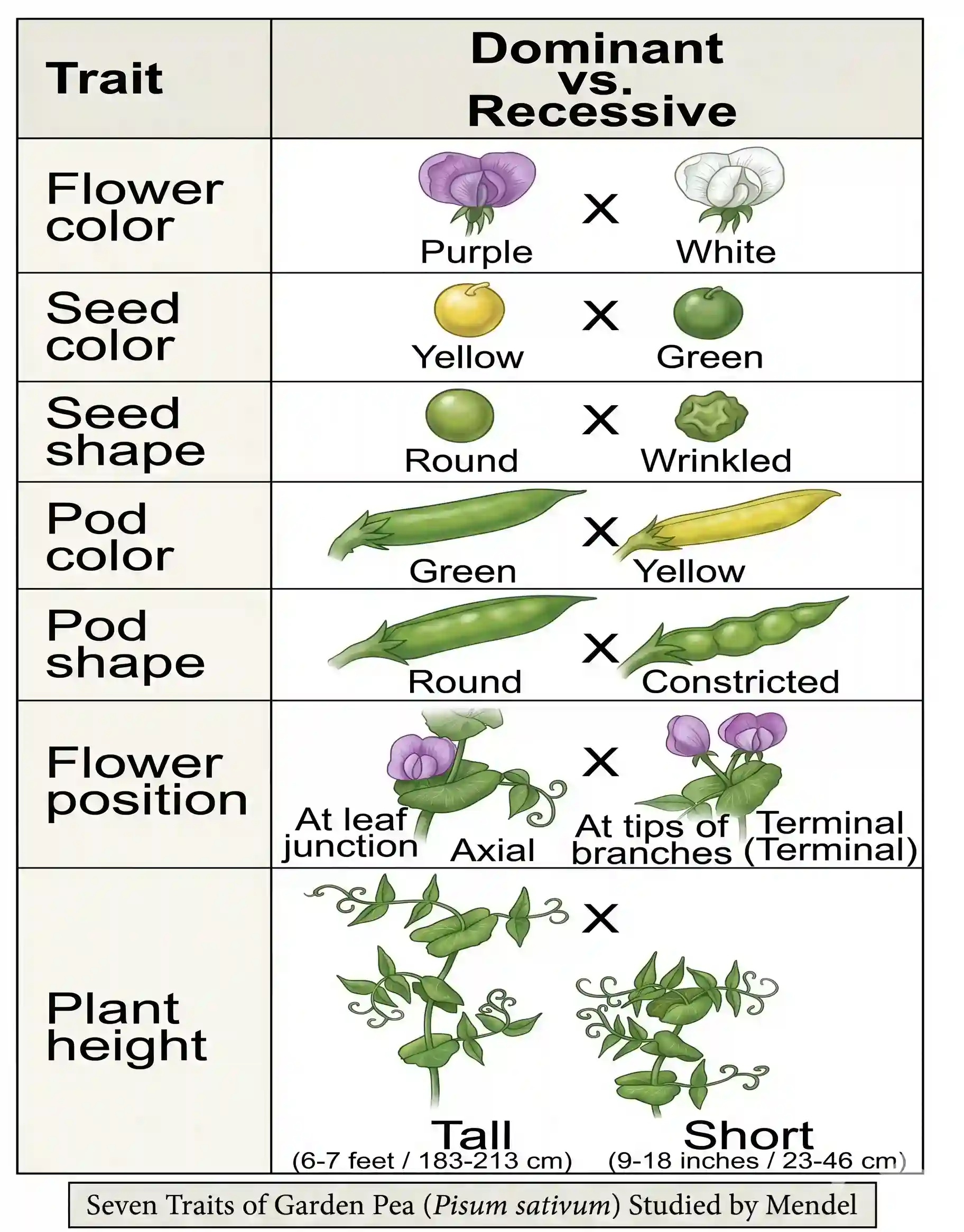 The Seven Discrete Traits of the Garden Pea (Pisum sativum) Studied by Gregor Mendel. This chart illustrates the contrasting dominant and recessive phenotypes for flower color, seed color and shape, pod color and shape, flower position, and overall plant height. These observations formed the basis for the laws of Mendelian inheritance.
2. Mendel’s First Law: The Law of Segregation
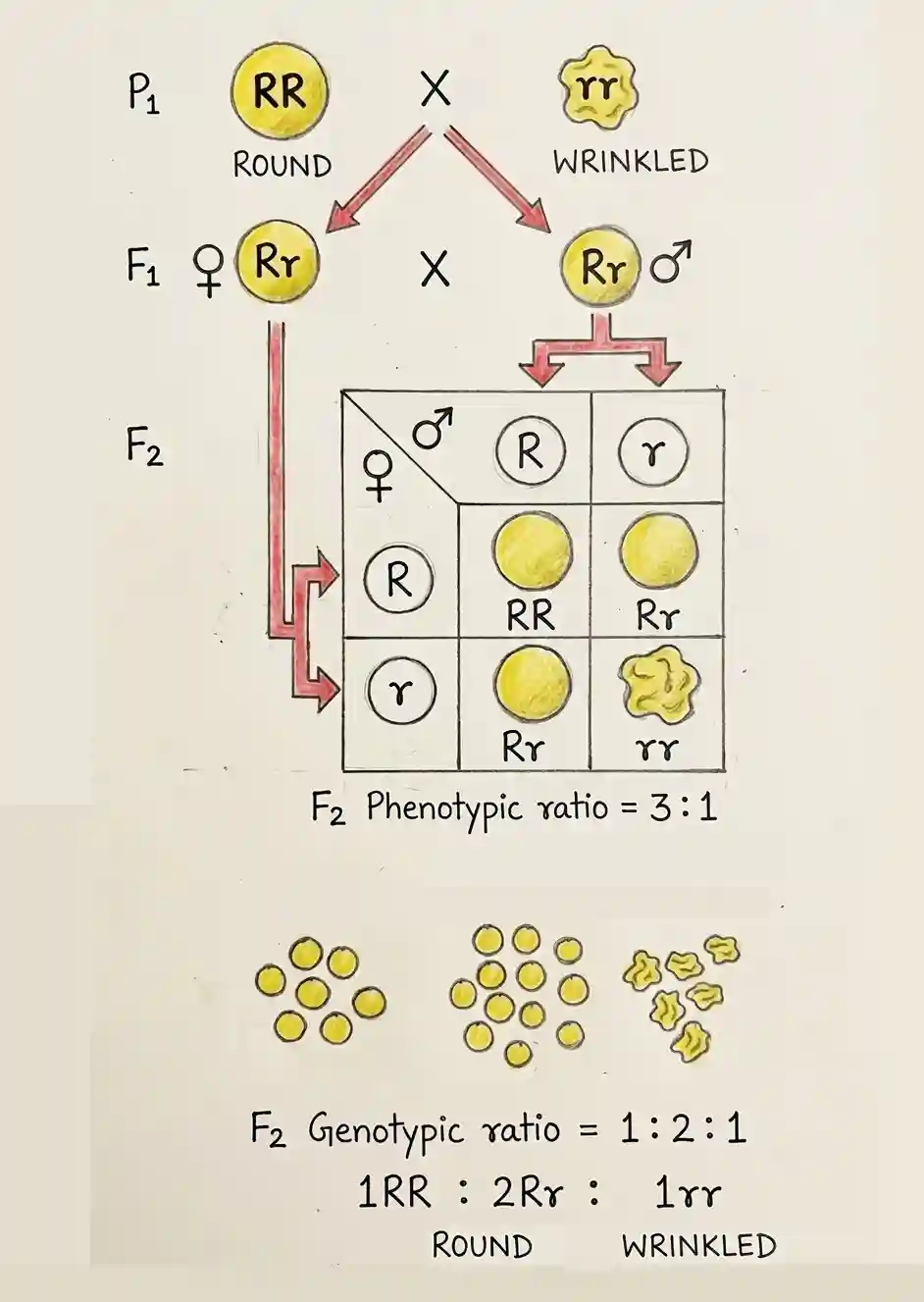
Mendel began by crossing true-breeding (pure) plants that differed in only a single trait—a monohybrid cross. For example, he crossed a true-breeding tall plant ($TT$) with a true-breeding dwarf plant ($tt$).
- P Generation (Parental): $TT \times tt$.
- $F_1$ Generation (First Filial): All offspring were $100\%$ tall ($Tt$). The dwarf trait completely disappeared. This led Mendel to deduce the Principle of Dominance—one allele completely masks the expression of another.
- $F_2$ Generation (Second Filial): Mendel allowed the $F_1$ plants to self-pollinate ($Tt \times Tt$). The dwarf trait mysteriously reappeared! The resulting ratio was consistently 3 tall plants to 1 dwarf plant.
This precise mathematical recurrence led to The Law of Segregation, which states: During the formation of gametes (meiosis), the two alleles for a heritable character segregate (separate) from each other so that each gamete carries only one allele for each gene.
| $F_1$ Cross: $Tt \times Tt$ (Tall $\times$ Tall) | ||
|---|---|---|
| Gametes | $T$ | $t$ |
| $T$ | $TT$ (Tall) | $Tt$ (Tall) |
| $t$ | $Tt$ (Tall) | $tt$ (Dwarf) |
$F_2$ Phenotypic Ratio = 3 Tall : 1 Dwarf | Genotypic Ratio = 1 $TT$ : 2 $Tt$ : 1 $tt$
3. The Law of Independent Assortment (Dihybrid Cross)
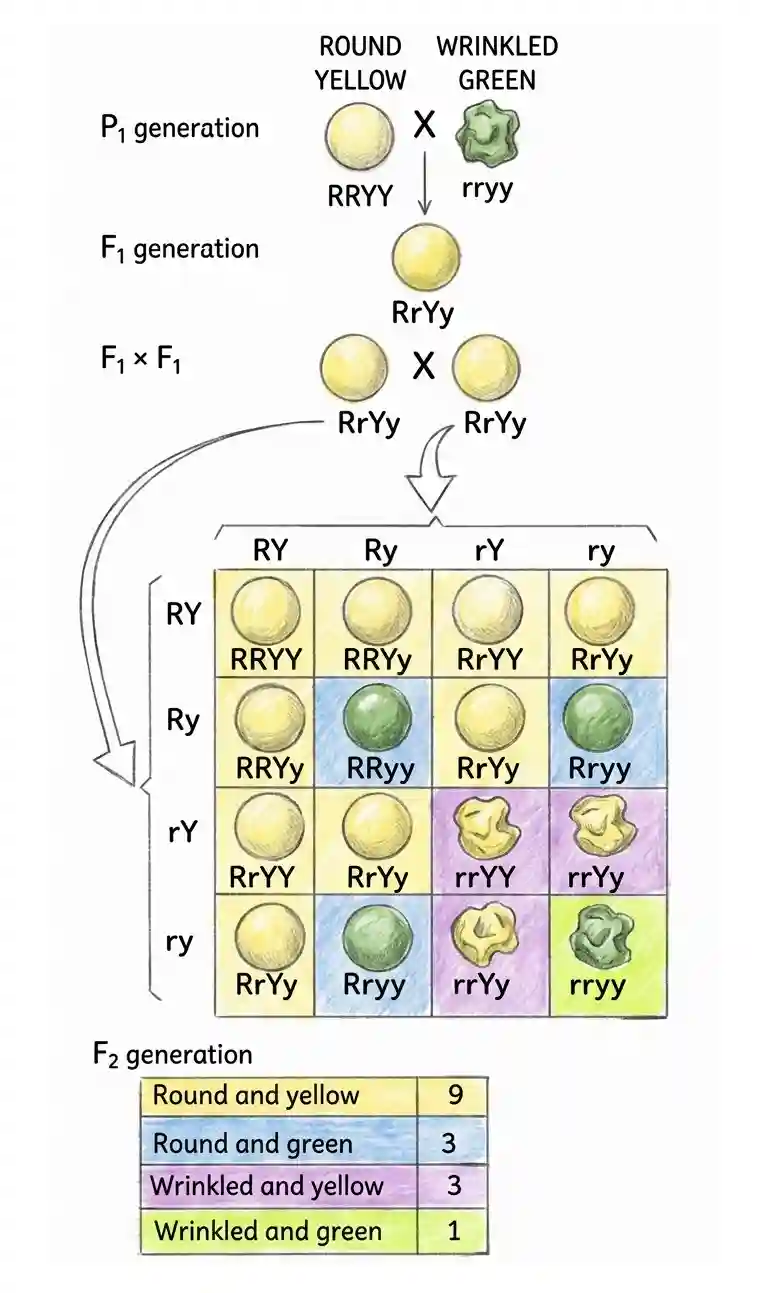
When two pairs of contrasting traits are followed simultaneously, the alleles of one gene pair assort into gametes entirely independently of the alleles of another gene pair. This occurs because non-homologous chromosomes align randomly at the metaphase plate during Meiosis I.
Example Cross: Seed Shape (Round $R$, Wrinkled $r$) and Seed Color (Yellow $Y$, Green $y$).
Crossing purebred Round-Yellow ($RRYY$) with Wrinkled-Green ($rryy$) yields an $F_1$ generation of 100% heterozygous Round-Yellow ($RrYy$).
9 : 3 : 3 : 1
(9 Round-Yellow : 3 Round-Green : 3 Wrinkled-Yellow : 1 Wrinkled-Green)
4. The Purpose and Method of a Test Cross
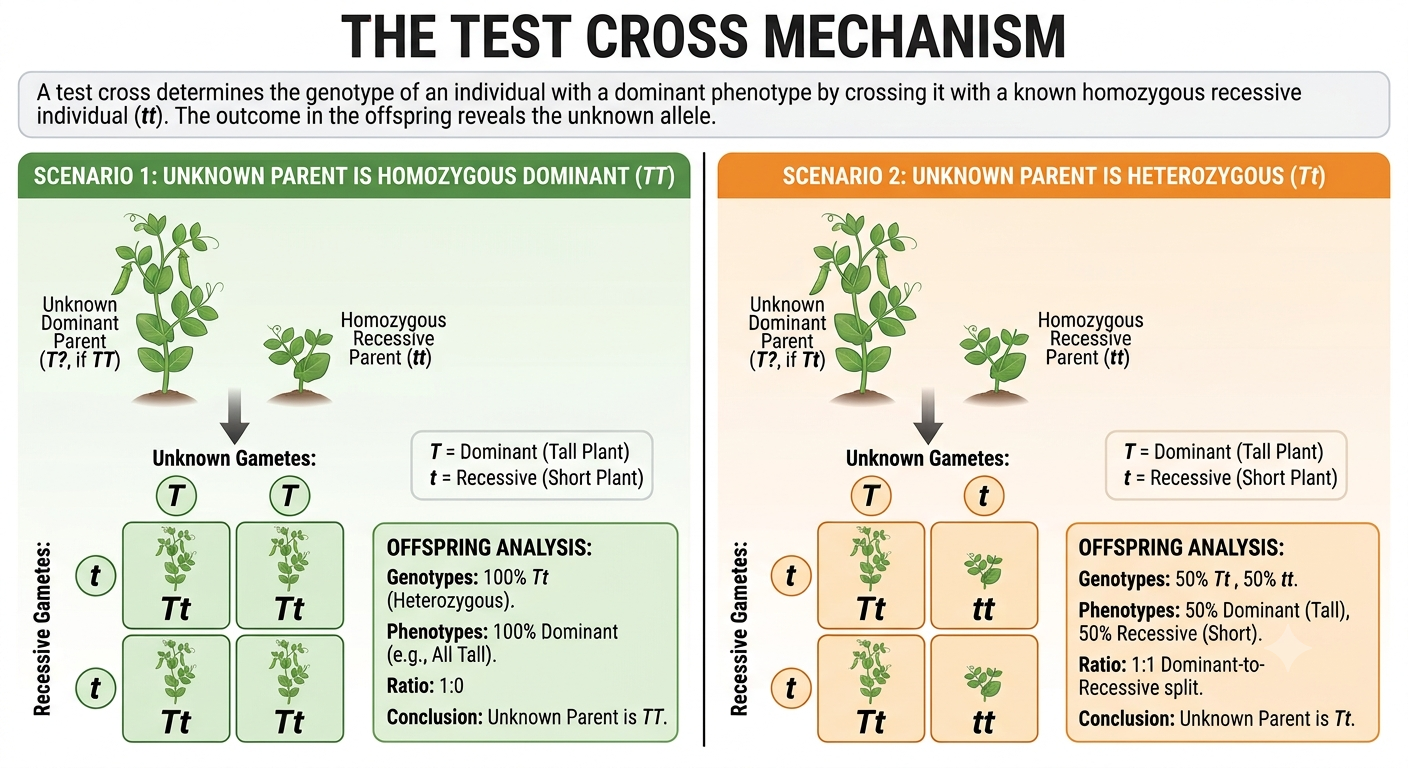
If you have a plant displaying a dominant phenotype (e.g., Purple flowers), you cannot visually determine its genotype. It could be homozygous ($PP$) or heterozygous ($Pp$). To discover the hidden genotype, geneticists perform a Test Cross.
- Method: Cross the individual with the unknown genotype with an individual that is homozygous recessive ($pp$) for that trait.
- Scenario A (If Unknown is $PP$): $PP \times pp \rightarrow$ 100% of offspring will be $Pp$ (Purple).
- Scenario B (If Unknown is $Pp$): $Pp \times pp \rightarrow$ 50% of offspring will be $Pp$ (Purple) and 50% will be $pp$ (White). This 1:1 ratio instantly proves the parent was a heterozygote.
5. Quantitative Analysis via Punnett Squares
The English geneticist Reginald Punnett devised a simple grid system to calculate mathematical probabilities of genotypes and phenotypes in genetic crosses.
For the $F_1$ cross ($Tt \times Tt$):
- Male gametes ($T$ or $t$) form the columns.
- Female gametes ($T$ or $t$) form the rows.
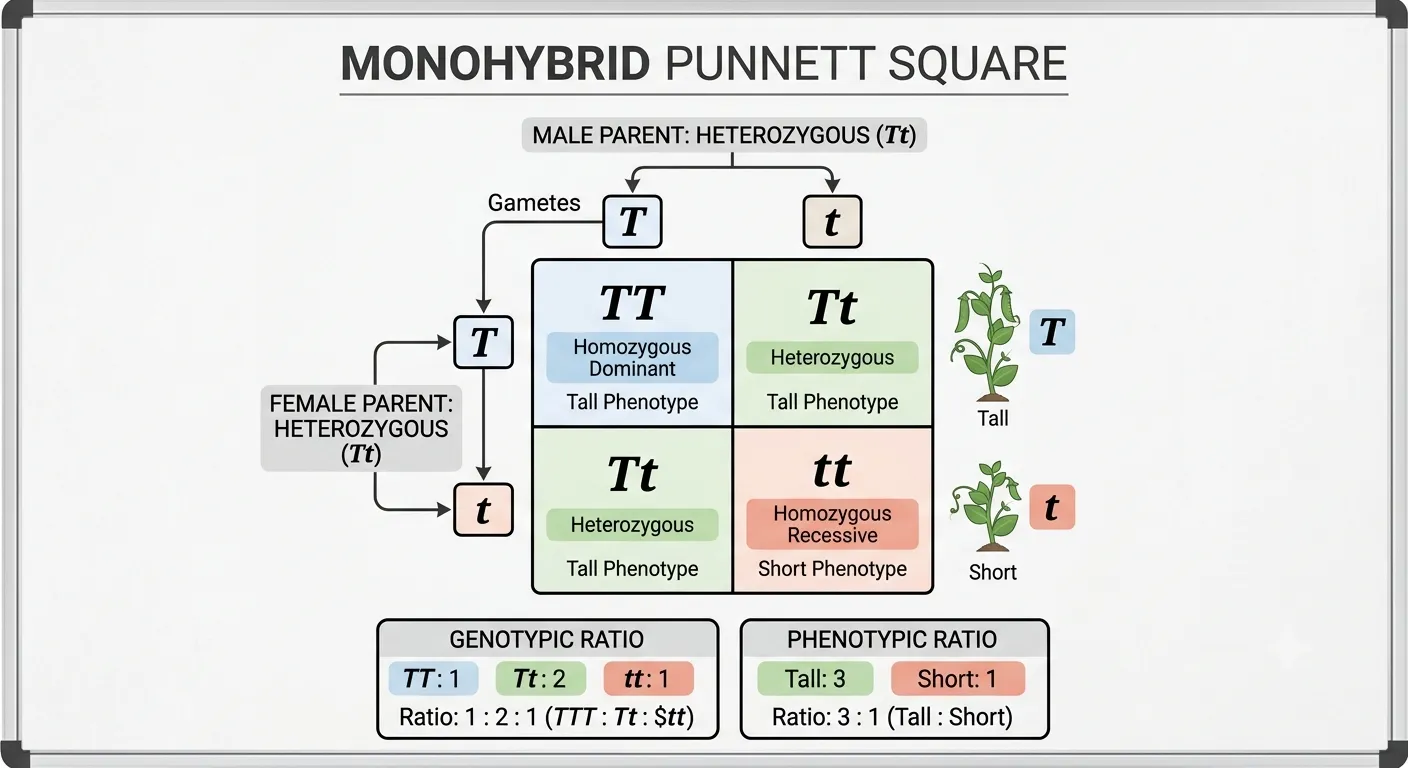
The resulting quantitative ratios from a Mendelian monohybrid cross are strictly fixed:
- Genotypic Ratio: 1 $TT$ : 2 $Tt$ : 1 $tt$ (or $\frac{1}{4}$ homozygous dominant, $\frac{1}{2}$ heterozygous, $\frac{1}{4}$ homozygous recessive).
- Phenotypic Ratio: 3 Tall : 1 Dwarf (or $\frac{3}{4}$ dominant phenotype, $\frac{1}{4}$ recessive phenotype).
6. The Test Cross
Because complete dominance masks the recessive allele, an organism expressing a dominant phenotype can be either homozygous dominant ($TT$) or heterozygous ($Tt$). To determine its true, hidden genotype, a test cross is performed.
A test cross involves breeding the organism of unknown genotype with a homozygous recessive individual ($tt$).
- Scenario A: If the unknown is $TT \rightarrow TT \times tt = 100\%$ of offspring are $Tt$ (all tall).
- Scenario B: If the unknown is $Tt \rightarrow Tt \times tt = 50\%$ $Tt$ (tall) and $50\%$ $tt$ (dwarf). This exact 1:1 phenotypic ratio confirms the unknown parent was heterozygous.
⚡ Quick-Fact: The Product Rule of Probability
You don’t always need a massive 16-square Punnett square for dihybrid crosses! Because the traits assort independently, you can calculate the probability of two traits occurring together simply by multiplying their individual probabilities. (e.g., Probability of Wrinkled is $\frac{1}{4}$. Probability of Green is $\frac{1}{4}$. Probability of Wrinkled AND Green = $\frac{1}{4} \times \frac{1}{4} = \frac{1}{16}$).
🎯 MDCAT Exam Insights
- Allele vs. Gene Location: Exam questions often test your understanding of homologous chromosomes. Remember that alleles for a specific trait are located at the exact same locus on homologous chromosomes, but they may carry different sequence codes (e.g., one maternal homolog has allele $T$, the paternal homolog has allele $t$).
- Test Cross Definition: Never confuse a test cross with a back cross. A test cross is always performed against the homozygous recessive genotype. If an exam asks how to find the genotype of a purple flower (dominant), the answer must involve crossing it with a white flower (recessive).
- Probability Calculations: Master the multiplication rule for independent events. If asked for the probability of obtaining a $tt$ offspring from $Tt \times Tt$, calculate the chance of inheriting $t$ from the father ($\frac{1}{2}$) AND $t$ from the mother ($\frac{1}{2}$). Therefore, $\frac{1}{2} \times \frac{1}{2} = \frac{1}{4}$.
📝 Concept Check
1. Which stage of cellular division provides the physical, chromosomal mechanism that directly explains Mendel’s Law of Segregation?
The separation of homologous chromosomes during Anaphase I of Meiosis.
The replication of DNA during the S phase of Interphase.
The crossing over of non-sister chromatids during Prophase I.
Check Answer
Explanation: The Law of Segregation states that allele pairs separate during gamete formation. Since alleles reside on homologous chromosomes (one from each parent), this segregation physically occurs when the homologous pairs are pulled to opposite poles during Anaphase I of Meiosis.
2. A botanist performs a test cross on a pea plant exhibiting round seeds (the dominant phenotype). The resulting offspring consist of 52 round-seeded plants and 48 wrinkled-seeded plants. What was the exact genotype of the original round-seeded parent?
Heterozygous ($Rr$)
Homozygous recessive ($rr$)
It is impossible to determine without an $F_2$ cross.
Check Answer
Explanation: The offspring ratio is approximately 1:1 (52 round to 48 wrinkled). In a test cross (Unknown $\times$ $rr$), a 1:1 phenotypic split can only occur if the unknown parent provides a dominant allele half the time and a recessive allele the other half, proving its genotype is heterozygous ($Rr$).
3. In Mendelian genetics, an organism’s specific, observable physical characteristics—which arise as a direct result of the interaction between its genetic makeup and the environment—are defined as its:
Genotype
Phenotype
Allele
Check Answer
Explanation: The genotype represents the actual genetic code sequence (the letters like $Tt$), while the phenotype is the tangible, biological expression of those genes (the physical trait of being tall).
4. Which stage of meiosis physically demonstrates Mendel’s Law of Segregation?
View Answer & Explanation
Correct: Anaphase I (Separation of Homologous Chromosomes)
Explanation: During Anaphase I, the homologous pairs are pulled apart to opposite poles. Since each homologue carries one allele for a given trait, this physical separation is the exact mechanism of the Law of Segregation.
5. A tall pea plant is subjected to a test cross. The resulting offspring are 50% tall and 50% dwarf. What was the genotype of the original tall parent?
View Answer & Explanation
Correct: $Tt$ (Heterozygous)
Explanation: A test cross is always performed with a homozygous recessive individual ($tt$). If the unknown parent were $TT$, all offspring would be $Tt$ (tall). Because dwarf ($tt$) offspring appeared, the unknown parent must have carried a recessive ‘$t$’ allele, making it $Tt$.
6. In a classic Mendelian dihybrid cross ($RrYy \times RrYy$), what fraction of the $F_2$ generation is expected to display BOTH recessive phenotypes (wrinkled and green)?
View Answer & Explanation
Correct: 1/16
Explanation: The phenotypic ratio of a standard dihybrid cross is 9:3:3:1. The “1” represents the offspring that are homozygous recessive for both traits ($rryy$), which is 1 out of the 16 possible combinations.
➡ Coming Next
Unit 2: Explain the Law of Independent Assortment Using a Suitable Example
⏱️