
6.1. Describe the distinguishing characteristics of enzymes
〰️ Unit 1: Distinguishing Characteristics of Enzymes
Chapter 6: Enzymes
Student Learning Outcomes (SLO 6.1)
Learning Objectives
- Define enzymes as biological catalysts and identify their predominantly globular protein structure.
- Explain the thermodynamic function of enzymes in lowering activation energy ($E_a$).
- Categorize the specific traits of enzymes, including specificity, reusability, and sensitivity to extreme conditions.
- Differentiate between an apoenzyme, cofactor, coenzyme, prosthetic group, and a complete holoenzyme.
📺 Video Lesson: Introduction to Enzymes
An animated overview of biological catalysts, focusing on their 3D conformation, active sites, and extreme specificity.
1. The Biochemical Nature of Enzymes
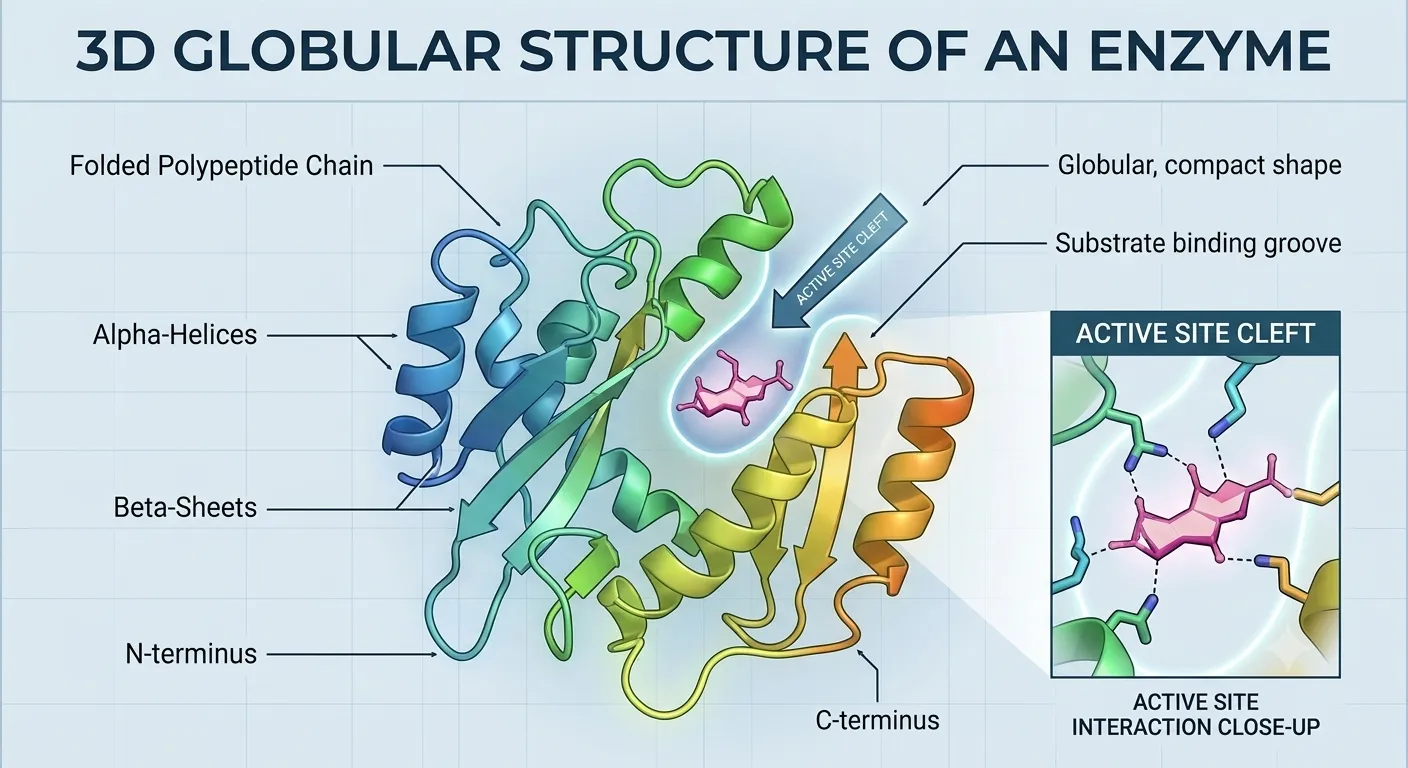
Enzymes are highly specialized biological macromolecules that act as catalysts—substances that accelerate the rate of a chemical reaction without being consumed or permanently altered in the process. With the exception of a few catalytic RNA molecules (ribozymes), all enzymes are globular proteins. Their catalytic ability is entirely dependent on their highly complex, three-dimensional tertiary or quaternary structure.
Within this massive 3D protein fold lies a small, highly specific microenvironment known as the active site. The active site contains a precise arrangement of amino acid R-groups that perfectly complement the shape and charge of the target substrate.
2. Thermodynamic Characteristics
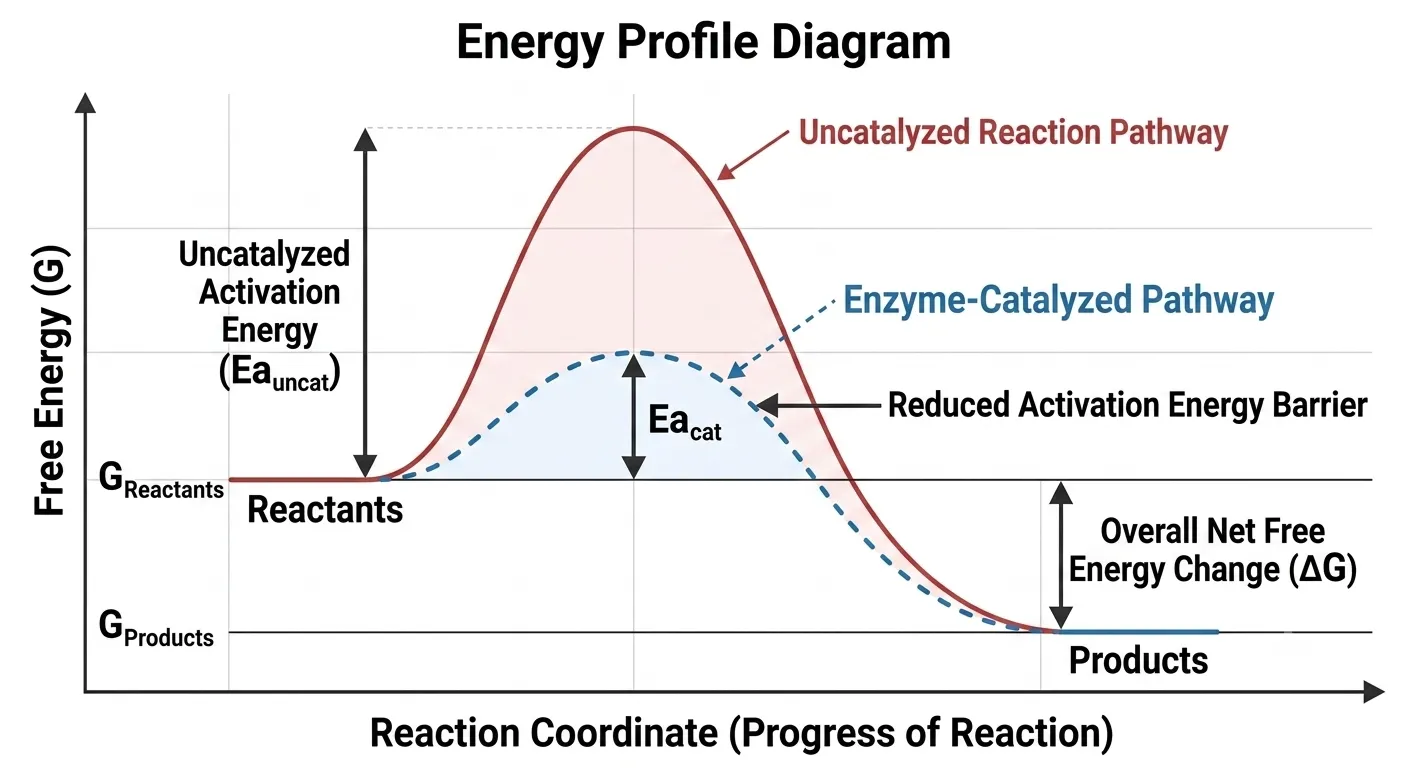
Enzymes operate strictly within the laws of thermodynamics. Their defining characteristic is the ability to drastically lower the Activation Energy ($E_a$), which is the minimum energy required to contort reactant molecules into an unstable transition state.
Consider a reversible biological reaction:
$\text{Reactants} \; \overset{\text{Enzyme}}{\rightleftharpoons} \; \text{Products}$
- Kinetics, not Thermodynamics: Enzymes accelerate both the forward and reverse reactions equally. They hasten the time it takes to reach equilibrium, but they never change the equilibrium constant ($K_{eq}$) or the overall Gibbs free energy change ($\Delta G$) of the reaction.
- Extreme Efficiency: An enzyme can increase the reaction rate by a factor of $10^6$ to $10^{12}$ compared to an uncatalyzed reaction!
3. Structural Components: Cofactors and Coenzymes
While some enzymes consist purely of protein, many require non-protein helper molecules to perform their catalytic function:
- Apoenzyme: The inactive, pure protein portion of an enzyme.
- Cofactor: An inorganic, non-protein helper (often metal ions like $\text{Zn}^{2+}$, $\text{Mg}^{2+}$, or $\text{Fe}^{2+}$) that binds to the apoenzyme to make it functional.
- Coenzyme: A complex organic cofactor. Most coenzymes are derived from dietary vitamins (e.g., $NAD^+$ from Niacin, $FAD$ from Riboflavin). They often act as transient carriers of specific functional groups or electrons.
- Prosthetic Group: A tightly and permanently bound coenzyme or cofactor (e.g., the heme group in catalase).
- Holoenzyme: The fully active, functional enzyme complex: $\text{Apoenzyme} + \text{Cofactor} = \text{Holoenzyme}$.
4. Exquisite Sensitivity and Specificity
Enzymes are distinguished by their extreme specificity and sensitivity to their environment:
- Absolute Specificity: Because their active sites possess precise geometric and electronic architecture, enzymes usually catalyze only one highly specific chemical reaction (e.g., Urease only hydrolyzes urea).
- Environmental Sensitivity: Because they are proteins maintained by weak hydrogen bonds and hydrophobic interactions, enzymes are highly sensitive to extreme temperatures and pH levels, which can cause them to permanently unfold (denature), destroying the active site.
🎯 MDCAT Exam Insights
- The Thermodynamic Trap: Examiners frequently use misleading options suggesting that enzymes “supply energy” to a reaction or “change the final equilibrium.” This is universally false. You must explicitly remember: Enzymes only alter the activation energy ($E_a$) and the reaction rate ($v$); they have absolutely zero effect on $\Delta G$ or $K_{eq}$.
- Terminology Precision: Pay close attention to the distinction between a prosthetic group and a coenzyme. If the organic helper molecule is covalently and permanently attached, it is a prosthetic group. If it associates loosely and transiently, it is a coenzyme.
📝 Concept Check
1. An enzyme catalyzes the conversion of substrate A to product B. Which of the following thermodynamic parameters is fundamentally altered by the introduction of this enzyme?
The activation energy ($E_a$) required to reach the transition state.
The final equilibrium constant ($K_{eq}$) of the reaction.
The amount of heat energy released (enthalpy) by the reaction.
Check Answer
Explanation: Enzymes accelerate chemical reactions solely by providing an alternative reaction pathway with a lower activation energy. They do not alter the initial energy of the reactants, the final energy of the products, or the equilibrium point.
2. The inactive, purely proteinaceous portion of an enzyme that requires an inorganic metal ion to become catalytically functional is termed the:
Coenzyme
Apoenzyme
Prosthetic group
Check Answer
Explanation: The apoenzyme is the inactive protein scaffold. When it correctly binds to its required non-protein cofactor (like a metal ion or coenzyme), it forms the complete, catalytically active complex known as the holoenzyme.
3. Structurally, the vast majority of biological enzymes belong to which class of macromolecules?
Long, fibrous structural proteins.
Three-dimensionally folded globular proteins.
Amphipathic lipid bilayers.
Check Answer
Explanation: Almost all enzymes are globular proteins. This specific tertiary or quaternary spherical folding is critical because it creates the highly specific microenvironment known as the active site, where substrate binding and catalysis occur.
➡ Coming Next
Unit 2: Mechanism of Action of Enzymes
⏱️