
2.1. Outline the cellular respiration of proteins and fats and correlate these with that of glucose.
〰️ Unit 1: Alternative Respiratory Substrates – Fats & Proteins
Chapter 2: Bioenergetics
Student Learning Outcomes (SLO 2.1)
Learning Objectives
- Correlate the central pathway of glucose metabolism with the specific entry points for glycerol, fatty acids, and amino acids.
- Calculate the quantitative ATP yield of the $\beta$-oxidation of a standard fatty acid (e.g., palmitic acid).
- Differentiate between glucogenic and ketogenic amino acids based on their entry into the respiratory pathway.
- Mathematically derive the Respiratory Quotient (RQ) for carbohydrates, fats, and proteins.
📺 Video Lesson: Biochemistry of Alternative Substrates
An advanced biochemical breakdown of the metabolic funnel, detailing the precise molecular intersections of lipolysis and deamination.
1. The Metabolic Funnel & The Respiratory Quotient (RQ)
Cellular respiration acts as a central “metabolic funnel.” Carbohydrates, fats, and proteins are all oxidized to extract high-energy electrons, but their chemical compositions dictate how much oxygen they require. This is measured by the Respiratory Quotient (RQ):
$RQ = \frac{\text{Volume of } CO_2 \text{ evolved}}{\text{Volume of } O_2 \text{ consumed}}$
- Carbohydrates ($RQ = 1.0$): They already contain substantial oxygen. Equation for glucose: $C_6H_{12}O_6 + 6O_2 \longrightarrow 6CO_2 + 6H_2O$. Thus, $RQ = \frac{6}{6} = 1.0$.
- Fats ($RQ \approx 0.7$): Fats are highly reduced (massive amounts of $C-H$ bonds, very little oxygen). They require a large influx of external oxygen for complete oxidation. Equation for tripalmitin: $2C_{51}H_{98}O_6 + 145O_2 \longrightarrow 102CO_2 + 98H_2O$. Thus, $RQ = \frac{102}{145} \approx 0.7$.
- Proteins ($RQ \approx 0.8 \text{ to } 0.9$): Intermediate oxygen requirement depending on the specific amino acid composition.
2. Quantitative Respiration of Fats
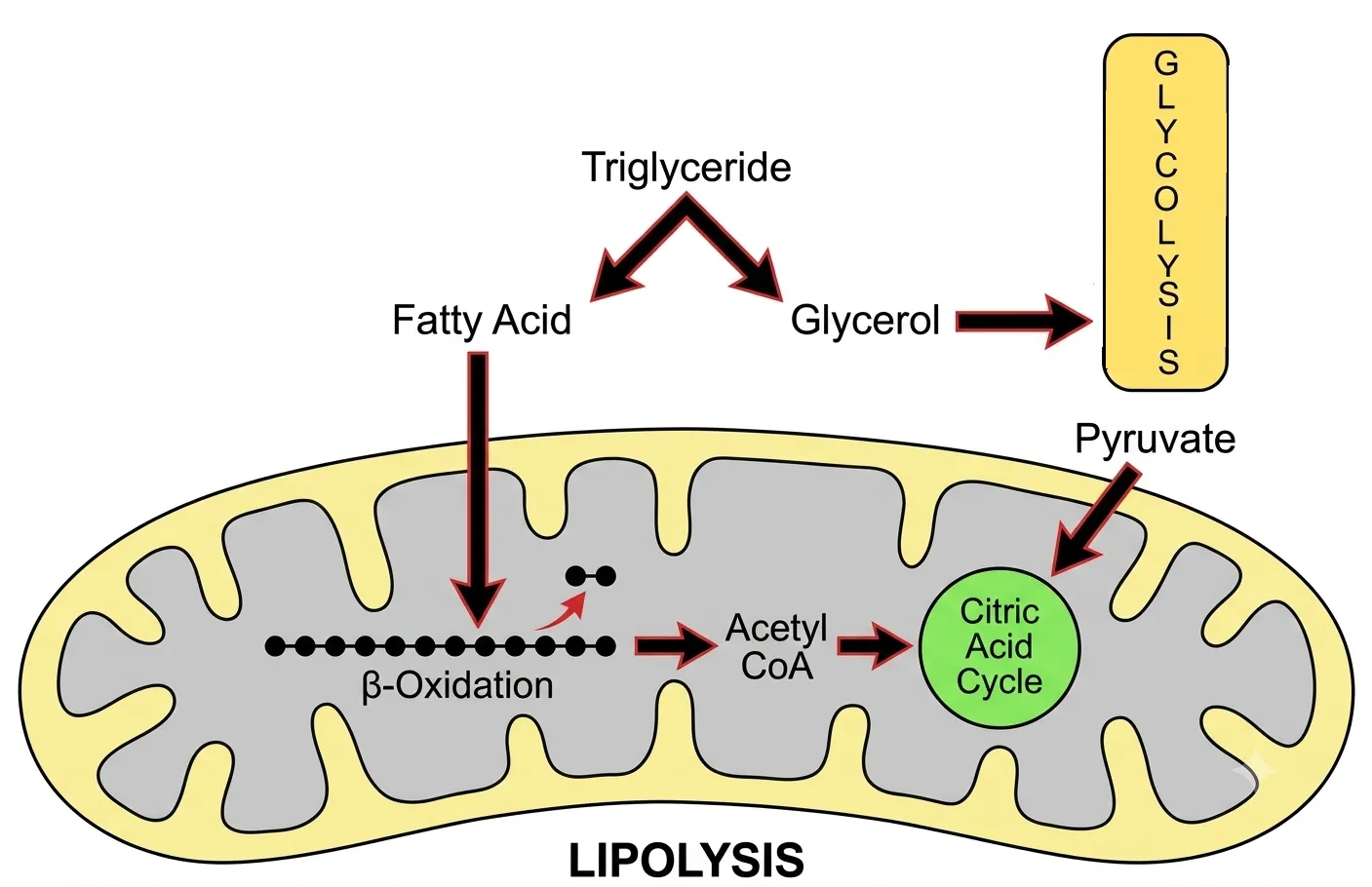
Triglycerides undergo lipolysis into glycerol and three fatty acids. They yield more than twice the energy of carbohydrates ($9.4 \text{ kcal/g}$ vs. $4.1 \text{ kcal/g}$).
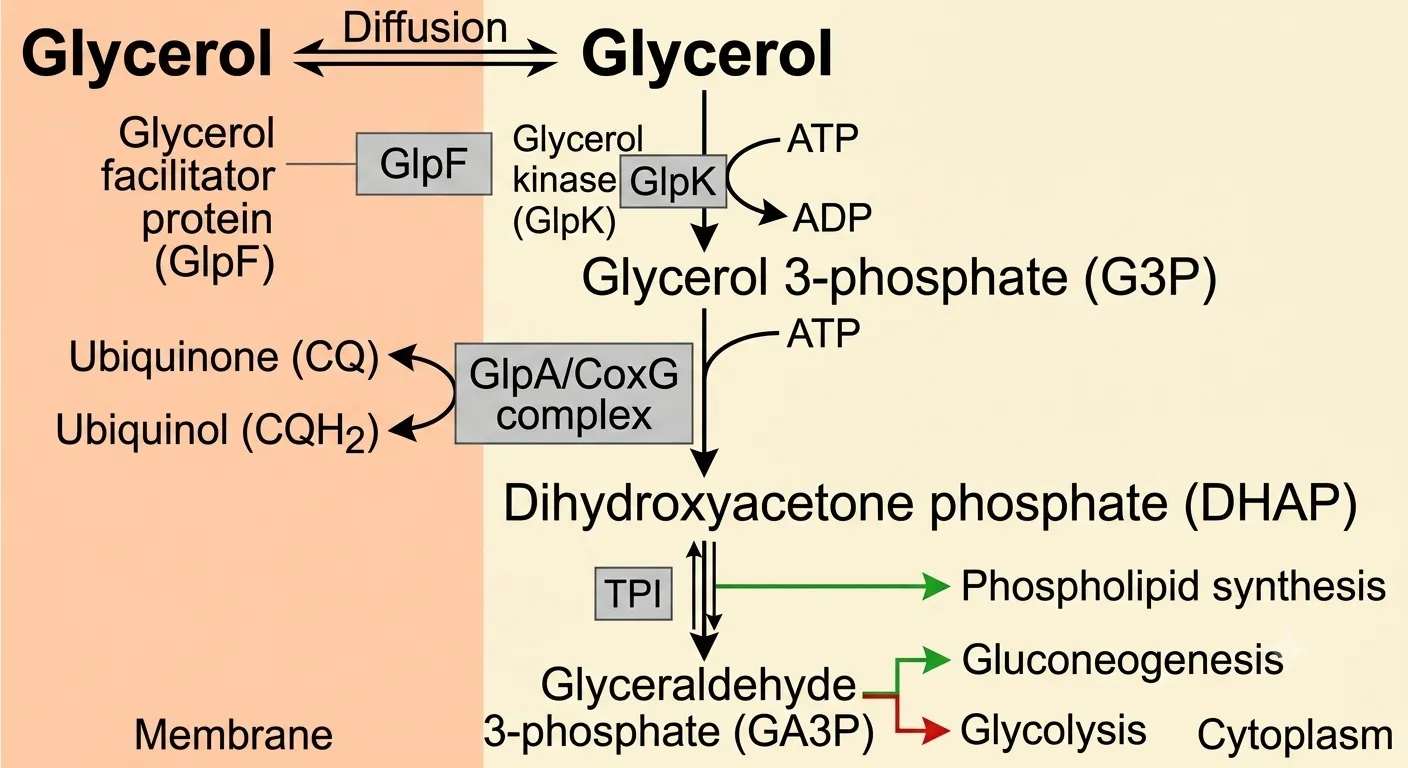
- Glycerol: Converted in the cytoplasm into Glyceraldehyde 3-phosphate (PGAL), entering glycolysis directly.
- Fatty Acids ($\beta$-oxidation): This occurs strictly in the mitochondrial matrix. The fatty acid chain is cleaved into 2-carbon fragments, creating Acetyl-CoA molecules.
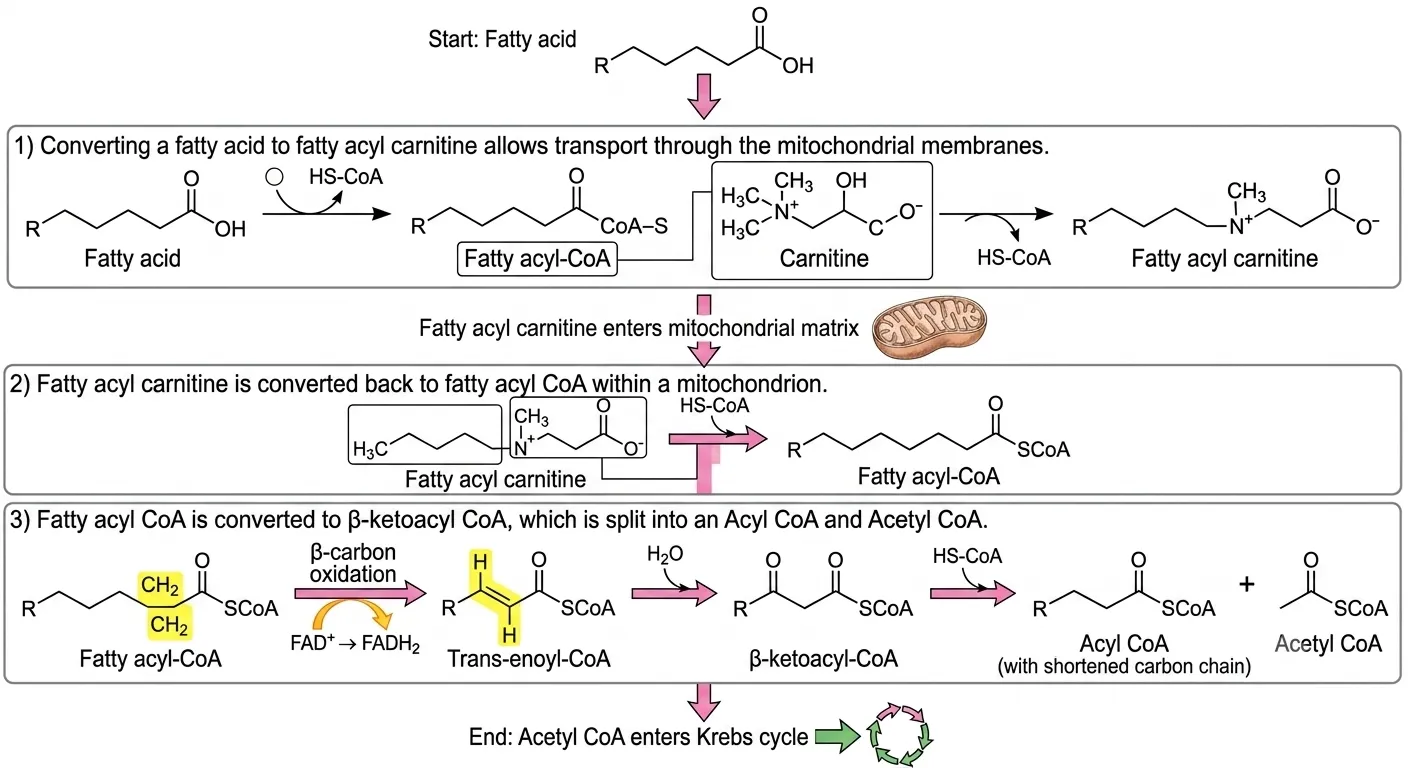
Fatty Acids ($\beta$-oxidation)
🧮 MDCAT Math: Deep Dive into ATP Yield of a 16-Carbon Palmitic Acid
To excel MDCAT bioenergetics, you must understand the exact origin of every ATP molecule generated during lipid metabolism. Using the traditional curriculum stoichiometry ($1 \text{ NADH} = 3 \text{ ATP}$, $1 \text{ FADH}_2 = 2 \text{ ATP}$), let’s break down the quantitative yield of Palmitic Acid ($C_{16}H_{32}O_2$).
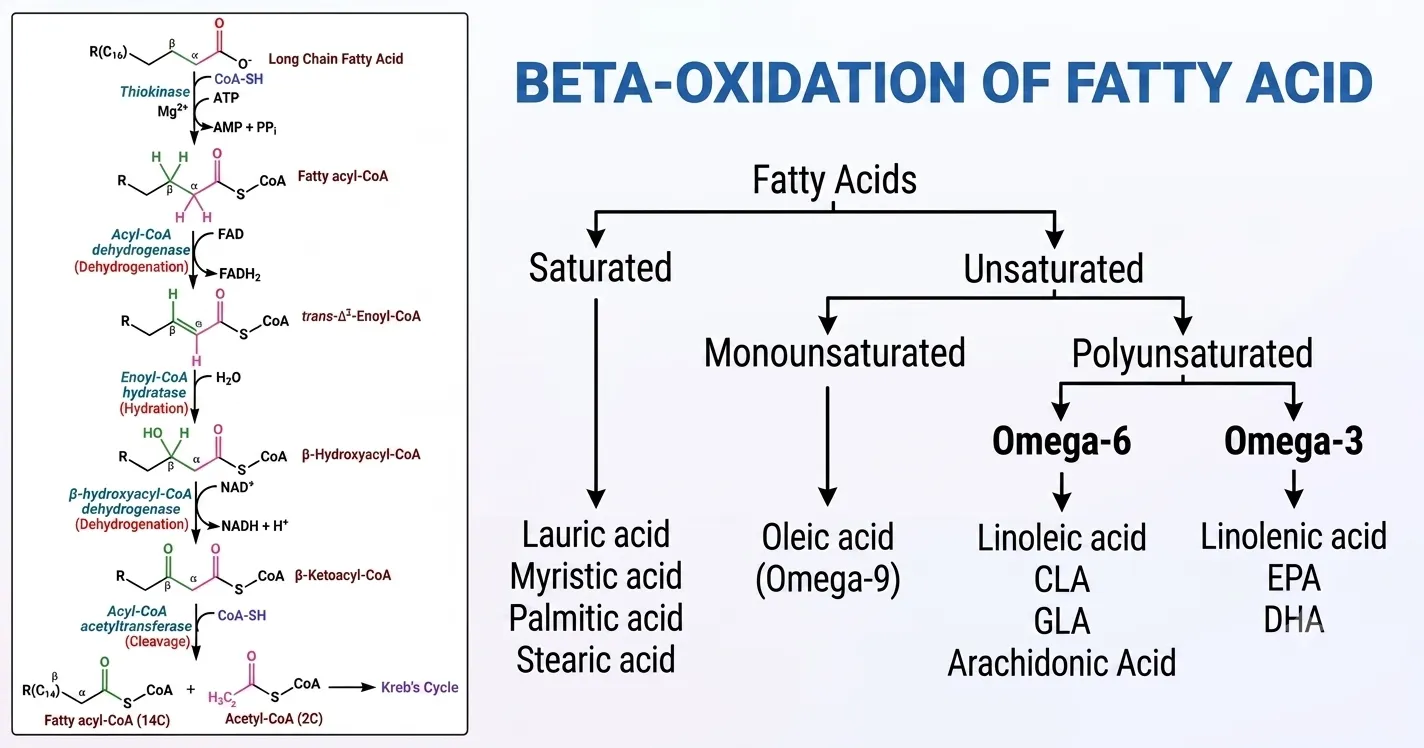
- 1. Cleavage (The $N/2 – 1$ Rule): A fatty acid must be chopped into 2-carbon fragments to enter the Krebs cycle. For a 16-carbon chain ($N = 16$), the number of 2-carbon Acetyl-CoA molecules produced is $N/2 = 8$. However, because the final “cut” splits a 4-carbon fragment into two 2-carbon pieces simultaneously, the number of cleavage cycles required is always $N/2 – 1$. Therefore, a 16-carbon chain requires exactly $7$ cleavage cycles.
- 2. Products of $\beta$-oxidation: During each of the $7$ cleavage cycles, the carbon chain is oxidized. Electrons are extracted and transferred to electron carriers. Each individual cycle produces exactly $1 \text{ NADH}$ and $1 \text{ FADH}_2$. Therefore, $7$ cycles yield a total of $7 \text{ NADH}$ and $7 \text{ FADH}_2$.
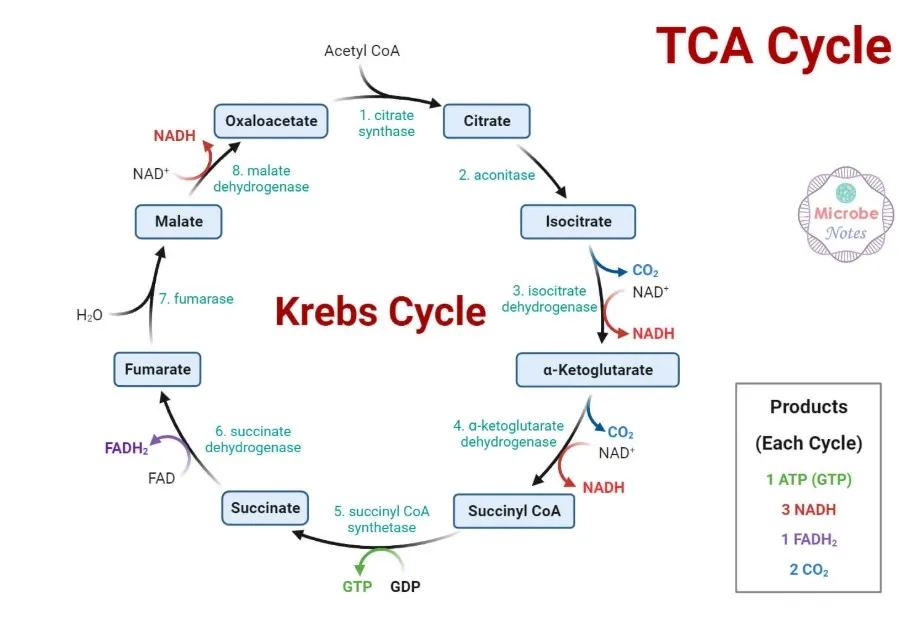
- 3. Krebs Cycle ATP Yield: The $8 \text{ Acetyl-CoA}$ molecules now enter the mitochondrial matrix for the Krebs cycle. Recall that one turn of the Krebs cycle (per Acetyl-CoA) generates $3 \text{ NADH}$, $1 \text{ FADH}_2$, and $1 \text{ ATP}$ (via substrate-level phosphorylation).
- Energy per Acetyl-CoA: $(3 \times 3 \text{ ATP}) + (1 \times 2 \text{ ATP}) + 1 \text{ ATP} = 12 \text{ ATP}$.
- Total Krebs Yield: $8 \text{ Acetyl-CoA} \times 12 \text{ ATP} = \mathbf{96 \text{ ATP}}$.
- 4. ETC Yield from $\beta$-oxidation: The electron carriers generated directly during the $7$ cleavage cycles in the matrix travel directly to the Electron Transport Chain.
- Calculation: $(7 \text{ NADH} \times 3 \text{ ATP}) + (7 \text{ FADH}_2 \times 2 \text{ ATP}) = 21 + 14 = \mathbf{35 \text{ ATP}}$.
- 5. Activation Cost: Before a fatty acid can enter the mitochondria for $\beta$-oxidation, it must be “activated” in the cytoplasm into a Fatty Acyl-CoA molecule. This specific enzymatic reaction breaks a single ATP molecule down into AMP and Pyrophosphate ($PP_i$). Because two high-energy phosphate bonds are broken, the biochemical energy cost is equivalent to consuming $2 \text{ ATP}$.
Net Total ATP Yield Calculation:
ETC (from $\beta$-oxidation) ……….. $35$
Gross Total …………………… $131$
Activation Cost ……………….. $-2$
Net ATP Yield …………………. $\mathbf{129}$
(Contrast this massive yield with the mere $36$ to $38 \text{ ATP}$ generated from a single 6-carbon glucose molecule. This mathematically proves why fats are the body’s premier long-term energy storage reservoir!)
3. Cellular Respiration of Proteins
While proteins are primarily functional and structural macromolecules, their constituent amino acids are mobilized for energy during starvation, prolonged exercise, or when dietary protein exceeds the body’s immediate synthetic needs. The utilization of proteins for ATP production is a biochemically expensive, multi-step process.
Step A: Transamination and Oxidative Deamination
Unlike carbohydrates and fats, amino acids contain a toxic amino group ($-\text{NH}_2$). Because there is no cellular pathway to oxidize nitrogen for energy, it must be stripped away before the carbon skeleton can enter the respiratory funnel.
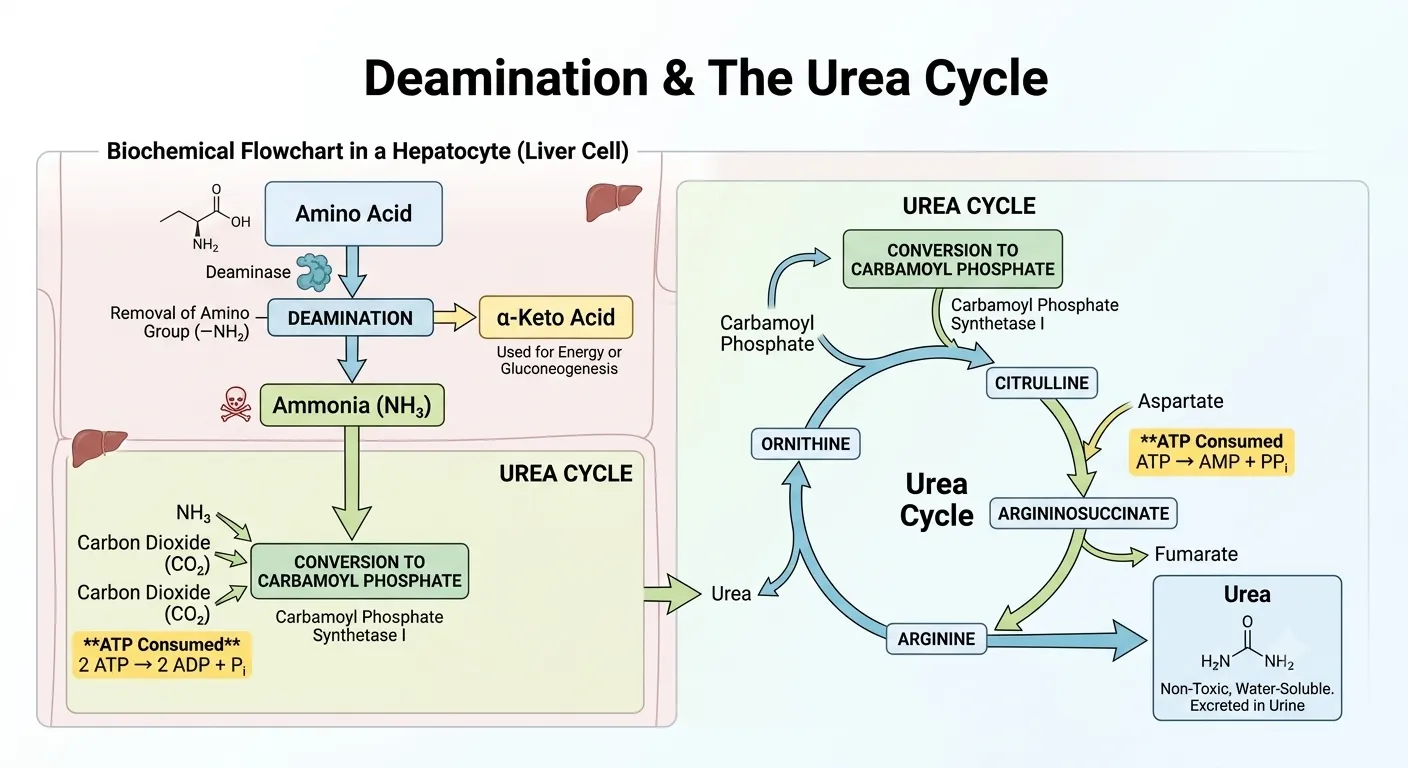
- Transamination: In the cytoplasm of liver cells (hepatocytes), an aminotransferase enzyme transfers the $-\text{NH}_2$ group from the target amino acid to $\alpha\text{-ketoglutarate}$, transforming it into the amino acid Glutamate, and leaving behind a carbon skeleton (a keto acid).
- Oxidative Deamination: The newly formed Glutamate enters the hepatic mitochondria, where the enzyme glutamate dehydrogenase removes the amino group entirely, releasing it as highly toxic free ammonia ($\text{NH}_3$).
- The Urea Cycle: Because free $\text{NH}_3$ is lethal to the central nervous system, the liver immediately feeds it into the ornithine cycle, combining it with $\text{CO}_2$ to form Urea ($\text{CH}_4\text{N}_2\text{O}$). MDCAT Note: This detoxification process costs the cell $3 \text{ ATP}$ per molecule of urea produced, making protein metabolism far less energetically efficient than carbohydrate metabolism!
Step B: The Fate of the Carbon Skeleton
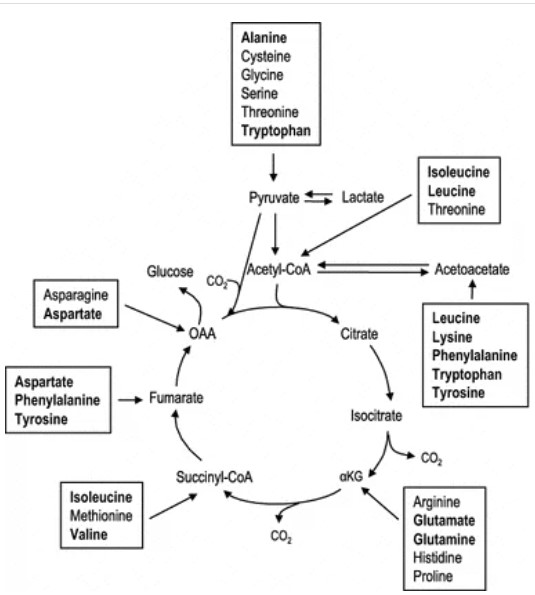
Once the nitrogen is safely removed, the remaining organic carbon skeleton (the $\alpha$-keto acid) enters the central respiratory pathway. The specific molecular entry point is dictated entirely by the $R$-group side chain of the original amino acid. They are classified into three distinct categories:
- 1. Glucogenic Amino Acids: Their carbon skeletons degrade into Pyruvate or direct Krebs cycle intermediates (e.g., $\alpha\text{-ketoglutarate}$, succinyl-CoA, fumarate, oxaloacetate). Because these intermediates can be enzymatically reversed back into glucose via gluconeogenesis, they are termed “glucogenic.”
- Alanine $\longrightarrow$ Converts to Pyruvate (3C).
- Glutamate $\longrightarrow$ Converts to $\alpha\text{-ketoglutarate}$ (5C).
- Aspartate $\longrightarrow$ Converts to Oxaloacetate (4C).
- 2. Strictly Ketogenic Amino Acids: These carbon skeletons degrade directly into Acetyl-CoA or Acetoacetyl-CoA. They cannot be used to synthesize glucose because the Pyruvate Dehydrogenase reaction (Pyruvate $\longrightarrow$ Acetyl-CoA) is strictly irreversible in humans. They can only be oxidized for ATP or used to synthesize lipids and ketone bodies.
- Leucine and Lysine are the only two strictly ketogenic amino acids in humans.
- 3. Mixed (Glucogenic & Ketogenic): Larger aromatic or complex amino acids yield multiple breakdown products, some entering as Acetyl-CoA and others as Krebs intermediates.
- Examples: Phenylalanine, Isoleucine, Tryptophan, Tyrosine, Threonine.
🎯 MDCAT Exam Insights
- The Entry Point Trap: You must know the exact intersection points. Glycerol enters at PGAL (Glycolysis). Fatty acids enter at Acetyl-CoA (Link Reaction). Amino acids can enter at Pyruvate, Acetyl-CoA, or directly into the Krebs Cycle.
- Mass vs. Energy: If a question asks why fats yield $9.4 \text{ kcal/g}$, the specific biochemical answer is: “They have a higher ratio of $C-H$ bonds to oxygen atoms, meaning they are more highly reduced and thus provide more electrons for oxidative phosphorylation.”
📝 Concept Check
1. Calculate the number of Acetyl-CoA molecules and the number of cleavage cycles required during the $\beta$-oxidation of an 18-carbon Stearic Acid.
9 Acetyl-CoA; 9 cycles
9 Acetyl-CoA; 8 cycles
8 Acetyl-CoA; 7 cycles
Check Answer
Explanation: Each Acetyl-CoA contains 2 carbons, so an 18-carbon fatty acid yields $18/2 = 9$ Acetyl-CoA molecules. However, the final cycle splits a 4-carbon fragment into two 2-carbon molecules at once. Therefore, the number of cycles is always $\frac{n}{2} – 1$, which equals $8$ cycles.
2. During extreme starvation, skeletal muscle begins breaking down its own proteins for energy. If the amino acid Alanine is deaminated, its carbon skeleton directly enters the respiratory pathway as which molecule?
Pyruvate
$\alpha$-ketoglutarate
Oxaloacetate
Check Answer
Explanation: Alanine is a 3-carbon amino acid. When its amine group is removed, the remaining 3-carbon keto acid is structurally identical to pyruvate, allowing it to enter the pathway immediately prior to the Link Reaction.
3. A patient in an intensive care unit is hooked up to a respirometer. The machine calculates their Respiratory Quotient (RQ) to be exactly 0.71. What does this quantitative value indicate about the patient’s primary cellular metabolism?
The patient is undergoing massive muscle protein breakdown.
The patient is metabolizing almost entirely lipids (fats) for energy.
The patient is undergoing anaerobic respiration.
Check Answer
Explanation: An RQ of ~0.7 is the biochemical hallmark of fat oxidation. Because fats are highly reduced and lack oxygen compared to carbohydrates (RQ = 1.0), they consume much more $O_2$ relative to the $CO_2$ they produce.
➡ Coming Next
Chapter 3, Unit 1: Definition and Classification of Biological Molecules
⏱️