
7.1. Explain origin of life according to concept of evolution
〰️ Unit 1: Origin of Life According to the Concept of Evolution
Chapter 7: Evolution
Student Learning Outcomes (SLO 7.1)
Learning Objectives
- Describe the geochemical conditions of early Earth and the Oparin-Haldane hypothesis of chemical evolution.
- Analyze the methodology and biochemical findings of the classic Miller-Urey experiment (1953).
- Explain the transition from abiotic monomers to polymers, coacervates, and the “RNA World.”
- Detail the Endosymbiotic Theory and the evolutionary shift from prokaryotic to eukaryotic cellular life.
📺 Video Lesson: The Origin of Life
A detailed exploration of chemical evolution, from the primordial soup and the Miller-Urey apparatus to the dawn of the first living cells.
1. The Oparin-Haldane Hypothesis & The Primordial Soup
In the 1920s, Alexander Oparin and J.B.S. Haldane independently proposed that life on Earth originated through abiogenesis—the gradual chemical evolution of non-living matter into living organisms over millions of years. This process was uniquely possible due to the specific conditions of the primitive Earth (approximately 4 billion years ago):
- A Reducing Atmosphere: Early Earth’s atmosphere was largely composed of water vapor ($\text{H}_2\text{O}$), methane ($\text{CH}_4$), ammonia ($\text{NH}_3$), and hydrogen gas ($\text{H}_2$). Crucially, there was no free oxygen ($\text{O}_2$). Oxygen is highly electronegative and reactive; its absence allowed complex organic bonds to form without being immediately oxidized and destroyed.
- Energy Sources: The energy required to force these simple inorganic gases to bond into organic monomers was supplied by intense ultraviolet (UV) radiation (since there was no protective ozone layer), violent lightning storms, and geothermal heat from volcanism.
- The Primordial Soup: As the Earth cooled, water vapor condensed into vast oceans. The newly formed organic molecules rained down and accumulated in these oceans, creating a nutrient-rich “primordial soup.”
2. Testing the Hypothesis: The Miller-Urey Experiment (1953)
Stanley Miller and Harold Urey provided the first experimental evidence supporting chemical evolution. They constructed a closed, sterile glass apparatus that perfectly simulated early Earth conditions.
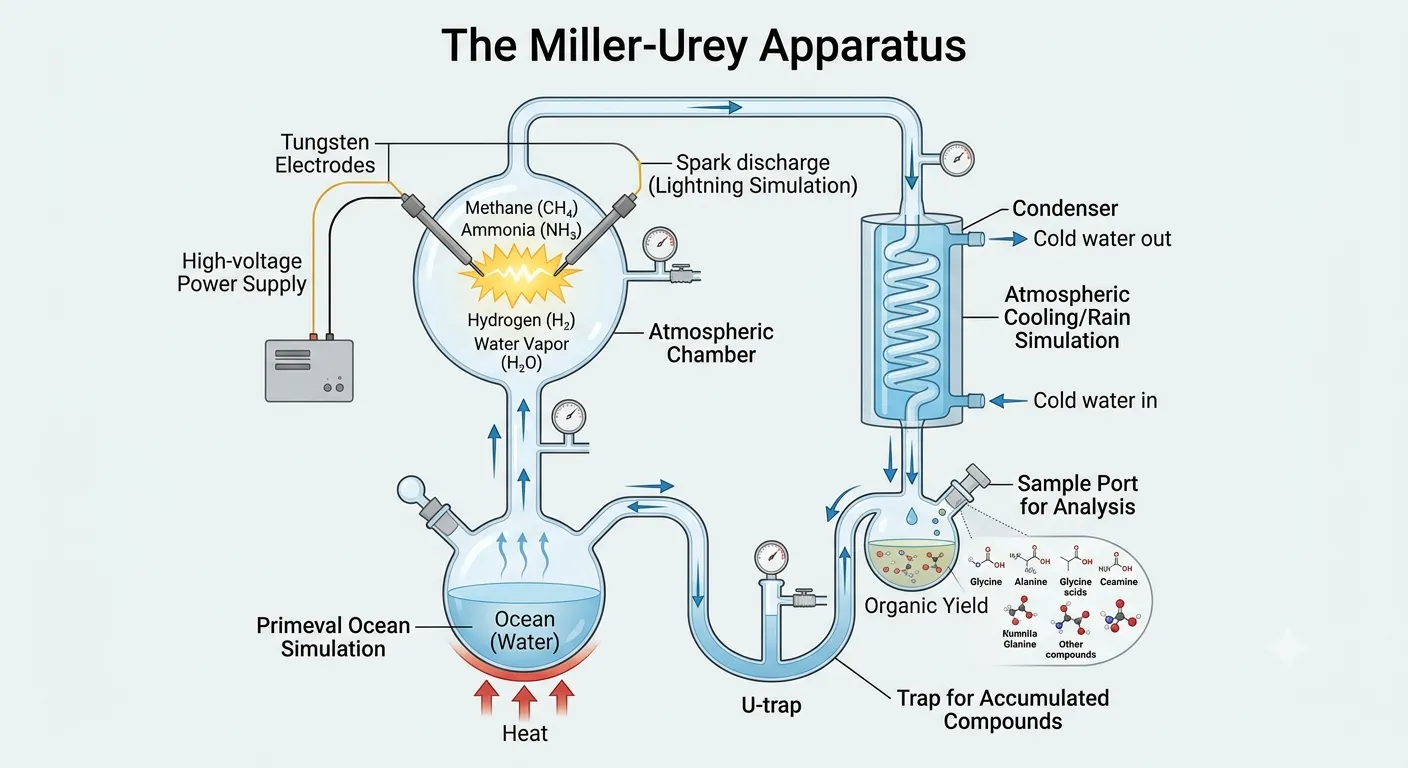
- The Setup: A mixture of $\text{CH}_4$, $\text{NH}_3$, and $\text{H}_2$ was circulated past continuously sparking electrodes (simulating lightning) while water vapor was added.
- The Results: After just one week, the clear water turned into a dark, muddy liquid. Chemical analysis revealed the spontaneous formation of several organic compounds, including simple sugars, lipids, and multiple amino acids (such as glycine and alanine). This definitively proved that the basic building blocks of life could arise purely from physics and chemistry.
3. Protobionts and the RNA World
Once organic monomers existed, the next step was polymerization and compartmentalization.
- Protobionts (Coacervates and Microspheres): Organic polymers spontaneously aggregate in water into distinct, membrane-bound droplets called coacervates. While not truly alive, these protobionts exhibit internal chemical environments different from their surroundings, can selectively absorb substances, and can even divide mechanically.
- The RNA World Hypothesis: Which came first, proteins (the catalysts) or DNA (the information)? The answer is likely RNA. RNA is unique because it can store genetic information (like DNA) and fold into complex 3D shapes to act as an enzyme (called a ribozyme). The first living entities likely relied solely on RNA before DNA and complex proteins evolved.
4. Biological Evolution & The Endosymbiotic Theory
The first true cells on Earth were anaerobic, heterotrophic prokaryotes, surviving by consuming the organic molecules in the primordial soup. Over time, as food became scarce, autotrophs (cyanobacteria) evolved, releasing toxic free oxygen ($\text{O}_2$) into the atmosphere (the Oxygen Revolution), which radically changed life on Earth.
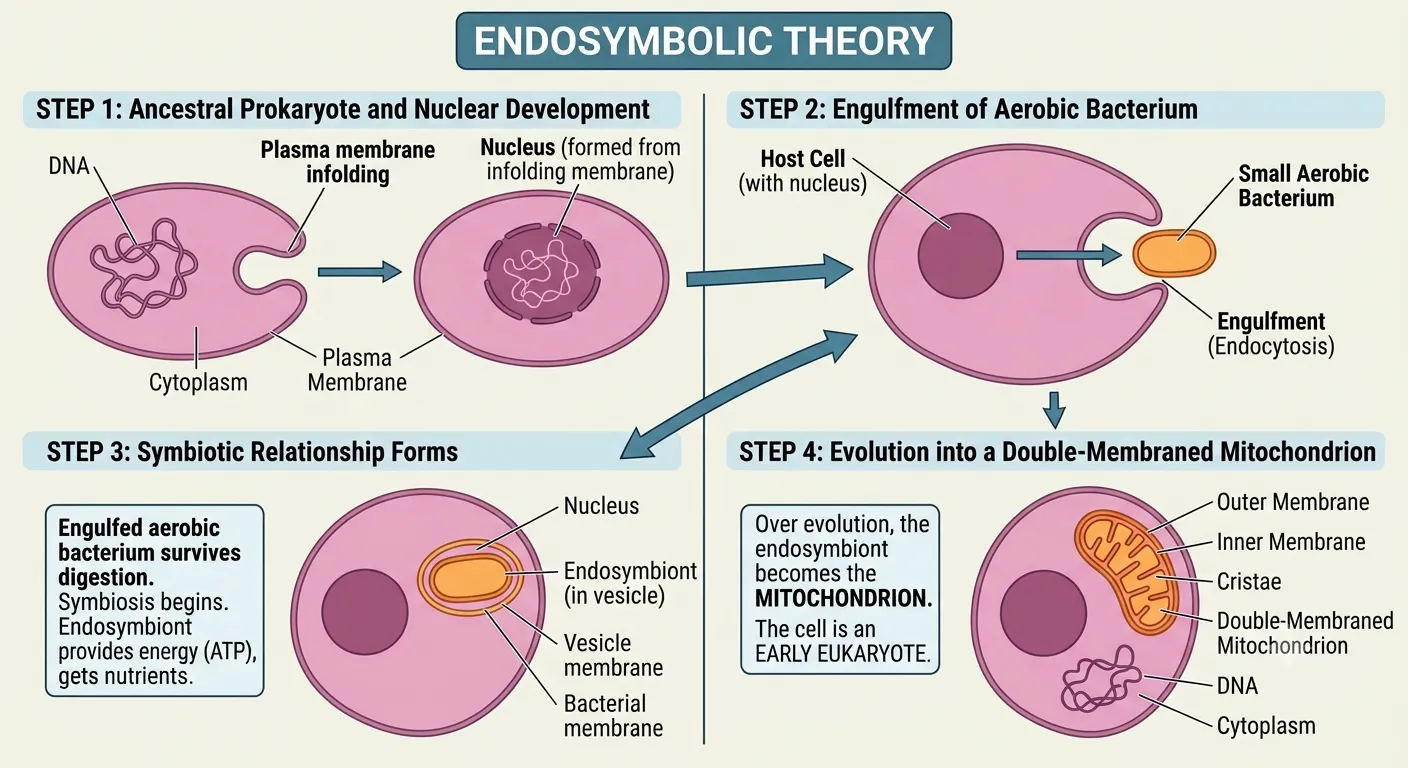
Proposed by Lynn Margulis, the Endosymbiotic Theory explains how complex eukaryotic cells evolved from these simple prokaryotes. It states that an ancestral, large anaerobic prokaryote engulfed smaller, free-living aerobic prokaryotes. Instead of digesting them, a mutually beneficial (symbiotic) relationship formed. Over millions of years, the engulfed aerobic bacteria became mitochondria, and engulfed photosynthetic bacteria became chloroplasts.
🎯 MDCAT Exam Insights
- The Reducing Atmosphere Trap: Examiners will frequently try to trick you by including molecular oxygen ($\text{O}_2$) in the list of gases present in the early atmosphere or the Miller-Urey apparatus. Free oxygen was strictly absent. The presence of oxygen would have immediately broken down developing organic molecules.
- The Sequence of Early Life: Memorize the evolutionary chronological order: 1. Anaerobic heterotrophic prokaryotes $\rightarrow$ 2. Anaerobic autotrophic prokaryotes (cyanobacteria/photosynthesis) $\rightarrow$ 3. Aerobic prokaryotes $\rightarrow$ 4. Eukaryotes.
📝 Concept Check
1. In the classical Miller-Urey experiment (1953), which specific mixture of gases was circulated through the apparatus to simulate the primitive Earth’s atmosphere?
Methane ($\text{CH}_4$), Ammonia ($\text{NH}_3$), Hydrogen ($\text{H}_2$), and Water vapor ($\text{H}_2\text{O}$)
Methane ($\text{CH}_4$), Oxygen ($\text{O}_2$), Hydrogen ($\text{H}_2$), and Carbon monoxide ($\text{CO}$)
Helium ($\text{He}$), Ammonia ($\text{NH}_3$), Carbon dioxide ($\text{CO}_2$), and Water vapor ($\text{H}_2\text{O}$)
Check Answer
Explanation: The primitive atmosphere was highly reducing, meaning it lacked free, highly reactive oxygen ($\text{O}_2$). Miller and Urey used this specific combination of hydrogen-rich gases, which successfully synthesized amino acids when subjected to electrical sparks.
2. What is the foundational premise of the “RNA World” hypothesis regarding the early stages of chemical evolution?
RNA is chemically more stable than DNA and therefore survived the harsh early Earth temperatures.
RNA uniquely possesses the dual ability to store genetic information and catalyze biochemical reactions.
Early Earth’s atmosphere was predominantly composed of uracil and ribose sugars.
Check Answer
Explanation: Before the complex DNA-Protein system evolved, life faced a “chicken-and-egg” problem: you need DNA to make proteins, but you need protein enzymes to replicate DNA. RNA solves this because it acts as both the genetic blueprint and a biological catalyst (ribozyme).
3. Which of the following provides the strongest cytological evidence supporting Lynn Margulis’s Endosymbiotic Theory for the origin of eukaryotes?
All eukaryotic cells possess a highly folded, double-membraned nucleus.
Mitochondria are capable of surviving indefinitely when completely removed from the host cell.
The biochemical pathways of glycolysis occur universally in the cytoplasm of all cell types.
Check Answer
Explanation: The presence of naked circular DNA, prokaryotic-style 70S ribosomes, and the fact that these organelles reproduce independently via binary fission within the eukaryotic cell, strongly indicate they were once free-living bacteria that were engulfed by a larger host cell.
➡ Coming Next
Unit 2: Theory of Inheritance of Acquired Characters (Lamarckism)
⏱️