
- 16 Sections
- 431 Lessons
- 365 Days
- AKU ASDH Entrance Test Syllabus4
- Diagnostic Tests2
- Biology Part I (Grade XI)138
- 3.1Curriculum-Biology (Copy)
- 3.21.1. Introduction to Biology-Major Fields of Specialisation in Biology (Copy)
- 3.31.2. Levels of Biological Organisation (Copy)
- 3.41.3. Biological Method (Copy)
- 3.51.4. Services of Biology (Copy)
- 3.61.5 Exercise: Introduction to Biology Practice Quiz-1 (Copy)
- 3.71.6 Introduction to Biology Quiz (Timed) (Copy)14 Questions
- 3.82.1. Biological Molecules-Introduction to Biochemistry (Copy)
- 3.92.2. Properties of Carbon (Copy)
- 3.102.3. Chemical Nature and Importance of Water (Copy)
- 3.112.4. Carbohydrates (Copy)
- 3.122.5. Lipids (Copy)
- 3.132.6. Proteins (Copy)
- 3.142.7. Nucleic Acids. (Copy)
- 3.152.8. Conjugated Molecules (Copy)
- 3.162.9 Exercise: Biological Molecules Quiz-1 (Copy)
- 3.172.10 Exercise: Biological molecules Quiz-2 (Copy)
- 3.183.1. Enzymes-Structure of Enzyme (Copy)
- 3.193.2. Characteristics of Enzymes (Copy)
- 3.203.3. Mechanism of Enzyme Action (Copy)
- 3.213.4. Factors Affecting Enzyme Action (Copy)
- 3.223.5. Enzyme Inhibition (Copy)
- 3.233.6 Classification of Enzymes (Copy)
- 3.243.7 Enzymes-Summary Quiz (Copy)
- 3.253.8 Exercise: Enzymes Quiz-1 (Copy)
- 3.263.9 Enzymes Quiz (Timed) (Copy)15 Minutes10 Questions
- 3.274.1 Discovery of Cell (Copy)
- 3.284.2 Microscope (Copy)
- 3.294.3 Techniques used in Cell Biology (Copy)
- 3.304.4 Structure of Animal and Plant Cell (Copy)
- 3.314.5 The Cell-Summary Quiz (Copy)
- 3.324.6 Exercise: The Cell Quiz-1 (Copy)
- 3.334.7 Exercise: The Cell Quiz-2 (Copy)
- 3.344.8 The Cell Quiz (Timed) (Copy)33 Minutes22 Questions
- 3.355.1 Classification of Living Organisms (Copy)
- 3.365.2 Binomial Nomenclature (Copy)
- 3.375.3 Two and Five-Kingdom System (Copy)
- 3.385.4 Characteristics of Viruses (Copy)
- 3.395.5 Classification of Viruses and Viral Diseases (Copy)
- 3.405.6 Life Cycle of Viruses (Copy)
- 3.415.7 Viral Diseases (Copy)
- 3.425.8 Prions and Viroids (Copy)
- 3.435.9 Economic and Human Loss by Viruses (Copy)
- 3.445.10 Classification and Acellular Life-Summary Quiz (Copy)
- 3.455.11 Exercise: Classification and Acellular Life Quiz-1 (Copy)
- 3.465.12 Exercise: Classification and Acellular Life Quiz-2 (Copy)
- 3.476.1 Kingdom Prokaryotae-Characteristic Features of Prokaryotes (Copy)
- 3.486.2 Morphology of Bacteria (Part-I) (Copy)
- 3.496.2 Morphology of Bacteria (Part-II) (Copy)
- 3.506.3 Nutrition in Bacteria (Copy)
- 3.516.4 Respiration in Bacteria (Copy)
- 3.526.5 Locomotion in Bacteria (Copy)
- 3.536.6 Growth in Bacteria (Copy)
- 3.546.7 Reproduction in Bacteria (Copy)
- 3.556.8 Economic Importance of Bacteria (Copy)
- 3.566.9 Control and Prevention of Bacteria (Copy)
- 3.576.9.3 Antibiotics — Uses and Misuses (Copy)
- 3.586.10 Cyanobacteria (Copy)
- 3.596.11 Kingdom Prokaryotae-Summary Quiz (Copy)
- 3.606.12 Exercise: Kingdom Prokaryotae Quiz-1 (Copy)
- 3.616.13 Exercise: Kingdom Prokaryotae Quiz-2 (Copy)
- 3.627.1 Kingdom Protista-Unifying Features (Copy)
- 3.637.2 Diversity among Protists (Copy)
- 3.647.3 Animal-like Protists (Copy)
- 3.657.4 Plant-like Protists (Copy)
- 3.667.5 Fugus-like Protists (Copy)
- 3.677.6 Kingdom Protista-Summary Quiz (Copy)
- 3.687.7 Kingdom Protista (Protoctista) Quiz-1 (Copy)
- 3.697.8 Kingdom Protista (Protoctista) Quiz-2 (Copy)
- 3.708.1 Kingdom Fungi-General Characteristics (Copy)
- 3.718.2 Classification of Fungi (Copy)
- 3.728.3 Land Adaptations of Fungi (Copy)
- 3.738.4 Importance of Fungi (Copy)
- 3.748.5 Kingdom Fungi-Summary Quiz (Copy)
- 3.758.6 Exercise: Kingdom Fungi Quiz-1 (Copy)
- 3.768.7 Exercise: Kingdom Fungi Quiz-2 (Copy)
- 3.779.1 Kingdom Plantae-Diversity among Plants (Copy)
- 3.789.2 Bryophytes (Copy)
- 3.799.3 Tracheophyta (Copy)
- 3.809.4 Seed Plants (Copy)
- 3.819.5 Angiospermic Families (Copy)
- 3.829.6 Kingdom Plantae-Summary Quiz (Copy)
- 3.839.7 Exercise: Kingdom Plantae Quiz-1 (Copy)
- 3.849.8 Exercise: Kingdom Plantae Quiz-2 (Copy)
- 3.8510.1 Kingdom Animalia-Introduction (Copy)
- 3.8610.2 Criteria for Animal Classification (Copy)
- 3.8710.3 Phylum Porifera (Copy)
- 3.8810.4 Grade Radiata-Phylum Coelenterata (Copy)
- 3.8910.5 Grade Bilateria Triploblastic Animals-Acoelomates Phylum Platyhelminthes (Copy)
- 3.9010.6 Grade Bilateria Triploblastic Animals-Pseudocoelomates Phylum Aschelminthes (Nematoda) (Copy)
- 3.9110.7 Grade Bilateria Triploblastic Animals-Coelomates Phylum Annelida (Copy)
- 3.9210.8 Phylum Arthropoda (Copy)
- 3.9310.9 Phylum Mollusca (Copy)
- 3.9410.10 Phylum Echinodermata (Copy)
- 3.9510.11 Phylum Hemichordata (Copy)
- 3.9610.12 Phylum Chordata (Copy)
- 3.9710.13 Sub-phylum Vertebrata (Copy)
- 3.9810.14 Kingdom Animalia-Summary Quiz (Copy)
- 3.9910.15 Exercise: Kingdom Animalia Quiz-1 (Copy)
- 3.10010.16 Exercise: Kingdom Animalia Quiz-2 (Copy)
- 3.10111.1 Bioenergetics-Role of ATP (Copy)
- 3.10211.2 Photosynthesis (Copy)
- 3.10311.3 Respiration (Copy)
- 3.10411.4 Bioenergetics-Summary Quiz (Copy)
- 3.10511.5 Exercise: Bioenergetics Quiz-1 (Copy)
- 3.10611.6 Exercise: Bioenergetics Quiz-2 (Copy)
- 3.10711.7 Exercise: Bioenergetics Quiz-3 (Copy)
- 3.10812.1 Nutrition-Nutrition in Plants (Copy)
- 3.10912.2 Nutrition in Animals (Copy)
- 3.11012.3 Nutrition in Non-Chordates (Copy)
- 3.11112.4 Digestion in Human Beings (Part 1) (Copy)
- 3.11212.5 Digestion in Human Beings (Part 2) (Copy)
- 3.11312.6 Nutrition-Summary Quiz (Copy)
- 3.11412.7 Exercise: Nutrition Quiz-1 (Copy)
- 3.11512.8 Exercise: Nutrition Quiz-2 (Copy)
- 3.11612.9 Exercise: Nutrition Quiz-3 (Copy)
- 3.11712.10 Exercise: Nutrition Quiz-4 (Copy)
- 3.11813.1 Gaseous Exchange-Gaseous Exchange in Plants (Copy)
- 3.11913.2 Gaseous Exchange in Animals (Copy)
- 3.12013.3 Respiratory System of Human Being (Copy)
- 3.12113.4 Respiratory Disorders (Copy)
- 3.12213.5 Gaseous Exchange-Summary Quiz (Copy)
- 3.12313.6 Exercise: Gaseous Exchange Quiz-1 (Copy)
- 3.12413.7 Exercise: Gaseous Exchange Quiz-2 (Copy)
- 3.12514.1 Transport-Introduction (Copy)
- 3.12614.2 Transportation in Plants (Copy)
- 3.12714.3 Ascent of Sap (Copy)
- 3.12814.4 Transpiration (Copy)
- 3.12914.5 Translocation (Copy)
- 3.13014.6 Transportation in Animals (Copy)
- 3.13114.7 Circulatory System of Human Beings (Copy)
- 3.13214.8 Cardiovascular Disorders (Copy)
- 3.13314.9 Immune System (Copy)
- 3.13414.10 Transport-Summary Quiz (Copy)
- 3.13514.11 Exercise: Transport Quiz-1 (Copy)
- 3.13614.12 Exercise: Transport Quiz-2 (Copy)
- 3.13714.13 Exercise: Transport Quiz-3 (Copy)
- 3.138AKU BScN Entrance Test Simulation: Biology-XI (Copy)60 Minutes40 Questions
- Biology Part II (Grade XII)46
- 4.115.1 Homeostasis-Introduction (Copy)
- 4.215.2 Feedback System (Copy)
- 4.315.3 Osmoregulation in Plants and Animals (Copy)
- 4.415.4 Excretion in Plants (Copy)
- 4.515.5 Excretion in Animals (Copy)
- 4.615.6 Excretion in Man (Copy)
- 4.715.7 Kidney Problems (Copy)
- 4.815.8 Thermoregulation in Plants (Copy)
- 4.915.9 Thermoregulation in Animals (Copy)
- 4.1015.10 Homeostasis: Challenge Test (Copy)
- 4.1116.1 Support and Movement-Support in Plants (Copy)
- 4.1216.2 Movement in Plants (Copy)
- 4.1316.3 Support and Locomotion in Animals (Copy)
- 4.1416.4 Human Skeleton (Copy)
- 4.1516.5 Muscular System (Copy)
- 4.1616.6 Locomotion in Protozoa and Animals (Copy)
- 4.1716.7 Support and Movement: Challenge Test (Copy)
- 4.1817.1 Coordination and Control-Introduction (Copy)
- 4.1917.2 Coordination in Plants (Copy)
- 4.2017.3 Coordination in Animals (Copy)
- 4.2117.4 Evolution of Nervous System (Copy)
- 4.2217.5 Chemical Coordination (Copy)
- 4.2317.6 Behaviour (Copy)
- 4.2417.7 Coordination and Control: Challenge Test (Copy)
- 4.2518.1 Reproduction-Asexual Reproduction in Plants (Copy)
- 4.2618.2 Photoperiodism (Copy)
- 4.2718.3 Sexual Reproduction in Plants (Copy)
- 4.2818.4 Germination in Plants (Copy)
- 4.2918.5 Asexual Reproduction in Animals (Copy)
- 4.3018.6 Sexual Reproduction in Animals (Copy)
- 4.3118.7 Reproduction: Challenge Test (Copy)
- 4.3220.1 Chromosomes and DNA-Structure and Types of Chromosomes (Copy)
- 4.3320.2 Chromosomal Theory of Inheritance (Copy)
- 4.3420.3 DNA as the Hereditary Material (Copy)
- 4.3520.4 DNA Replication (Copy)
- 4.3620.5 Gene Expression (Copy)
- 4.3720.6 Mutations (Copy)
- 4.3820.7 Chromosomes and DNA: Challenge Test (Copy)
- 4.3922.1 Variation and Genetics-Gene and Allele (Copy)
- 4.4022.2 Mendel’s Law of Inheritance (Copy)
- 4.4122.3 Incomplete Dominance and Codominance (Copy)
- 4.4222.4 Multiple Allele (Copy)
- 4.4322.5 Linkage and Crossing over (Copy)
- 4.4422.6 Sex Determination and Sex Linkage (Copy)
- 4.4522.7 Genetic Disorder (Copy)
- 4.4622.8 Variation and Genetics: Challenge Test (Copy)
- Biology Full Length Tests1
- Chemistry Part I (Grade XI)84
- 6.11.1 Stoichiometry-Chemistry as a Quantitative Science (Copy)
- 6.21.2 Mole and Avogadro’s Number (Copy)
- 6.31.3 Formulae and Percentage Composition (Copy)
- 6.41.4 Excess and Limiting Reagent (Copy)
- 6.51.5 Theoretical, Actual and Percentage Yield (Copy)
- 6.61.6 Stoichiometry-Summary Quiz (Copy)
- 6.71.7 Exercise: Stoichiometry Quiz-1 (Copy)
- 6.81.8 Exercise: Stoichiometry Quiz-2 (Copy)
- 6.91.9 Exercise: Stoichiometry Quiz-3 (Copy)
- 6.101.10 Stoichiometry Challenge Test (Copy)
- 6.112.1 Atomic Structure-Discharge Tube Experiment (Copy)
- 6.122.2 Planck’s Quantum Theory (Copy)
- 6.132.3 Bohr’s Atomic Theory (Copy)
- 6.142.4 X-Rays and Atomic Numbers (Copy)
- 6.152.5 Heisenberg’s Uncertainty Principle and Quantum Numbers (Copy)
- 6.162.6 Dual Nature of Electron (Copy)
- 6.172.7 Electronic Configuration (Copy)
- 6.182.8 Atomic Structure: Challenge Test (Copy)
- 6.192.9 Atomic Structure Quiz (Copy)30 Minutes20 Questions
- 6.203.1 Theories of Covalent Bonding and Shape of Molecules-Bond Characteristics (Copy)
- 6.213.2 Shape of Molecules using VSEPR Theory (Copy)
- 6.223.3 VBT, MOT and Hybridisation (Copy)
- 6.233.4 Effect of Bonding on Physical and Chemical Properties (Copy)
- 6.243.5 Atomic Structure: Challenge Test (Copy)
- 6.253.6 Theories of Covalent Bonding and Shape of Molecules Quiz (Copy)26 Minutes17 Questions
- 6.264.1 Gases-Kinetic Molecular Theory of Gases (Copy)
- 6.274.2 Absolute Temperature Scale on the Basis of Charles’s Law (Copy)
- 6.284.3 Ideal Gas Equation (Copy)
- 6.294.4 Deviation from Ideal Behaviour (Copy)
- 6.304.5 van der Waal’s Equation (Copy)
- 6.314.6 Liquefaction of Gases (Copy)
- 6.324.7 Fourth State of Matter: Plasma (Copy)
- 6.334.8 Gases: Challenge Test (Copy)
- 6.344.9 States of Matter I: Gases Quiz (Copy)30 Minutes20 Questions
- 6.355.1 Liquids-Kinetic Molecular Interpretation of Liquid (Copy)
- 6.365.2 Intermolecular Forces (Copy)
- 6.375.3 Energetics of Phase Changes (Copy)
- 6.385.4 Calculating Energy Changes During Phase Transitions (Copy)
- 6.395.5 Liquid Crystals (Copy)
- 6.405.6 Liquids: Challenge Test (Copy)
- 6.415.7 States of Matter II: Liquids Quiz (Copy)30 Minutes20 Questions
- 6.426.1 Solids-Kinetic Molecular Interpretation of Solids (Copy)
- 6.436.2 Types and properties of Solids (Copy)
- 6.446.3 Crystal Lattice (Copy)
- 6.456.4 Types of Crystalline Solid (Copy)
- 6.466.5 Solids: Challenge Test (Copy)
- 6.476.6 State of Matter III: Solids Quiz (Copy)30 Minutes20 Questions
- 6.487.1 Chemical Equilibrium-Reversible Reaction and Dynamic Equilibrium (Copy)
- 6.497.2 Le-Chatelier’s Principle and its Application (Copy)
- 6.507.3 Solubility Product and Precipitation Reactions (Copy)
- 6.517.4 Common Ion Effect (Copy)
- 6.527.5 Chemical Equilibrium: Challenge Test (Copy)
- 6.537.6 Chemical Equilibrium Quiz (Copy)30 Minutes20 Questions
- 6.548.1 Acids, Bases and Salts-Acids, Bases and Amphoteric Substances (Copy)
- 6.558.2 Conjugate Acids and Bases (Copy)
- 6.568.3 Strengths of Acids and Bases (Copy)
- 6.578.4 Lewis Concept of Acids and Bases (Copy)
- 6.588.5 Buffer Solution (Copy)
- 6.598.6 Hydrolysis and Hydration (Copy)
- 6.608.7 Acids, Bases and Salts: Challenge Test (Copy)
- 6.619.1 Chemical Kinetics (Copy)
- 6.629.2 Rate and Order of Reaction (Copy)
- 6.639.3 Collision Theory, Transition State and Activation Energy (Copy)
- 6.649.4 Catalysis (Copy)
- 6.659.5 Chemical Kinetics: Challenge Test (Copy)
- 6.6610.1 Solution and Colloids-Colloid, Suspension and Solution (Copy)
- 6.6710.2 Concentration Units (Copy)
- 6.6810.3 General Properties of Solution and Solubility (Copy)
- 6.6910.4 Raoult’s Law (Copy)
- 6.7010.5 Colligative Properties (Copy)
- 6.7110.6 Solution and Colloids: Challenge Test (Copy)
- 6.7211.1 Thermochemistry-Thermodynamics (Copy)
- 6.7311.2 First Law of Thermodynamics (Copy)
- 6.7411.3 Hess’s Law (Copy)
- 6.7511.4 Measurement of Enthalpy of a Reaction (Copy)
- 6.7611.5 Born-Haber Cycle (Copy)
- 6.7711.6 Heat Capacity (Copy)
- 6.7811.7 Thermochemistry: Challenge Test (Copy)
- 6.7912.1 Electrochemistry-Oxidation Reduction Concept (Copy)
- 6.8012.2 Electrode, Electrode Potential, and Electrochemical Series (Copy)
- 6.8112.3 Types of Electrochemical Cells (Copy)
- 6.8212.4 Faraday’s Law (Copy)
- 6.8312.5 Electrochemistry: Challenge Test (Copy)
- 6.84AKU BScN Chemistry XI Quiz (Copy)
- Chemistry Part II (Grade XII)22
- 7.115.1 Organic Compounds-Coal as a Source of Organic Compound (Copy)
- 7.215.2 Classification of Organic Compounds (Copy)
- 7.315.3.1 Foundations of Isomerism (Additional) (Copy)
- 7.415.3.2 Isomerism (Copy)
- 7.515.4 Organic Compounds: Challenge Test (Copy)
- 7.616.1 Hydrocarbons-Nomenclature, Shape of Molecules and Resonance (Copy)
- 7.716.2 Types of Organic Reactions (Copy)
- 7.816.3 Alkanes (Copy)
- 7.916.4 Alkenes (Copy)
- 7.1016.5 Alkynes (Copy)
- 7.1116.6 Benzene and Substituted Benzene (Copy)
- 7.1216.7 Hydrocarbons: Challenge Test (Copy)
- 7.1317.0 Alkyl Halides & Amines: Challenge Test (Copy)
- 7.1418.0 Alcohols, Phenols and Ethers: Challenge Test (Copy)
- 7.1519.0 Carbonyl Compound I: Aldehydes and Ketones: Challenge Test (Copy)
- 7.1620.0 Carboxylic Acids and Functional Derivatives: Challenge Test (Copy)
- 7.1721.0 Biochemistry: Challenge Test (Copy)
- 7.1821.1 Biochemistry: Challenge Test-2 (Copy)
- 7.1922.0 Industrial Chemistry: Challenge Test (Copy)
- 7.2023.0 Environmental Chemistry: Challenge Test (Copy)
- 7.2122 and 23 Environmental and Industrial Chemistry: High Order Challenge Test (Copy)
- 7.2224.0 Analytical Chemistry: Challenge Test (Copy)
- Chemistry Full Length Tests1
- Chemistry-11 AKUEB Past Papers (Paper I) (New)3
- English (Notes and Practice Tests)Strengthen your Grammar Fundamentals, Tense Proficiency, and Contextual Vocabulary—key areas that often define the highest scores.29
- 10.1Introduction: Understanding the AKU English Test (Copy)
- 10.2Effective Study Planning & Time Management (Copy)
- 10.3Core English Language Skills Overview (Copy)
- 10.4Grammar Fundamentals: Articles (a, an, the, zero article) (Copy)
- 10.5Parts of Speech (Copy)
- 10.6Sentence Structure (Copy)
- 10.7Punctuation Precision (Copy)
- 10.8Subject-Verb & Pronoun-Antecedent Agreement (Copy)
- 10.9Avoiding Common Grammatical Errors (Copy)
- 10.10Expanding Vocabulary: Strategies for Vocabulary Acquisition (Copy)
- 10.11Synonyms & Antonyms (Copy)
- 10.12Understanding Word Formation (Morphology) (Copy)
- 10.13Collocations & Idiomatic Expressions (Copy)
- 10.14Academic Vocabulary Essentials (Copy)
- 10.15Tenses & Advanced Structures: Present Tenses (Copy)
- 10.16Past Tenses (Copy)
- 10.17Future Tenses (Copy)
- 10.18Conditional Sentences (Copy)
- 10.19Active and Passive Voice (Copy)
- 10.20Reported Speech (Direct and Indirect) (Copy)
- 10.21Developing Contextual Skills: Understanding Sentence Meaning & Interpretation (Copy)
- 10.22Fill-in-the-Blanks Strategies (Copy)
- 10.23Advanced Sentence Correction (Copy)
- 10.24Basic Reading Comprehension Techniques (Copy)
- 10.25Mock Test Simulation & Performance Analysis Lesson: Full-Length Mock Test Simulation (Copy)
- 10.26Detailed Mock Test Review (Copy)
- 10.27Strategic Improvement Plan (Copy)
- 10.28Test Day Strategies & Mental Preparation (Copy)
- 10.29Conclusion and Next Steps (Copy)
- Physics Part I (Grade XI)90
- 11.11.1 Measurement-Scope of Physics (Copy)
- 11.21.2 International System (SI) Units (Copy)
- 11.31.3 Errors and Uncertainty (Copy)
- 11.41.4 Precision and Accuracy (Copy)
- 11.51.5 Significant Figures (Copy)
- 11.61.6 Dimensions (Copy)
- 11.71.7 Measurement: Challenge Test (Copy)
- 11.81.8 Measurement: Challenge Test (Explanations) (Copy)
- 11.91.9 Measurement Quiz (Copy)3 Minutes2 Questions
- 11.101.10 Measurement (Extra Notes) (Copy)
- 11.112.1 Vectors and Equilibrium-Cartesian Coordinate System (Copy)
- 11.122.2 Addition of Vectors by Head to Tail Rule (Copy)
- 11.132.3 Addition of Vectors by Rectangular Component Method (Copy)
- 11.142.4 Scalar Product of Two Vectors (Copy)
- 11.152.5 Vector Product of Two Vectors (Copy)
- 11.162.6 Torque (Copy)
- 11.172.7 Equilibrium of Forces (Copy)
- 11.182.8 Vectors and Equilibrium: Challenge Test (Explanations) (Copy)
- 11.192.9 Vectors and Equilibrium Quiz (Copy)18 Minutes12 Questions
- 11.203.1 Motion and Force-Displacement (Copy)
- 11.213.2 Velocity (Copy)
- 11.223.3 Acceleration (Copy)
- 11.233.4 Laws of Motion (Copy)
- 11.243.5 Force, Momentum and Impulse (Copy)
- 11.253.6 Projectile (Copy)
- 11.263.7 Motion and Force: H5P Quiz (Copy)
- 11.273.8 Motion and Force: Challenge Test (Explanations) (Copy)
- 11.284.1 Work, Power and Energy-Work (Copy)
- 11.294.2 Work Done in a Gravitational Field (Copy)
- 11.304.3 Power (Copy)
- 11.314.4 Energy (Copy)
- 11.324.5 Work-Energy Relation (Copy)
- 11.334.6 Absolute Gravitational Energy (Copy)
- 11.344.7 Escape Velocity (Copy)
- 11.354.8 Conservation of Energy (Copy)
- 11.364.9 Types of Energy Sources (Copy)
- 11.374.10 Work, Power and Energy: Challenge Test (Explanations) (Copy)
- 11.384.11 Work, Power and Energy Quiz (Copy)41 Minutes27 Questions
- 11.395.1 Circular Motion-Angular Motion (Copy)
- 11.405.2 Centripetal Force and Centripetal Acceleration (Copy)
- 11.415.3 Moment of Inertia (Copy)
- 11.425.4 Angular Momentum (Copy)
- 11.435.5 Rotational Kinetic Energy (Copy)
- 11.445.6 Artificial Satellites and Weightlessness (Copy)
- 11.455.7 Orbital Velocity (Copy)
- 11.465.8 Circular Motion: Challenge Test (Explanations) (Copy)
- 11.475.9 Circular Motion and Momentum-Quiz (Copy)35 Minutes25 Questions
- 11.486.1 Fluid Dynamics-Streamline and Turbulent Flow (Copy)
- 11.496.2 Equation of Continuity (Copy)
- 11.506.3 Bernoulli’s Equation (Copy)
- 11.516.4 Viscous Fluids and Fluid Friction (Copy)
- 11.526.5 Fluid Friction and Terminal Velocity (Copy)
- 11.536.6 Fluid Dynamics: Challenge Test (Explanations) (Copy)
- 11.547.1 Oscillations-Simple Harmonic Motion (SHM) (Copy)
- 11.557.2 Uniform Circular Motion and SHM (Copy)
- 11.567.3 Phase Angle (Copy)
- 11.577.5 Simple Pendulum (Copy)
- 11.587.6 Energy Conservation in SHM (Copy)
- 11.597.7 Free and Forced Oscillation (Copy)
- 11.607.8 Resonance (Copy)
- 11.617.9 Damped Oscillations (Copy)
- 11.627.10 Oscillations: Challenge Test (Explanations) (Copy)
- 11.638.1 Waves-Wave Motion (Copy)
- 11.648.2 Speed of Sound (Copy)
- 11.658.3 Superposition of Waves (Copy)
- 11.668.4 Stationary Waves (Copy)
- 11.678.5 Doppler’s Effect (Copy)
- 11.688.6 Waves: Challenge Test (Explanations) (Copy)
- 11.699.1 Physical Optics-Nature of Light (Copy)
- 11.709.2 Interference of Light (Copy)
- 11.719.3 Interference in Thin Films (Copy)
- 11.729.4 Newton’s Ring (Copy)
- 11.739.5 Michelson’s Interferometer (Copy)
- 11.749.6 Diffraction of Light (Copy)
- 11.759.7 Bragg’s Law (Copy)
- 11.769.8 Polarisation (Copy)
- 11.779.9 Physical Optics: Challenge Test (Explanations) (Copy)
- 11.7810.1 Thermodynamics-Kinetic Theory of Gases (Copy)
- 11.7910.2 Gas Laws (Copy)
- 11.8010.3 Internal Energy (Copy)
- 11.8110.4 Work and Heat (Copy)
- 11.8210.5 Thermodynamics (Copy)
- 11.8310.6 Specific and Molar Specific Heat of Gases (Copy)
- 11.8410.7 Reversible and Irreversible Process (Copy)
- 11.8510.8 Second Law of Thermodynamics (Copy)
- 11.8610.9 Carnot Engine (Copy)
- 11.8710.10 Refrigerator (Copy)
- 11.8810.11 Entropy (Copy)
- 11.8910.12 Thermodynamics: Challenge Test (Explanations) (Copy)
- 11.90AKU BScN Physics XI Quiz (Copy)30 Minutes20 Questions
- AKU Physics: Simulated Past PapersThis section features a collection of full-syllabus mock exams built from carefully reconstructed, memory-based questions, allowing you to evaluate your exam readiness.7
- 12.11.0 Physics Syllabus Quiz (Copy)75 Minutes50 Questions
- 12.21.1 AKU Physics Simulated Past Paper 1 (Copy)
- 12.31.2 AKU Physics Simulated Past Paper 2 (Copy)
- 12.41.3 AKU Physics Simulated Past Paper 3 (Copy)
- 12.51.4 AKU Physics Simulated Past Paper 4 (Copy)
- 12.61.5 AKU Physics Simulated Past Paper 5 (Copy)
- 12.71.6 AKU Physics Simulated Past Paper 6 (Copy)
- Mathematics (Practice Tests)This section focuses on core math concepts (arithmetic, algebra, geometry), data interpretation, and logical deduction.13
- 13.1Numbers Quiz (Copy)20 Minutes13 Questions
- 13.2Sets Quiz (Copy)15 Minutes10 Questions
- 13.3Exponents Quiz (Copy)24 Minutes16 Questions
- 13.4Logarithms Quiz (Copy)10 Questions
- 13.5Percentages Quiz (Copy)10 Minutes4 Questions
- 13.6Ratios, Proportions, and Rates Quiz (Copy)21 Questions
- 13.7Men and Food Problems Quiz (Copy)5 Questions
- 13.8Work, Time, and Efficiency Quiz (Copy)22 Questions
- 13.9Pipes and Cisterns Problems Quiz (Copy)7 Questions
- 13.10Averages Quiz (Copy)16 Questions
- 13.11Algebra Quiz (Copy)13 Questions
- 13.12Probability Quiz (Copy)20 Questions
- 13.13Math Reasoning Syllabus Quiz (Copy)50 Questions
- Mathematics (Notes)32
- 14.1Numbers (Copy)
- 14.2Sets (Copy)
- 14.3Exponents (Copy)
- 14.4Logarithms (Copy)
- 14.5Percentages (Copy)
- 14.6Ratios, Proportions, and Rates (Copy)
- 14.7Men and Food Problems (Copy)
- 14.8Work, Time, and Efficiency (Copy)
- 14.9Pipes and Cistern Problems (Copy)
- 14.10Averages (Copy)
- 14.11Age Questions (Copy)
- 14.12Algebra (Copy)
- 14.13Inequalities (Copy)
- 14.14Surds (Copy)
- 14.15Sequences and Series (Copy)
- 14.16Probability (Copy)
- 14.17Counting (Copy)
- 14.18Time, Distance, and Speed (Copy)
- 14.19Statistics 1 (Copy)
- 14.20Statistics 2 (Copy)
- 14.21Functions (Copy)
- 14.22Complex Numbers (Copy)
- 14.23Absolute Value (Copy)
- 14.24Lines, Angles, and Clock Problems (Copy)
- 14.25Triangles (Copy)
- 14.26Circles (Copy)
- 14.27Trigonometry (Copy)
- 14.28Co-ordinate Geometry (Copy)
- 14.29Solid Geometry (Copy)
- 14.30Quadrilaterals & Other Polygons (Copy)
- 14.31How to Solve Problems on Quantitative Comparison (Copy)
- 14.32How to Solve Problems on Data Sufficiency (Copy)
- Mathematics Tactics (New)1
- AKU ASDH Biology: Simulated Past Papers2
1.1 AKU Physics Simulated Past Paper 1 (Copy)
AKU Physics Simulated Past Paper 1
A Full-Syllabus Exam Featuring Recreated Questions from Actual Past Papers
Are you preparing for the AKU Nursing (BScN) entrance test? Securing a seat at the Aga Khan University School of Nursing and Midwifery requires a precise understanding of their unique testing style. Because AKU strictly guards its official materials, finding authentic AKU BScN Physics past papers is a significant challenge for many applicants.
To support your preparation, we have developed the AKU BScN Physics Simulated Past Paper 1. This full-syllabus mock exam is specifically curated to reflect the difficulty level and high-yield concepts traditionally encountered in the nursing entry test. From the fundamentals of mechanics to the complexities of wave optics and modern physics, this simulator provides the rigorous practice needed to succeed.
Each question is accompanied by a detailed, step-by-step explanation, acting as a diagnostic tool to help you identify and bridge your conceptual gaps. Strengthen your physics foundation and approach your AKU BScN exam with the confidence of having practiced with the most realistic models available. Take the simulator below and evaluate your readiness!
Important Disclaimer:
Aga Khan University (AKU) does not officially release its past entrance exam papers. The questions in this assessment are memory-based, reconstructed models that have been pedagogically improved for clarity. They are designed to closely simulate the difficulty, pattern, and conceptual scope of the actual exam. Please note that these are strictly unofficial practice questions intended exclusively to aid your preparation.
1. The Pfund series of the hydrogen emission spectrum lies in which of the following electromagnetic regions?
Check Answer
Correct: Infrared (IR) region
Explanation: In the hydrogen spectrum, electron transitions that drop down to the $n=5$ energy level emit photons with very low energy and long wavelengths, placing the entire Pfund series firmly in the Infrared (IR) region of the electromagnetic spectrum.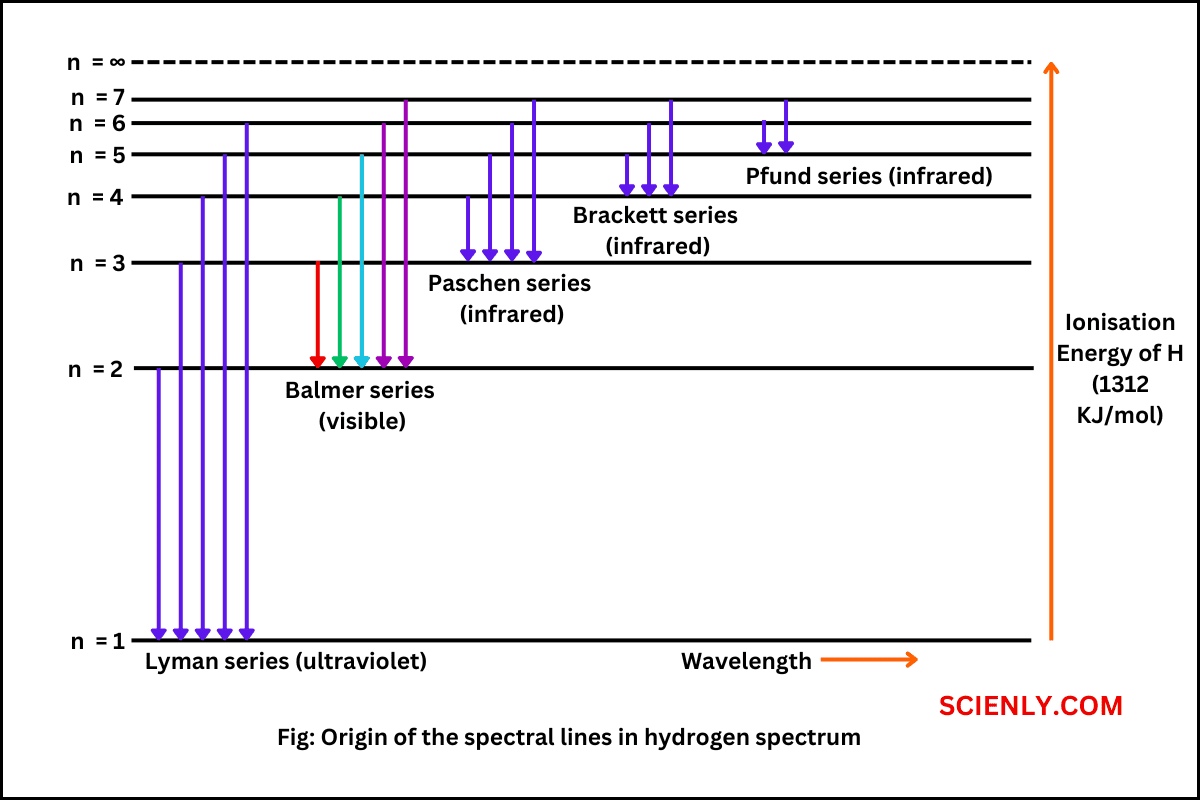
2. If a convex lens is cut horizontally (along its principal axis), which of its following properties will change?
Check Answer
Correct: Intensity of the image
Explanation: Cutting a lens horizontally reduces the total surface area available to gather light rays. While the focal length and radii of curvature remain exactly the same (meaning the image forms in the same place and size), fewer light rays converge to form the image, significantly reducing its intensity and making it dimmer.
3. The physical quantity of angular momentum shares the exact same SI base units as:
Check Answer
Correct: Planck’s Constant
Explanation: Both angular momentum ($L = mvr$) and Planck’s Constant ($h$) share the derived unit of Joule-seconds ($text{J} cdot text{s}$), which breaks down into the fundamental SI base units of $text{kg} cdot text{m}^2 / text{s}$.
4. Inside a positively charged hollow brass sphere, the electric potential is:
Check Answer
Correct: Equal to the potential on the surface
Explanation: The electric field ($E$) inside any hollow charged conductor is completely zero. Since the electric field is the negative gradient of the potential ($E = -Delta V / Delta r$), an electric field of zero means there is absolutely no change in potential ($Delta V = 0$). Therefore, the potential inside is constant and equals the potential at the surface.
5. A firework explosion occurs at a distance of $0.75text{ km}$ from an observer. If the speed of sound in the air is $340text{ m/s}$, the time delay before the sound is heard will be approximately:
Check Answer
Correct: $2.2text{ sec}$
Explanation: Using the basic kinematic formula $v = frac{d}{t}$, we rearrange to solve for time: $t = frac{d}{v}$. First, convert kilometers to meters: $0.75text{ km} = 750text{ m}$. Then, $t = frac{750}{340} approx 2.2text{ seconds}$.
6. While classical mechanics considers mass a fixed quantity, which of the following frameworks states that mass is variable and depends on velocity?
Check Answer
Correct: Theory of Relativity
Explanation: Albert Einstein’s Special Theory of Relativity introduces the concept of relativistic mass. It posits that the measured mass of an object increases as its velocity approaches the speed of light, governed by the Lorentz factor.
7. A charge of $0.1text{ C}$ is accelerated through a potential difference of $1000text{ V}$. The kinetic energy acquired by the charge is:
Check Answer
Correct: $100text{ J}$
Explanation: The kinetic energy ($KE$) acquired by a charge ($q$) accelerating across a potential difference ($V$) is equal to the electrical work done on it. The formula is $KE = qV$. Substituting the values: $KE = 0.1text{ C} times 1000text{ V} = 100text{ Joules}$.
8. If the tension in a vibrating string is increased to 4 times its original value, the speed of the transverse waves in the string will become:
Check Answer
Correct: $2V$
Explanation: The speed of a wave traveling through a stretched string is determined by $v = sqrt{frac{T}{mu}}$, where $T$ is the tension. Because the speed is proportional to the square root of the tension ($sqrt{T}$), multiplying the tension by $4$ results in the speed multiplying by $sqrt{4}$, effectively doubling it to $2V$.
9. The penetrating power of an X-ray beam can be effectively increased by increasing its:
Check Answer
Correct: Frequency (via accelerating voltage)
Explanation: Penetrating power depends strictly on the kinetic energy of the individual X-ray photons. By Planck’s equation ($E = hf$), energy increases directly with frequency. Increasing intensity only increases the number of photons, not their individual penetrating strength.
10. Which of the following fundamental subatomic particles represents the antiparticle of a neutron?
Check Answer
Correct: Antineutron
Explanation: Every particle in the standard model has a corresponding antiparticle with the identical mass but reversed quantum numbers (such as baryon number). The exact antiparticle of the neutron is simply the antineutron.
11. In which of the following technological devices does the phenomenon of Total Internal Reflection form the primary basis of operation?
Check Answer
Correct: Optical Fiber
Explanation: Optical fibers transmit data through light over long distances by trapping the light inside a glass core. Because the light strikes the boundary between the core and the cladding at an angle greater than the critical angle, it undergoes continuous total internal reflection without escaping.
12. According to Wien’s Displacement Law, the characteristic color (peak wavelength) of radiation emitted by a perfect black body is dependent exclusively on its:
Check Answer
Correct: Temperature
Explanation: Wien’s Displacement Law dictates that the wavelength corresponding to maximum emission intensity is inversely proportional to the absolute temperature ($lambda_{text{max}} T = text{constant}$). As an object heats up, its peak emission shifts toward shorter wavelengths, directly altering its perceived color.
13. A ball is thrown vertically upward with a certain initial velocity. The exact moment it approaches and reaches its highest point of trajectory, its velocity will be:
Check Answer
Correct: Zero
Explanation: Due to the constant downward acceleration of gravity ($g$), the upward velocity of the ball steadily decreases. It momentarily halts completely at the exact apex of its flight before reversing direction to begin its descent. Thus, instantaneous velocity at the peak is zero.
14. Which of the following is a dimensionally correct SI unit for representing linear Momentum?
Check Answer
Correct: $text{Ns}$
Explanation: Momentum ($p = mv$) has standard base units of $text{kg} cdot text{m/s}$. By Newton’s Second Law, an impulse ($F cdot Delta t$) causes a change in momentum. Therefore, Force $times$ Time yields Newton-seconds ($text{Ns}$), which is perfectly equivalent.
15. Two identical bodies are moving directly towards each other from opposite directions, each with a speed $V$. What is the magnitude of their relative velocity to each other?
Check Answer
Correct: $2V$
Explanation: Relative velocity is calculated by vector subtraction: $v_{rel} = v_1 – v_2$. Since they move in opposite directions, one velocity is positive ($V$) and the other is negative ($-V$). Thus, $v_{rel} = V – (-V) = 2V$. They perceive each other as approaching at double the individual speed.
16. The power output of a small electric car motor is $10text{ W}$. What is the total energy consumed by the car in exactly $5text{ minutes}$?
Check Answer
Correct: $3000text{ J}$
Explanation: Power is defined as energy over time ($P = frac{E}{t}$), meaning $E = P cdot t$. Time must be converted to standard SI units (seconds). $5text{ minutes} = 300text{ seconds}$. Thus, $E = 10text{ W} times 300text{ s} = 3000text{ Joules}$.
17. Physical wave deformations specifically categorized as “crests” and “troughs” are produced in:
Check Answer
Correct: Both Transverse and EM waves
Explanation: Crests and troughs describe the highest and lowest points formed when oscillations occur perpendicular to the wave’s direction of travel. This defines all transverse waves. Because Electromagnetic (EM) waves are strictly transverse by nature, both answers are correct.
18. In vector mathematics, the cross product of a vector with itself ($vec{A} times vec{A}$) yields:
Check Answer
Correct: Zero
Explanation: The magnitude of a cross product is given by $|vec{A} times vec{B}| = AB sin(theta)$. Because a vector is perfectly parallel to itself, the enclosed angle $theta = 0^circ$. Since $sin(0^circ) = 0$, the entire cross product collapses entirely to the zero vector.
19. The fundamental speed of acoustic sound waves traveling through a perfect vacuum is:
Check Answer
Correct: Zero
Explanation: Unlike electromagnetic radiation (which travels at $3 times 10^8 text{ m/s}$ in a vacuum), sound is a mechanical wave that absolutely requires a physical medium (particles) to transmit its vibrations. Because a vacuum is entirely void of particles, sound cannot travel through it.
20. At an altitude perfectly equal to the radius of the Earth, the acceleration due to gravity ($g$) will be reduced to:
Check Answer
Correct: $g/4$
Explanation: Newton’s law of universal gravitation dictates that $g = frac{GM}{r^2}$. At the Earth’s surface, $r = R_e$. At an altitude equal to the Earth’s radius ($h = R_e$), the total distance from the center of mass is $r = 2R_e$. Squaring this new distance yields $(2R_e)^2 = 4R_e^2$. Thus, the gravity becomes $frac{1}{4}$ of its surface value.
Found an error? Please report it in the comments below.