
15.2 Feedback System (Copy)
☀️ Lesson 2: Feedback Systems
Chapter 15: Homeostasis
Student Learning Outcomes (SLOs 15.2.1 – 15.2.3)
Learning Objectives
- Define what a feedback system is within the context of homeostasis.
- Identify and describe the three core components: receptor, control center, and effector.
- Compare positive and negative feedback mechanisms and provide biological examples of each.
📺 Video Lesson: Positive & Negative Feedback Loops
A visual breakdown of how the body detects changes and triggers responses to restore or amplify conditions.
1. Defining a Feedback System (SLO 15.2.1)
Because the internal and external environments are constantly changing, the body must continuously monitor its internal conditions. A feedback system (or feedback loop) is a highly coordinated cycle of events in which the status of a body condition is continuously monitored, evaluated, changed, remonitored, and reevaluated.
Any disruption that changes a controlled condition (like blood glucose levels, temperature, or blood pressure) is called a stimulus. Feedback systems are the biological circuits that respond to these stimuli to either restore balance or drive a specific process to completion.
2. Components of a Feedback System (SLO 15.2.2)
Every feedback system, regardless of whether it is in a human body or a mechanical thermostat, relies on three fundamental components working in sequence: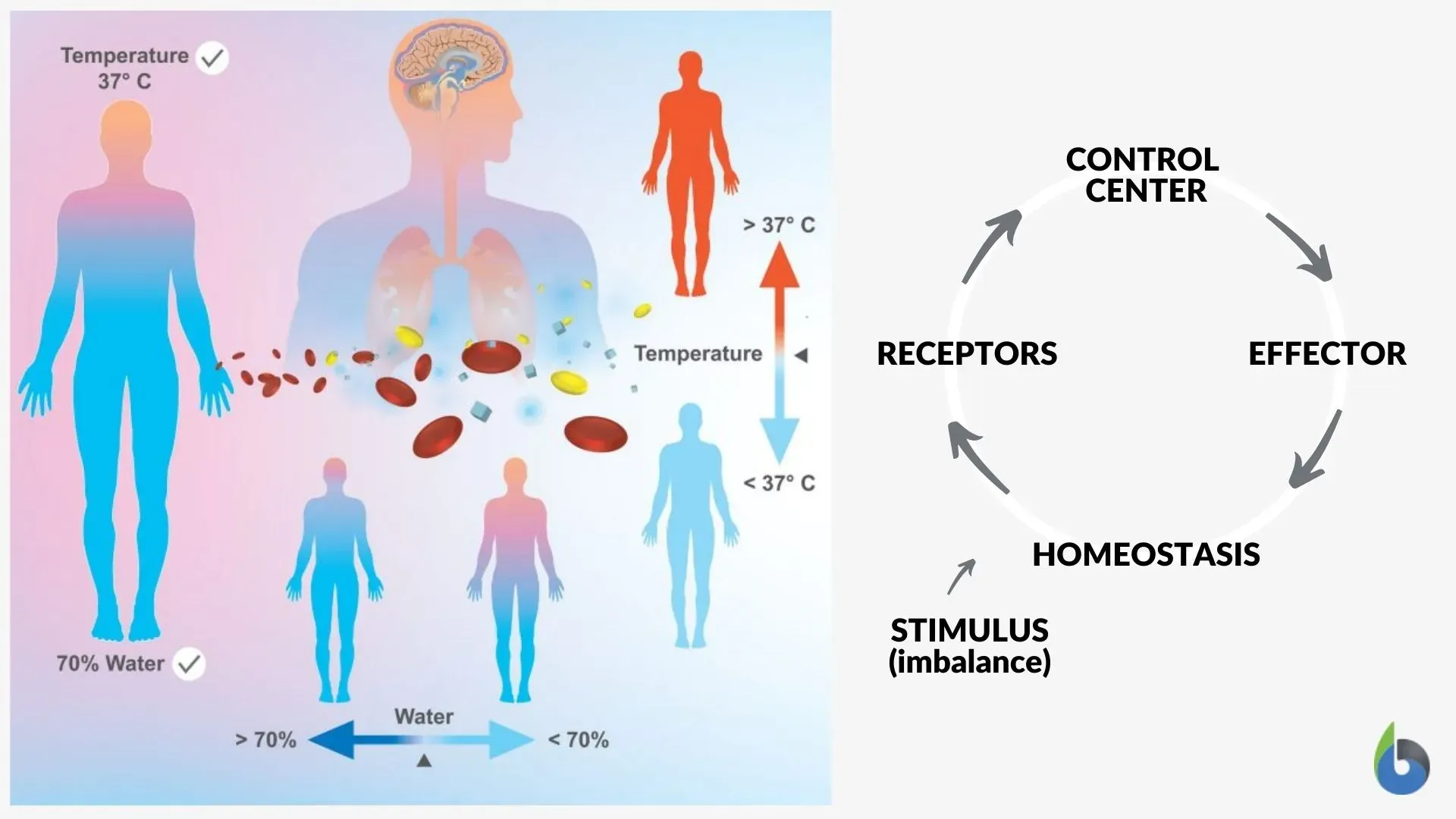
- 1. Receptor (Sensor): This is a body structure that monitors changes in a controlled condition and sends input (usually nerve impulses or chemical signals) to a central command area. Example: Thermoreceptors in the skin detect a drop in outside temperature.
- 2. Control Center: This component sets the range of values within which a controlled condition should be maintained (the set-point). It evaluates the input it receives from receptors and generates output commands. Example: The hypothalamus in the brain receives the temperature data and decides the body is too cold.
- 3. Effector: This is the body structure that receives output from the control center and produces a response or effect that changes the controlled condition. Example: Skeletal muscles receive signals to begin shivering, which generates heat.
3. Negative vs. Positive Feedback (SLO 15.2.3)
Feedback systems are categorized into two distinct types based on how they respond to the initial stimulus.
A. Negative Feedback Systems
A negative feedback system reverses a change in a controlled condition. It is “negative” because the response acts in the opposite direction of the initial stimulus, bringing the system back to its normal set-point. The vast majority of homeostatic mechanisms in the body operate via negative feedback.
- Example (Thermoregulation): If body temperature rises (stimulus), sweat glands (effectors) produce sweat to cool the body down (response), reversing the initial rise.
- Example (Blood Glucose): If blood sugar rises after a meal, the pancreas releases insulin, causing cells to absorb the sugar, thereby lowering the blood sugar back to normal.
B. Positive Feedback Systems
A positive feedback system strengthens or reinforces a change in one of the body’s controlled conditions. Instead of reversing the stimulus, the response pushes the system further in the same direction. Because this creates a “runaway” effect, positive feedback events are rare and must have a definitive physiological endpoint to break the loop.
- Example (Childbirth): As a baby’s head pushes against the cervix, receptors send signals to the brain, releasing the hormone oxytocin. Oxytocin causes the uterus to contract even harder, pushing the baby further, which stretches the cervix more, releasing more oxytocin. This cycle amplifies until the baby is born (the endpoint).
- Example (Blood Clotting): When a blood vessel is damaged, platelets cling to the injured site and release chemicals that attract more platelets. This rapid accumulation continues until the clot seals the break.
🎯 AKU Exam Insights
- Scenario Identification: AKU papers frequently provide a short clinical scenario and ask you to identify the specific component (e.g., “In this scenario, what acts as the effector?”). Remember: Receptors detect, Control Centers decide, Effectors act.
- The “Negative” Trap: Do not confuse “negative feedback” with something harmful. Examiners often try to trick students into associating “positive” with good and “negative” with bad. In biology, negative feedback is the essential, life-saving mechanism of stability.
QUICK-FACT: Severe, life-threatening fever is actually a rare example of a negative feedback system failing and temporarily becoming a destructive positive feedback loop. High heat speeds up metabolism, which produces even more heat, driving the temperature higher!
📝 Concept Check
1. When you touch a hot stove, sensory nerve endings in your fingers send a signal to your brain. In this specific feedback loop, the sensory nerve endings act as the:
Control Center
Effector
Receptor
Stimulus
Check Answer
Correct: Receptor
Explanation: The sensory nerve endings are detecting the change in the environment (the heat) and sending that input to the brain. Therefore, they are functioning as the receptors (sensors).
2. Which of the following is a classic biological example of a positive feedback system?
The release of insulin to lower blood sugar levels.
Sweating to reduce an elevated body temperature.
The release of oxytocin to amplify uterine contractions during childbirth.
The kidneys retaining water when a person is dehydrated.
Check Answer
Correct: The release of oxytocin to amplify uterine contractions during childbirth.
Explanation: Positive feedback reinforces or amplifies a stimulus. In childbirth, contractions trigger oxytocin release, which triggers stronger contractions, creating an amplifying cycle until the endpoint (birth) is reached. All other options are negative feedback mechanisms designed to reverse a change and restore balance.
🏆 Up Next
Next: Lesson 15.3 – Osmoregulation in Plants and Animals
📝