
16.1 Hydrocarbons-Nomenclature, Shape of Molecules and Resonance (Copy)
⬡ Lesson 1: Nomenclature, Shape, and Resonance
Chapter 16: Hydrocarbons
Student Learning Outcomes (SLOs 16.1.1 – 16.1.2)
Learning Objectives
- Relate the concepts of $sp^3$, $sp^2$, and $sp$ hybridization to the 3D shapes of alkanes, alkenes, alkynes, and cycloalkanes.
- Apply systematic nomenclature to aliphatic and substituted aromatic hydrocarbons (ortho, meta, para).
- Define Resonance and mathematically explain the thermodynamic stability of Benzene.
📺 Video Lesson: The Architecture of Hydrocarbons
Explore the transition from localized $sigma$ bonds in alkanes to the delocalized $pi$ rings of aromatic compounds.
1. Geometry Based on $sigma$ and $pi$ Bonds (SLO 16.1.1)
The 3D shape of any hydrocarbon is dictated by the hybridization of its carbon atoms. Hybridization determines how the $s$ and $p$ orbitals mix to form $sigma$ (sigma) bonds and whether any unhybridized $p$ orbitals remain to form $pi$ (pi) bonds.
 Alkanes (Saturated)
Every carbon undergoes $sp^3$ hybridization. The four hybrid orbitals repel each other equally, creating a perfect Tetrahedral geometry with bond angles of 109.5°. They contain strictly head-to-head $sigma$ bonds, allowing free rotation.
 Alkenes (Unsaturated)
The carbons involved in the double bond undergo $sp^2$ hybridization, creating a flat, Trigonal Planar geometry with 120° bond angles. The unhybridized $p$ orbitals overlap laterally to form a rigid $pi$ bond, restricting rotation.
 Alkynes (Unsaturated)
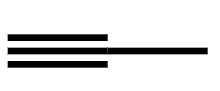
The carbons in the triple bond undergo $sp$ hybridization. This creates a straight, Linear geometry with 180° bond angles. Two unhybridized $p$ orbitals overlap to form a cylinder of high electron density (two $pi$ bonds) around the central $sigma$ bond.
 Cycloalkanes
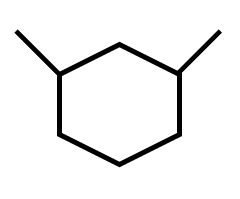
Like alkanes, carbons are $sp^3$ hybridized (ideal angle 109.5°). However, small rings force the angles to compress (e.g., cyclopropane is forced to 60°). This extreme deviation creates Angle Strain, making small cycloalkanes highly reactive.
📺 Video Lesson: Nomenclature of Aromatic Compounds
Understand the concept of aromaticity in organic chemistry, with an emphasis on the structure and nomenclature of benzene and its commonly substituted derivatives.
2. Nomenclature of Substituted Benzenes
While the IUPAC rules for aliphatic chains (finding the longest chain, alphabetical ordering) apply universally, aromatic compounds have unique naming conventions based on the positions of substituents on the benzene ring.
Disubstituted Benzenes: Ortho, Meta, Para
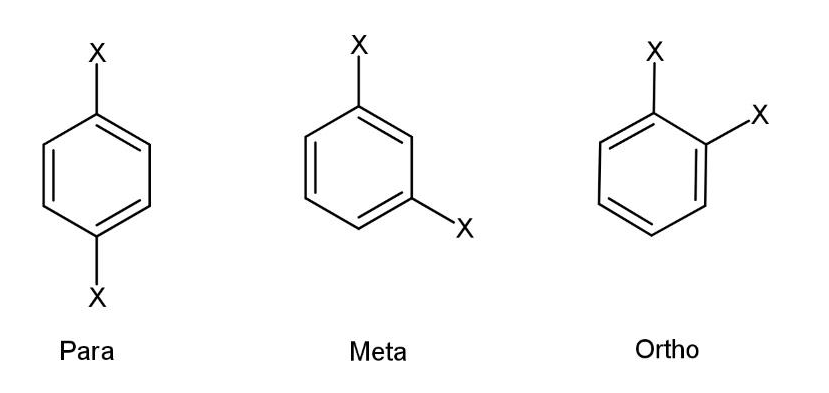
When two groups are attached to a benzene ring, their relative positions are indicated by specific prefixes:
- Ortho- (o-): The substituents are adjacent to each other at positions 1 and 2 (1,2-disubstituted).
- Meta- (m-): The substituents are separated by one carbon at positions 1 and 3 (1,3-disubstituted).
- Para- (p-): The substituents are directly across the ring from each other at positions 1 and 4 (1,4-disubstituted).
Example: Methylbenzene is commonly called Toluene. If a chlorine atom is attached at position 4, it is named p-chlorotoluene or 1-chloro-4-methylbenzene, also 2-iodotoluene.
📺 Video Lesson: Structure and Stability of Benzene
Understand why aromatic compounds with delocalized $pi$-electron rings are more stable than systems lacking such delocalization.
3. Resonance and the Stability of Benzene (SLO 16.1.2)
Benzene ($C_6H_6$) presented a massive historical puzzle. Its highly unsaturated formula suggested it should react like a polyalkene (undergoing rapid addition reactions). Instead, it is astonishingly stable and prefers substitution reactions. Why?
📊 Interactive 3D Widget: Benzene Resonance
The Resonance Hybrid
August Kekulé originally proposed a structure with alternating single and double bonds that rapidly shift back and forth in equilibrium. However, quantum mechanics gives us the true picture: Resonance.
Benzene does not flip between two forms. It exists constantly as a Resonance Hybrid. Every carbon atom is $sp^2$ hybridized, leaving one parallel $p$ orbital on each of the 6 carbons. Instead of pairing up into three isolated $pi$ bonds, all 6 $p$ orbitals merge laterally to form a continuous, delocalized electron cloud (a ring) above and below the planar carbon skeleton.
Thermodynamic Proof: Resonance Energy
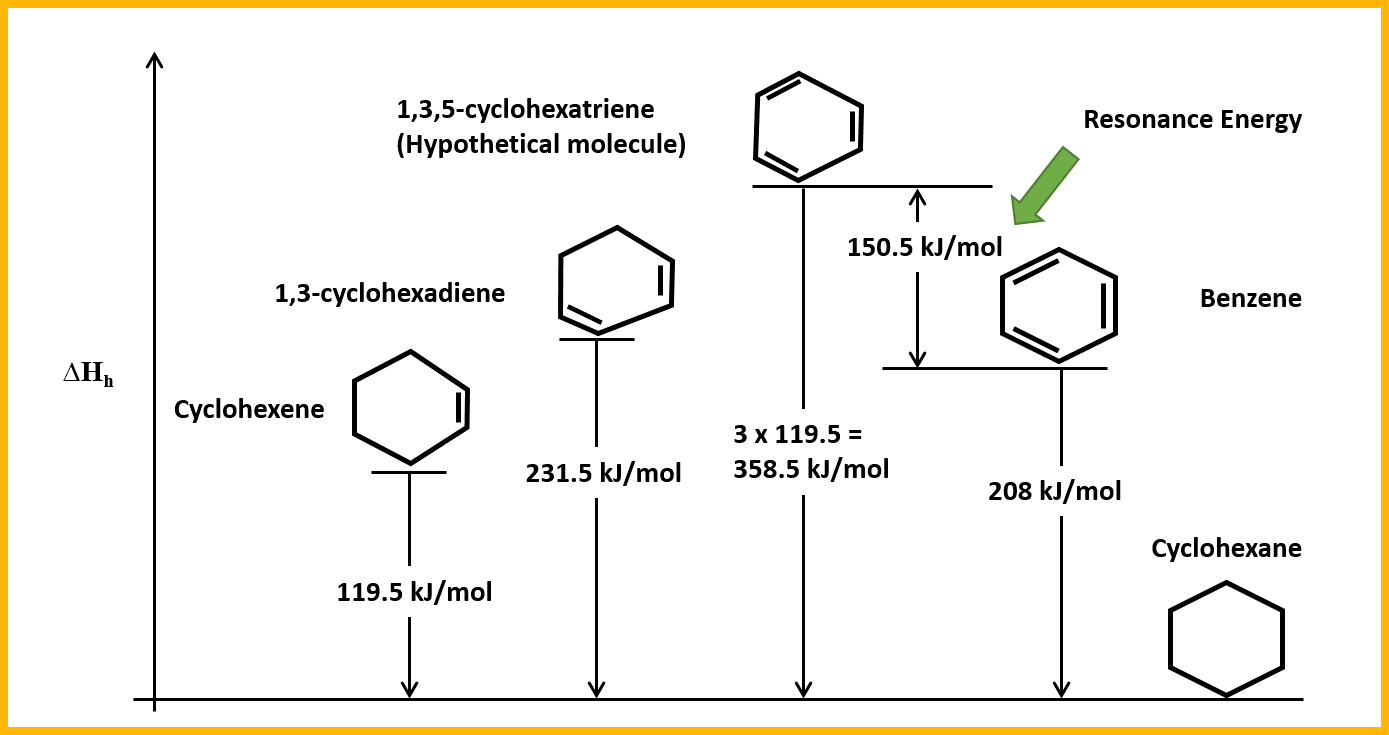
The stability of benzene is measurable. The theoretical heat of hydrogenation for the hypothetical “Kekulé structure” (cyclohexatriene, containing three isolated double bonds) is calculated to be roughly $-360 , text{kJ/mol}$.
However, the actual measured heat of hydrogenation of true benzene is only $-208 , text{kJ/mol}$. The difference between these values ($152 , text{kJ/mol}$) is known as the Resonance Energy. This massive chunk of energy represents the thermodynamic “bonus” stability the molecule achieves strictly due to the delocalization of its $pi$ electrons.
⚡ Quick-Fact: The Carbon-Carbon Bond Anomaly
X-ray diffraction proves that benzene does not have alternating single and double bonds. A standard $C-C$ single bond is 1.54 Å long, and a $C=C$ double bond is 1.34 Å long. In benzene, every single carbon-carbon bond is exactly 1.39 Å. They are all intermediate “1.5” bonds, proving perfect electron delocalization!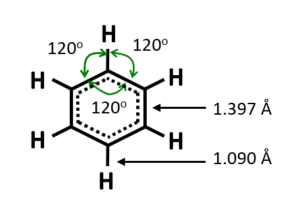
🎯 AKU Exam Insights
- Reaction Preference: Examiners frequently ask why benzene does not decolorize Bromine water like an alkene does. The answer is always that undergoing an addition reaction would break the continuous delocalized $pi$ ring, destroying its massive resonance energy ($152 , text{kJ/mol}$). Thus, it undergoes electrophilic substitution to preserve the ring.
- Angle Strain Calculation: For cycloalkanes, remember Baeyer’s Strain Theory. The deviation from the normal tetrahedral angle ($109.5^circ$) dictates reactivity. Cyclopropane ($60^circ$) has the most strain; Cyclopentane ($108^circ$) is nearly strain-free.
4. Concept Check
1. In an alkyne molecule like ethyne ($HC equiv CH$), what is the hybridization of the carbon atoms and the resulting molecular geometry?
View Answer & Explanation
Correct: $sp$ hybridized, linear
Explanation: The presence of a triple bond means the carbon atom uses only one $s$ and one $p$ orbital to form the $sigma$ framework ($sp$ hybridization), resulting in a straight 180° linear shape. The remaining two $p$ orbitals form the $pi$ bonds.
2. A benzene ring is substituted with a hydroxyl group (-OH) at carbon 1 and a nitro group (-NO2) at carbon 3. What is the correct relative prefix for this isomer?
View Answer & Explanation
Correct: Meta-
Explanation: Substituents located at the 1 and 3 positions on a benzene ring are designated with the prefix “meta-” (e.g., m-nitrophenol).
3. Which of the following best describes the true thermodynamic nature of the carbon-carbon bonds in benzene?
View Answer & Explanation
Correct: All six carbon-carbon bonds are identical, intermediate in length between a single and double bond, due to complete $pi$ electron delocalization.
Explanation: This is the defining feature of resonance in benzene. The six $pi$ electrons are shared equally across the entire ring, making every bond 1.39 Å in length and granting the molecule roughly $152 , text{kJ/mol}$ of resonance stabilization energy.
➡ Coming Next
16.2 Types of Organic Reactions
⚡