
Visualize the Problem with a Diagram (Copy)
📐 Lesson: Visualize the Problem with a Diagram
Mathematics Strategies & Testing Tactics
Learning Objectives
- Understand why drawing a diagram is a critical first step for both geometry and non-geometry questions.
- Translate word problems involving areas, perimeters, and relative positions into simple, labeled sketches.
- Use diagrams to solve complex relative-rate problems (like clock hands) without relying on heavy memorized formulas.
📺 Video Lesson: Draw a Diagram
Visualizing drawing a diagram as a problem-solving tool.
1. The Power of a Rough Sketch
When calculators are strictly prohibited, your working memory can easily become overloaded trying to hold multiple numerical relationships at once. Drawing a diagram offloads this mental burden onto the paper. A good drawing requires zero artistic ability; simple line segments, squares, and rough circles are entirely sufficient. It allows you to immediately spot relationships—like right triangles or intersecting lines—that are hidden within the text.
Example: Geometry Translation
Problem: What is the area of a rectangle whose length is twice its width and whose perimeter is equal to that of a square whose area is $1$?
Solution Steps: Do not attempt mental algebra here. Draw and label the shapes immediately:
- The Square: If the area is $1$, each side must be $1$. Therefore, the perimeter is $P = 4$.

- The Rectangle: Draw a rectangle. Label the width as $w$. Since the length is twice the width, label the length as $2w$. The perimeter of this rectangle is $w + 2w + w + 2w = 6w$.

- The Equation: Equate the perimeters: $6w = 4$.
- Solve (No Calculator): $w = frac{4}{6} = frac{2}{3}$. This makes the length $2w = frac{4}{3}$. The area of the rectangle is length $times$ width: $left(frac{4}{3}right)left(frac{2}{3}right) = frac{8}{9}$.
2. Mapping Directional Word Problems
Directional problems are designed to confuse you if you try to track them mentally. Drawing them out often reveals standard geometric shapes, particularly right-angled triangles.
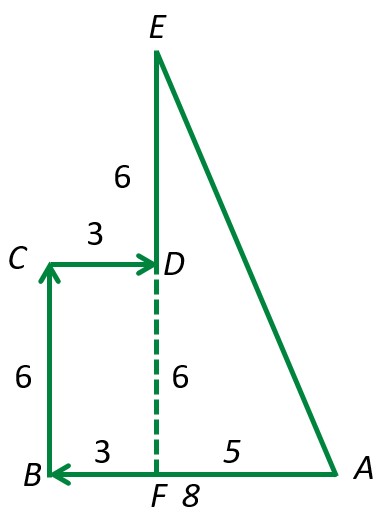
Problem: Maria drove $8$ miles west, $6$ miles north, $3$ miles east, and $6$ more miles north. How far was Tony from his starting place?
Solution Strategy: Draw the path segment by segment. By extending the final northward line straight down to meet the initial westward line, you form a large right triangle connecting his start and end points.
- The Horizontal Leg: He went $8$ miles west, but came back $3$ miles east. The net horizontal distance is $8 – 3 = 5$ miles.
- The Vertical Leg: He went $6$ miles north, then another $6$ miles north. The net vertical distance is $6 + 6 = 12$ miles.
Because you are not allowed a calculator to compute $sqrt{5^2 + 12^2} = sqrt{169}$, you must rely on recognizing common Pythagorean Triples. The legs $5$ and $12$ immediately tell you the hypotenuse (the direct distance) is $13$.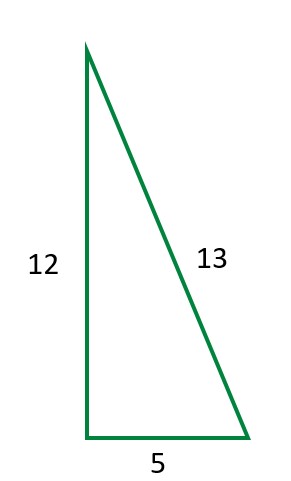
3. Visualizing Relative Rates (Clock Problems)
One of the most notoriously tricky problem types on standardized tests involves the angles of clock hands. Drawing a simple circle and breaking the movement down into standard fractional rates prevents the need for memorizing complex formulas.
Problem: By how many degrees does the angle formed by the hour hand and the minute hand of a clock increase from 2:25 to 2:26?
Solution Strategy: Analyze the independent movement of each hand in exactly $1$ minute:
- Minute Hand: It completes a full $360^circ$ circle in $60$ minutes. Therefore, its rate is $frac{360^circ}{60} = 6^circ$ per minute.
- Hour Hand: It moves from one number to the next (e.g., 12 to 1) in $1$ hour. That distance is $frac{360^circ}{12} = 30^circ$ per hour. To find its rate per minute, divide by $60$: $frac{30^circ}{60} = 0.5^circ$ per minute.
Since both hands are moving in the same direction, the difference between them increases by $6^circ – 0.5^circ = 5.5^circ$ every single minute. Drawing the clock face prevents you from wasting time calculating the absolute angle at exactly 2:25, which is unnecessary.
🎯 AKU & MDCAT Exam Insights
- Pythagorean Triples are Mandatory: Without a calculator, examiners design spatial routing questions (like Maria’s drive) to yield perfect integers. You must memorize the base triples: 3-4-5, 5-12-13, 8-15-17, and 7-24-25, along with their multiples (e.g., 6-8-10).
- The “Don’t Over-Calculate” Rule: Notice in the clock problem that the specific time “2:25” was completely irrelevant to the actual question. Standardized tests frequently include distractors. Drawing the diagram helps you realize that the rate of change is constant regardless of the starting position.
- Ratio Organization: When dealing with mixture or proportion word problems, drawing a quick table acts as a diagram for your numbers. Structuring “Red” vs “Green” in columns prevents alignment mistakes when cross-multiplying.
QUICK-FACT: The human brain processes visual information up to 60,000 times faster than text. By translating a 4-line word problem into a geometric sketch, you bypass the brain’s language processing centers and tap directly into its high-speed spatial reasoning capabilities.
📝 Concept Check
1. A student walks $15$ meters south, then $8$ meters west. What is the shortest straight-line distance back to the starting point?
$17$ meters
$23$ meters
$120$ meters
$7$ meters
Check Answer
Correct: 17 meters
Explanation: Drawing this reveals a right triangle with legs of $8$ and $15$. Recognizing the 8-15-17 Pythagorean triple instantly gives you the hypotenuse without needing to calculate $sqrt{64 + 225}$.
2. If a clock reads 3:00, the angle between the hands is $90^circ$. How much does this angle change after exactly $10$ minutes pass?
It increases by $60^circ$
It decreases by $55^circ$
It decreases by $60^circ$
It increases by $55^circ$
Check Answer
Correct: It decreases by $55^circ$
Explanation: The minute hand moves toward the hour hand, closing the gap. In $10$ minutes, the minute hand moves $10 times 6^circ = 60^circ$ forward. The hour hand moves $10 times 0.5^circ = 5^circ$ forward. The net reduction in the angle is $60^circ – 5^circ = 55^circ$.
➡ Coming Next
Tactic 2: Test the Answer Choices (Backsolving)
🔍