
6.3 Crystal Lattice (Copy)
📐 Lesson 3: Crystal Lattice and Energetics
Chapter: States of Matter III — Solids
Student Learning Outcomes (SLOs 6.3.1 – 6.3.3)
Learning Objectives
- Define and describe the unit cell and lattice energy.
- Exemplify the seven crystal systems with their axial parameters.
- Analyze the energetics and steps of the Born-Haber Cycle for $NaCl$.
📺 Video Lesson: Crystal Lattice and Unit Cell
This video visualizes the 3D structure of the crystal system and the concept of lattice energy.
1. Fundamental Definitions (SLO 6.3.1)
To understand the architecture of solids, we must look at the smallest structural unit and the energy that holds the entire assembly together.
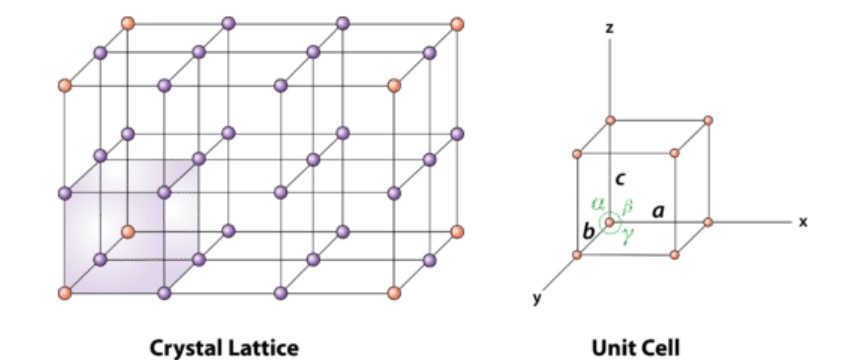
- Unit Cell: The smallest repeating unit of a crystal lattice which, when stacked in three dimensions, shows the complete geometry of the crystal. It is defined by axial lengths ($a, b, c$) and angles ($alpha, beta, gamma$).
- Lattice Energy: The amount of energy released when one mole of an ionic crystal is formed from its constituent gaseous ions.$text{Na}^+_{(g)} + text{Cl}^-_{(g)} ; rightarrow ; text{NaCl}_{(s)} quad Delta H_{latt} = -787 text{ kJ/mol}$
2. The Seven Crystal Systems (SLO 6.3.2)
Crystals are classified into seven systems based on their symmetry and the relationship between their axes and angles.
| System | Geometrical Shape | Axial Lengths | Angles | Example |
|---|---|---|---|---|
| Cubic | 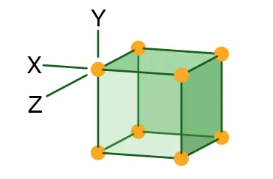 |
$a = b = c$ | $alpha = beta = gamma = 90^circ$ | $NaCl, Cu$ |
| Tetragonal | 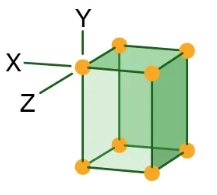 |
$a = b neq c$ | $alpha = beta = gamma = 90^circ$ | $SnO_2, TiO_2$ |
| Orthorhombic | 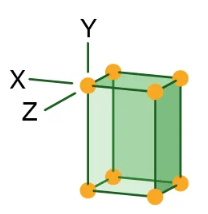 |
$a neq b neq c$ | $alpha = beta = gamma = 90^circ$ | $I_2, S_8 text{ (Rhombic)}$ |
| Monoclinic | 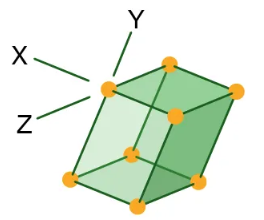 |
$a neq b neq c$ | $alpha = gamma = 90^circ, beta neq 90^circ$ | $S_8 text{ (Monoclinic)}$ |
| Hexagonal | 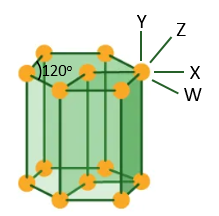 |
$a = b neq c$ | $alpha = beta = 90^circ, gamma = 120^circ$ | $text{Graphite, } ZnO$ |
| Rhombohedral | 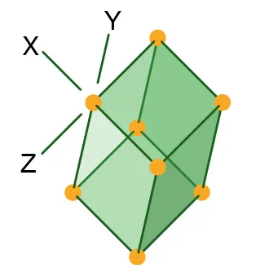 |
$a = b = c$ | $alpha = beta = gamma neq 90^circ$ | $CaCO_3, NaNO_3$ |
| Triclinic | 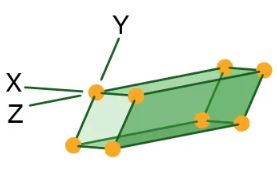 |
$a neq b neq c$ | $alpha neq beta neq gamma neq 90^circ$ | $K_2Cr_2O_7$ |
3. The Born-Haber Cycle (SLO 6.3.3)
The Born-Haber Cycle is a thermodynamic cycle used to calculate lattice energy by applying Hess’s Law. It breaks down the formation of an ionic solid into discrete steps.
| Step | Process | Equation | $Delta H$ |
|---|---|---|---|
| 1 | Sublimation | $text{Na}_{(s)} rightarrow text{Na}_{(g)}$ | $Delta H_{sub}$ (+) |
| 2 | Dissociation | $frac{1}{2}text{Cl}_{2(g)} rightarrow text{Cl}_{(g)}$ | $frac{1}{2}Delta H_{diss}$ (+) |
| 3 | Ionization | $text{Na}_{(g)} rightarrow text{Na}^+_{(g)} + e^-$ | $I.E.$ (+) |
| 4 | Electron Affinity | $text{Cl}_{(g)} + e^- rightarrow text{Cl}^-_{(g)}$ | $E.A.$ (-) |
| 5 | Lattice Formation | $text{Na}^+_{(g)} + text{Cl}^-_{(g)} rightarrow text{NaCl}_{(s)}$ | $Delta H_{latt}$ (-) |
Worked Numerical Example:
Data: $Delta H_f = -411, Delta H_{sub} = 108, Delta H_{diss} = 242, I.E. = 496, E.A. = -349$ (all in kJ/mol).Calculation:
$Delta H_f = Delta H_{sub} + frac{1}{2}Delta H_{diss} + I.E. + E.A. + Delta H_{latt}$
$-411 = 108 + 121 + 496 – 349 + Delta H_{latt}$
$-411 = 376 + Delta H_{latt} implies Delta H_{latt} = mathbf{-787 text{ kJ/mol}}$
⚡ Quick-Fact: Sign Convention
In chemistry textbooks, Lattice Energy is sometimes defined as the energy required to break a lattice (Endothermic, +). However, in the context of the Born-Haber cycle, it is almost always treated as the energy released during formation (Exothermic, -). Always check the phrasing of the exam question!
⚡ Quick-Fact: Stability of $NaCl$
The lattice energy of $NaCl$ is $-787 text{ kJ/mol}$. This massive release of energy is the “driving force” that makes the formation of the salt crystal possible, overcoming the energy spent on ionizing sodium and dissociating chlorine.
🎯 AKU Exam Insights
- Lattice Energy Factors: Lattice energy increases with higher ionic charge and smaller ionic radius. $MgO$ has a much higher lattice energy than $NaCl$ because of the $+2/-2$ charges.
- System Identification: Be ready to distinguish between Hexagonal ($gamma = 120^circ$) and Rhombohedral (angles equal but $neq 90^circ$).
4. Concept Check
1. In which crystal system are all axial lengths and all angles unequal?
View Answer & Explanation
2. Lattice energy is defined as the energy released when ions are in which state?
View Answer & Explanation
Correct: Gaseous state.
Explanation: Lattice energy specifically refers to the formation of a solid crystal from gaseous ions.
📌 Lesson Summary
- The unit cell is the fundamental repeating unit of a lattice.
- There are seven crystal systems based on geometry.
- The Born-Haber Cycle is an application of Hess’s Law to calculate Lattice Energy.
➡ Coming Next
Types of Crystalline Solids
🧱